Clan Stewart
– 3 min read


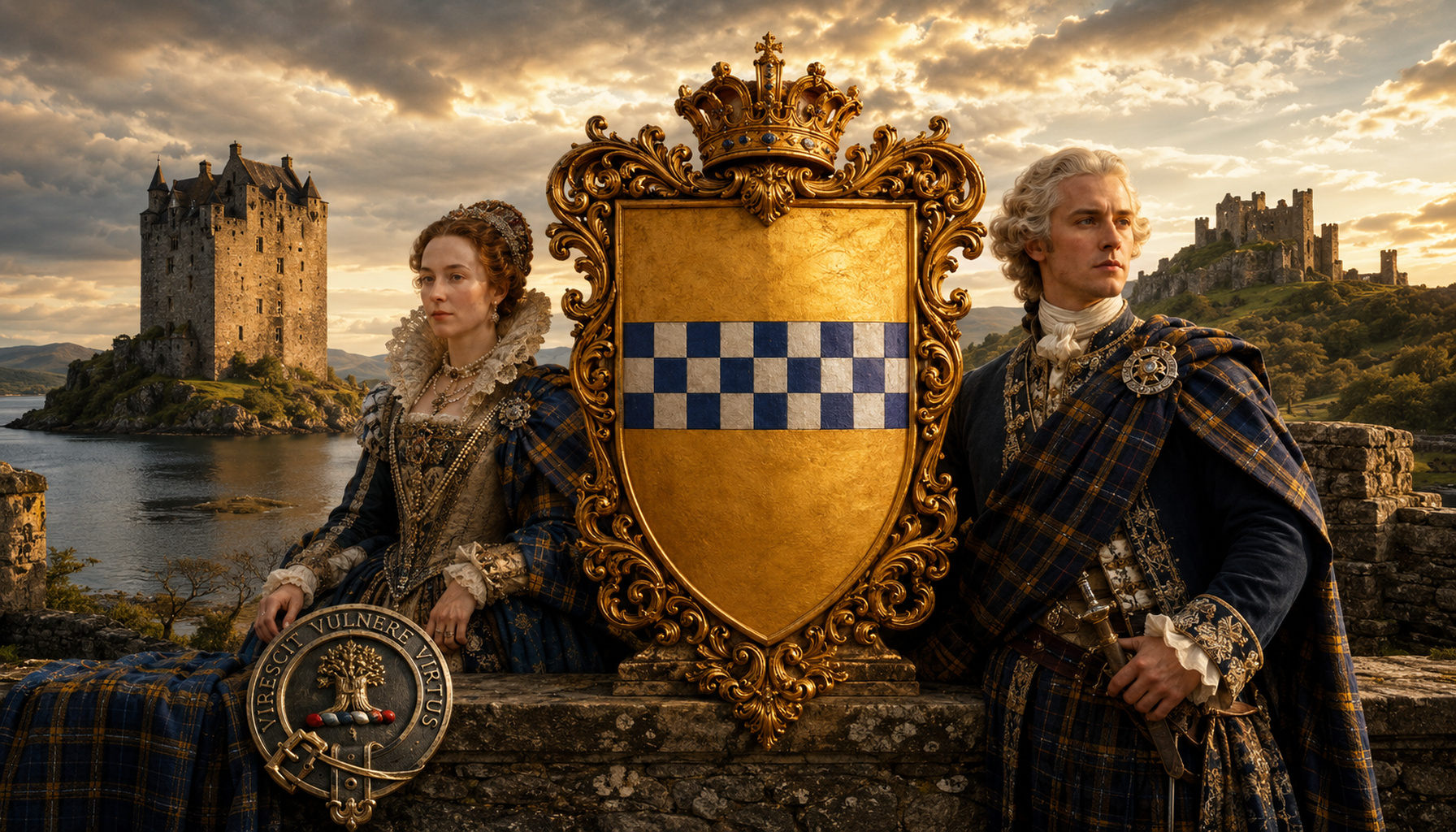
The House of Stewart, later often rendered Stuart in its royal form, was one of the great ruling families of Scotland and, eventually, of Britain and Ireland. The dynasty began not as kings but as royal servants of immense importance. Its founder was Walter fitz Alan, descended from a Breton or Anglo-Norman family rooted in the world that grew out of the Norman expansion across Britain. In the 12th century he became hereditary High Steward of Scotland, and from that office came the family name Stewart. Over time, through land, marriage, military service, and sheer political skill, the Stewarts rose from powerful lordship to the throne itself. The primary haplogroup linked with the family in this context is R1b1a1b1a1a2c1a1a1a1a1b.
Historically, this is a family story with proper scale to it: feudal Scotland, border politics, royal succession, court culture, rebellion, exile, and memory. Walter Flaad and his descendants helped establish the line that would become central to Scottish politics, and Walter fitz Alan, recorded as High Steward of Scotland by 1164, stands at the beginning of that transformation. By 1371, Robert II became the first Stewart king of Scotland, founding a royal house that would shape the country for centuries. Later, James VI of Scotland inherited the crowns of England and Ireland in 1603 as James I, creating the Union of the Crowns. The Stewart world includes figures such as Robert II, James IV, Mary Queen of Scots, and Charles II, but at heart it began with a family embedded in the frontier society of medieval Britain, rising through office into dynasty.
A key location anchor for the Stewarts is Dundonald Castle in South Ayrshire, Scotland, a place strongly associated with the early royal Stewarts and with Robert II in particular. The site stands on a prominent hill and had significance long before the surviving castle was built, with evidence of earlier occupation lending it that very Scottish sense of a place used, reused, and reimagined across centuries. The present castle is largely a 14th-century royal fortress, traditionally linked to Robert II, and it functioned not just as a residence but as a statement: this was a dynasty that had arrived. Architecturally it is one of the more important late medieval towered castles in Scotland, and historically it helps anchor the Stewarts in the landscape of western Scotland rather than leaving them floating as mere names in a royal pedigree. Yes, it can still be visited today, which is rather wonderful, because it allows you to stand where the early royal Stewarts made power visible in stone.
From a DNA perspective, the Stewart-associated haplogroup here is tagged as R1b1a1b1a1a2c1a1a1a1a1b, and while no responsible historian should wave ancient samples about as if they prove direct descent from any named dynasty, they do help sketch the deeper population background of lineages related to or linked with this branch. Comparable or linked samples have been identified from a wide spread of times and places: Medieval Jutland, Denmark at Vor Frue Kirkegard, Aalborg (CGG100512); the Thuringii context at Deersheim, Saxony-Anhalt, Germany (DRH026); Carolingian era Groningen in the Netherlands (GRO005); Medieval Ireland at Kilteasheen, Roscommon, Bishops Seat (KIL043); a Merovingian grave at Alt-Inden, North Rhine-Westphalia, Germany (IND007); Anglo-Saxon Sedgeford, Norfolk, England (SED005); Late Iron Age West Yorkshire at Wattle Syke (I14347); Iron Age Long Bredy, Dorset (I27382); Iron Age Briton Thornholme, East Riding of Yorkshire (I22060); Iron Age Chemin de Coupetz, Marne, France (I19359); Viking Age Faroe Islands at Panum (VK24); Aquitani Pech-Maho, France (PECH8); Viking Iceland (FOV-A1); and later colonial-era burials such as Philip Calvert of Maryland (2099) and the son of Philip Calvert in a lead coffin (I2097). Taken together, these linked results suggest a lineage with deep roots across Atlantic and northwestern European worlds that fed into the medieval populations from which families like the Stewarts emerged.
If you are researching Clan Stewart and want to see how your own DNA may connect with ancient populations linked to this wider lineage story, upload your DNA to MyTrueAncestry and explore the matches for yourself.
Comments