Clan Colquhoun
– 3 min read


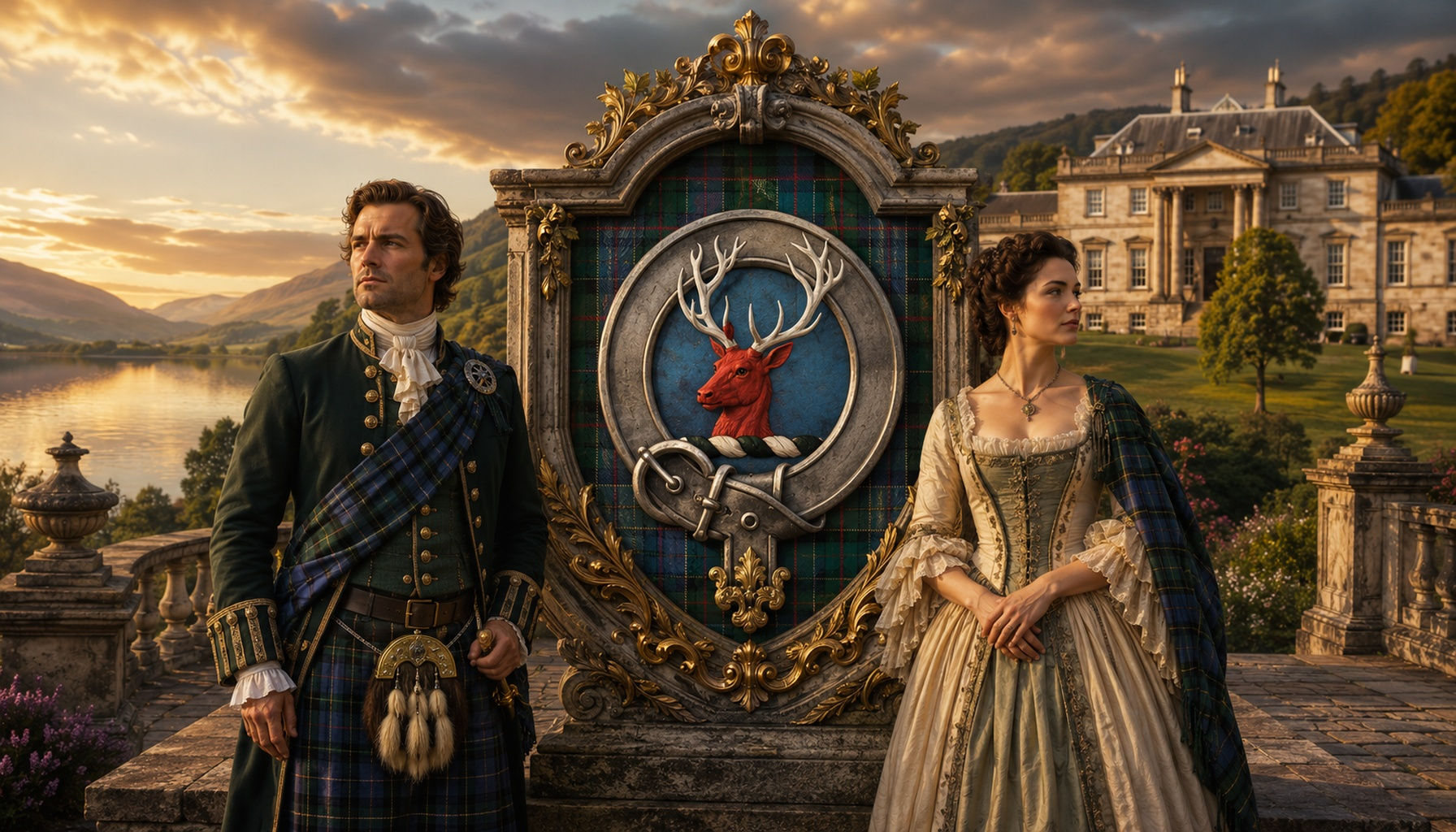
Clan Colquhoun was a Scottish territorial clan rooted above all in Luss and the lands around Loch Lomond, on that fascinating western edge where Highland and Lowland worlds met, rubbed against one another, and occasionally came to blows. In that sense the Colquhouns are wonderfully typical of medieval and early modern Scotland: a family made powerful not simply by blood, but by landholding, chiefship, charters, marriage alliances, local office, and the steady business of holding a region together. The haplogroup linked here is E1b1b1a1b1a14a, and for readers interested in deep ancestry it offers a genetic tag to set alongside the documentary and heraldic story of the clan.
The family name itself is locational, tied to Colquhoun in Dunbartonshire, and the clan's rise belongs to the long period when Scottish lordship was becoming more structured, more territorial, and more documented. By the later Middle Ages the Colquhouns had become closely associated with Luss, building an enduring identity around estate continuity and regional authority. Their history includes bitter conflict with neighboring powers, most famously Clan Gregor, but also the more ordinary, and perhaps more revealing, realities of Scottish noble life: guarding lands, negotiating loyalties, preserving inheritance, and displaying status through heraldry and motto. Their motto, Si Je Puis, meaning if I can, is brisk, modest, and stubborn in a very Scottish way. A later figure carrying the broader family name into a very different world was John Calhoun (1782-1850), the American statesman whose surname is a recognized variant of Colquhoun.
Read more about Clan MacGregor
A useful location anchor for the wider Colquhoun story is Dunglass Castle in East Lothian, a striking historic site near Cockburnspath, set dramatically above a rocky ravine where the Dunglass Burn runs to the North Sea. The present castle is largely a 15th-century tower house, though the site itself is older and had clear strategic value, controlling movement along an important coastal route. It later passed through several notable owners and became bound up in the troubled politics of late medieval and early modern Scotland. During the Wars of the Three Kingdoms the castle was badly damaged in 1640 by an explosion after being used to store munitions, a reminder that these places are not fairy-tale survivals but hard-used pieces of military and political history. Today the ruins still stand and can be visited from the outside area and nearby routes, so it remains a very tangible stop for anyone interested in Scotland's fortified landscape and the kind of lordly world in which families like the Colquhouns operated.
From the ancient DNA side, the primary family haplogroup tag here is E1b1b1a1b1a14a. That does not mean every bearer of the surname shares the same direct paternal line, and it certainly does not permit us to claim direct descent from excavated individuals. What it does give us is a wider web of related or linked ancient samples across a surprisingly broad historical map: Medieval Sicily Teatro di Segesta (SGBN10); Migration Period Hungary Rakoczifalva (RKF026, RKF027); Late Imperial Roman and Imperial Roman Serbia at Timacum Kuline Ravna Village and Timacum Slog Necropolis (I15553, I15554, I15544); Imperial Roman Trogir Dragulin Croatia (I26702); Late Roman Viminacium Serbia samples from Rit, Grobalja, and Vise Grobalja necropolises (I15504, I15507, I15513, I15518, I15490, I15525); Dark Ages South Tyrol (2425); post-Roman and Late Antique Pannonia samples in Hungary (MFC014, GYS044, GYS008); Merovingian Bavaria (Alh_154); Piast-era Poland (PCA0400, PCA0255); Gothic Wielbark Pommerania (PCA0495); Migration Period Roman Saxony-Anhalt (BRC014x); Early Medieval Croatia (VEM022); Ostrogoth-Gepid period Hungary (CGG021897); Medieval Slav Avar Slovakia (CGG018923); Bosporan Kingdom Crimea (CGG021473, CGG021475); Carolingian Hungary (AHS56); Iron Age Croatia (I5724); post-Roman Germany (IND009); Saxon palace Eastry in Kent (EAS006); Viking Age Denmark (VK362); Iberian Cordoba Caliphate (I7498); Late Medieval Cancelleria Basilica (R1219); Late Avar Hungary (SzKper239); and a Hungarian Conqueror outlier (K2per6). Taken together, these linked samples suggest a lineage with deep connections across the Mediterranean, Balkans, and central Europe before any later appearance in the British Isles. That is exactly why DNA is so interesting: clan history may be local, but human ancestry almost never is.
Explore Medieval Sicily's DNA history
If Clan Colquhoun is part of your family story, or if the mix of Scottish history and deeper ancient connections has caught your eye, the next step is to test it against the evidence. Upload your DNA to MyTrueAncestry and see whether you match the family, the haplogroup E1b1b1a1b1a14a, or any of the related ancient DNA samples linked to this wider story.
Comments