Clan Campbell
– 3 min read


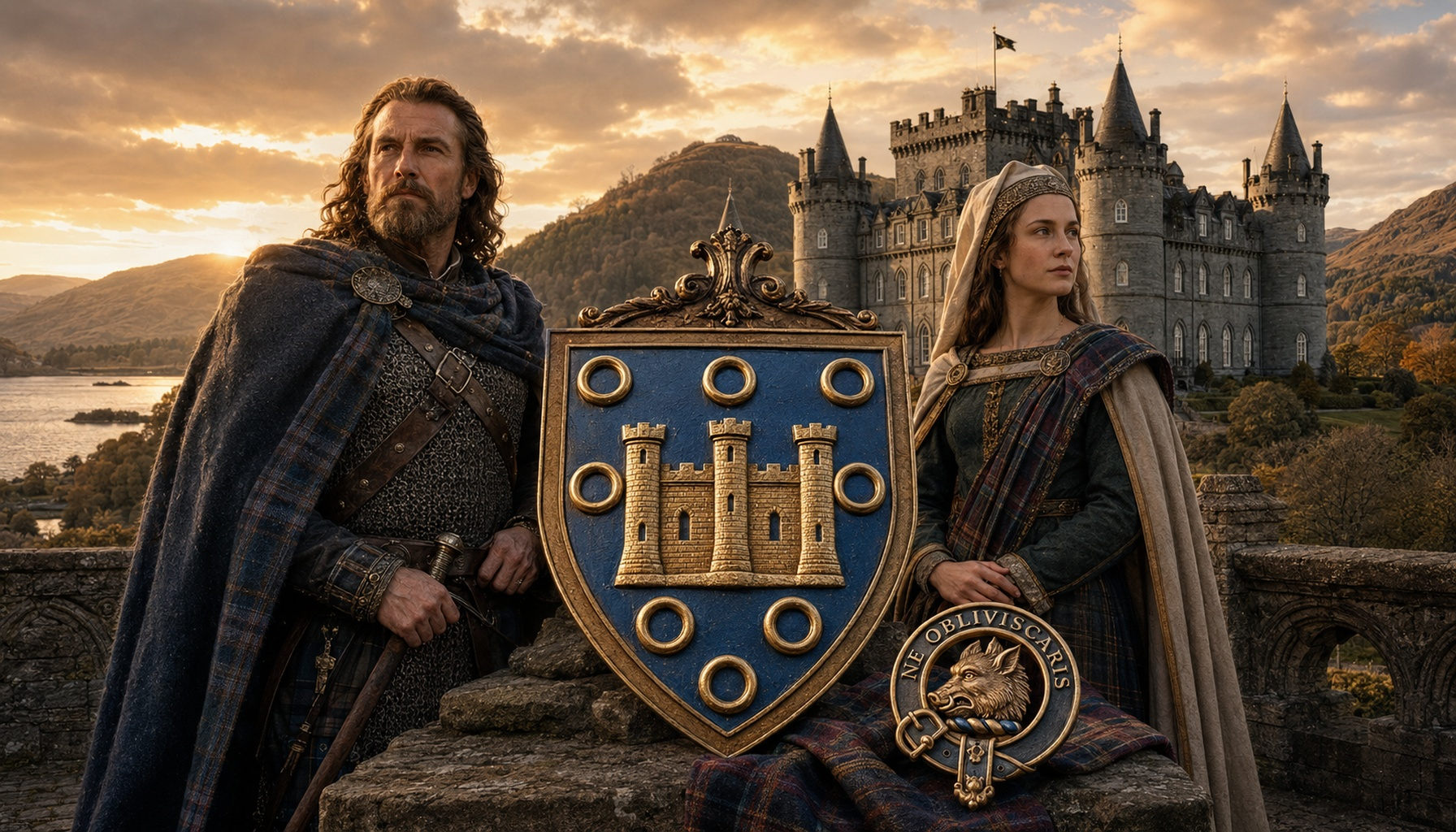
Clan Campbell was one of the great powerhouses of Scottish history: a Highland noble clan rooted above all in Argyll and the western Highlands, but influential far beyond them. Their story is not simply one of swords and tartan romance, though there was plenty of both. It is the story of a family that mastered landholding, royal service, legal office, marriage alliance, and political timing with extraordinary skill. The haplogroup most closely linked here to the family tradition is R1b1a1b1a1a2c1a1f1c1, a branch within the wider R1b lineage so often seen across Atlantic and western European history.
The Campbells emerged in medieval western Scotland in a world where kinship, lordship, and geography mattered enormously. Argyll was not some remote fringe; it was a strategic maritime zone tied into sea routes, island politics, Gaelic culture, and the Scottish crown. From that setting the Campbells rose steadily, gaining title after title and turning local authority into national importance. By 1445 the family had reached the rank of Lord Campbell, in 1457 the chief became Earl of Argyll, in 1641 the title of Marquess of Argyll appeared, and from 1701 to the present the chiefs have held the title Duke of Argyll. Another important branch held the Earls of Loudoun from 1633 to 1786. Their motto, Ne Obliviscaris, meaning forget not, feels entirely apt for a family so invested in lineage, memory, and continuity.
Read more about Clan Mackenzie
One of the most evocative places tied to the family is Castle Campbell, in Dollar, Clackmannanshire, on the edge of the Ochil Hills. Originally known as Castle Gloom, it stood in a steep and dramatic glen, naturally defended by burns cutting deep ravines on either side. In the 15th century it passed to the Campbells and was renamed to advertise the family's growing prestige. This was not their Argyll heartland seat, but that is precisely what makes it interesting: it shows the Campbells extending their footprint into central Scotland as they moved ever closer to the machinery of royal government. Architecturally it developed from a tower house into a more substantial courtyard castle, and historically it was caught up in the factional struggles of 16th-century Scotland, including attacks connected with the feud between Campbells and their enemies. Today it survives as an impressive ruin under public care, and yes, it can still be visited, which means you can quite literally walk into the landscape of Campbell ambition.
From an ancient-DNA perspective, the Campbell-linked haplogroup R1b1a1b1a1a2c1a1f1c1 sits within a deep and wide western European paternal story rather than a neat single-family line preserved unchanged across the ages. Related or linked samples associated with this branch include Celtic Durotriges burials from Duropolis at Winterborne Kingston in England such as WBK12, WBK20, WBK29, WBK41, WBK05, WBK30, WBK43, WBK06, WBK08, WBK18, and WBK191; Imperial Roman Era Zadar Croatia (I26776); Bronze Age Orkney Westray Links of Noltland (KD061); Bronze Age Calabria Cosenza Grotta della Monaca Sant Agata di Esaro (GMO015); Early Medieval Belgium Sint-Truiden Groenmarkt (ST2025); Medieval Belgium Outsider Sint-Truiden Onze-Lieve-Vrouwekerk (ST1308); Gallic France Parancot (CGG023699); Post Roman Era Worth Matravers Dorset England (I11580); Merovingian Grave North Rhine-Westphalia Germany Alt-Inden (IND013); Late Roman Era Klosterneuburg Lower Austria (R10656); Late Roman Conimbriga Portugal (R10488); Celtic Briton Oxfordshire Yarnton England (I21182); Iron Age Worlebury Somerset England (I11991); Iron Age Hillfort Battlesbury Bowl England (I21309); Bronze Age Trumpington Meadows Cambridge England (I3256); Bronze Age Amesbury Down Wiltshire England (I2417); Bell Beaker Wiltshire Upavon England (I4950); Bronze Age Bedfordshire England (I7576 and I7577); Bronze Age Boatbridge Quarry South Lanarkshire Scotland (I5473); Celt Hinxton Iron Age (HI2); Early Bronze Age England Thames (I5377); and Ireland Copper Age (Rathlin2B). These are not proof of direct descent from Campbells, of course. They are better understood as markers of the broader paternal landscape out of which later British and Scottish lineages, including Campbell-associated ones, emerged.
Explore the Royal House of Stewart
If Clan Campbell is part of your family story, or if you simply want to see whether your DNA shows links to the same wider genetic landscape and related ancient samples, this is exactly the kind of question ancient DNA can help illuminate. Upload your DNA to MyTrueAncestry and explore whether you match Clan Campbell connections, western Highland heritage, or any of the linked ancient individuals from Britain and beyond.
Comments