Clan Cameron
– 3 min read


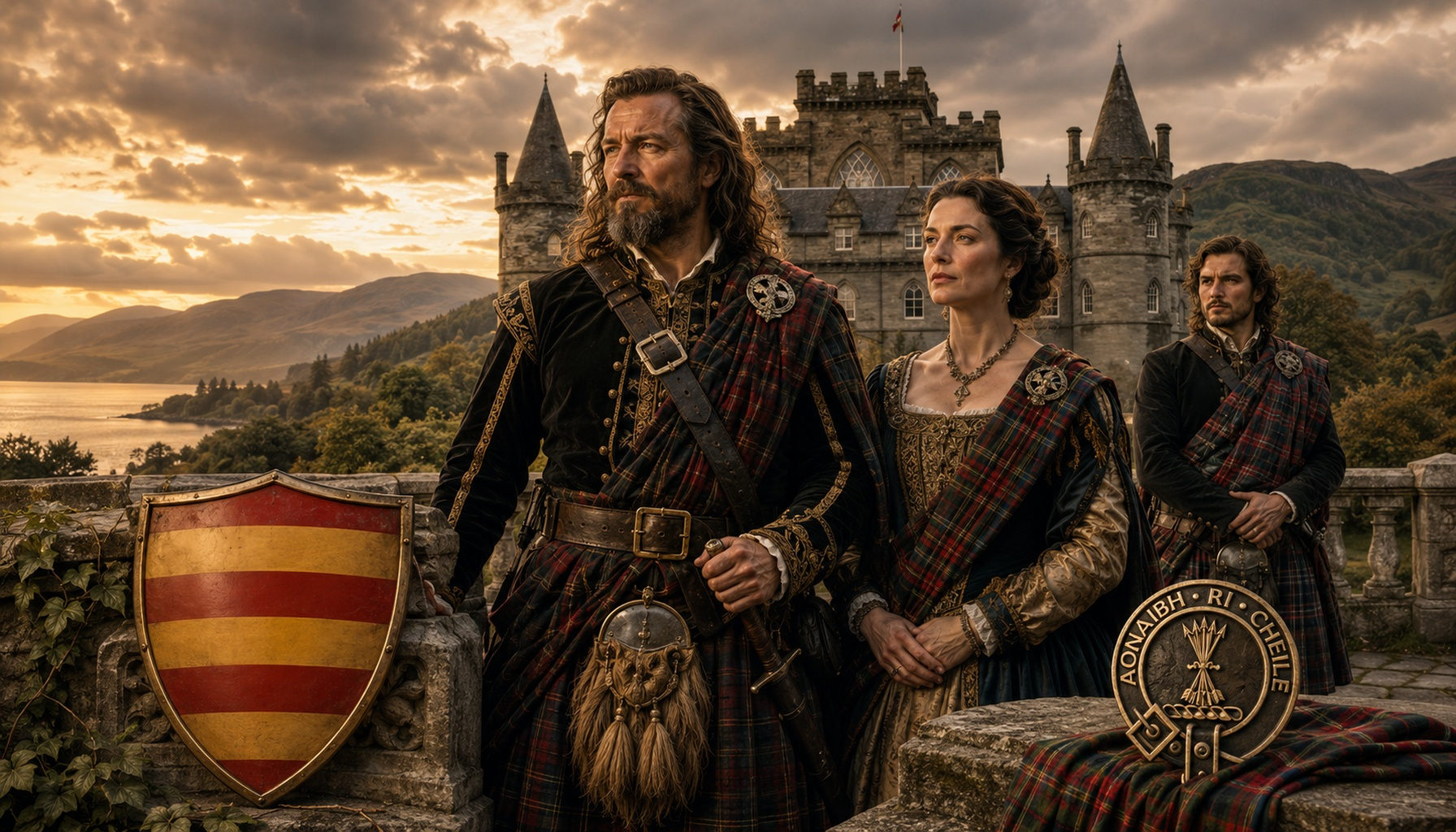
Clan Cameron was one of the great Highland kindreds of Scotland, rooted above all in Lochaber and the western Highlands, where landscape, kinship, and lordship were inseparable. Their tradition was built not simply on a surname, but on a whole Highland way of belonging: loyalty to chief, defense of territory, military reputation, and the stubborn endurance of a people tied to glens, lochs, and mountain passes. The clan motto, Aonaibh Ri Cheile, meaning unite, captures something essential here. The Camerons were not merely a family in the modern sense, but a political and social community, one that understood solidarity as a matter of survival as much as pride. Haplogroup tags linked with Cameron research include R1b1a1b1a1a2c1a4d1, which we note here as the primary family haplogroup associated with this heritage profile.
In historical terms, the Camerons belong squarely to the classic Highland clan world. Their rise came in a region where power depended on who held the land, who could gather fighting men, and who could command loyalty in an often violent neighborhood. They were frequently at odds with rival clans, especially in Lochaber, yet they also played a larger part in Scottish history through service in national conflicts and later in Jacobite causes. Figures such as Cameron of Lochiel became emblematic of Highland leadership, while names like Donal Dubh evoke the wider Gaelic world in which alliances, rebellion, and memory were deeply intertwined. Chiefs, tartan, heraldry, oral tradition, and attachment to ancestral ground all helped preserve Cameron identity long after the old clan system itself had been battered by war, state pressure, and social change.
Read more about Clan Mackenzie
No discussion of Clan Cameron feels complete without Tor Castle, one of the great location anchors of Cameron memory. Tor Castle stands near the River Lochy, close to Banavie and not far from Fort William, in the very landscape that shaped the power of Lochaber. The castle seen today is largely a 16th-century tower house, long associated with the Camerons of Lochiel, though the site itself likely had earlier importance. It is a compact but striking Highland stronghold, built for defense, status, and oversight of a region where control was never abstract but intensely local. This was not some ornamental residence dropped into a tame countryside; it sat in a contested and strategic zone, with the Great Glen nearby and the western Highlands all around it. In other words, Tor Castle belongs to the hard practical world of Highland chiefship, where architecture and authority marched together. It has survived in ruinous but evocative form, and yes, it can still be visited from the outside as a historic site in the Lochaber area, which makes it a tangible place to stand and imagine the Camerons in their own country.
From an ancient-DNA point of view, the Cameron-linked haplogroup R1b1a1b1a1a2c1a4d1 sits within a wider northwest European and Atlantic-facing story rather than a neat one-family line marching through time. Related or linked ancient samples associated with this branch include several Celtic Durotriges individuals from Duropolis, Winterborne Kingston in England, including WBK12, WBK20, WBK29, WBK41, WBK05, WBK30, WBK43, WBK06, WBK08, WBK18, and WBK191, as well as Iron Age and later examples such as Iron Age Worlebury Somerset England (I11991), Iron Age Hillfort Battlesbury Bowl England (I21309), Post Roman Era Worth Matravers Dorset England (I11580), and Imperial Roman Era Zadar Croatia (I26776). The same broader lineage also appears in older and wider contexts, including Bronze Age Orkney Westray Links of Noltland (KD061), Bronze Age Boatbridge Quarry South Lanarkshire Scotland (I5473), Bronze Age Trumpington Meadows Cambridge England (I3256), Bronze Age Amesbury Down Wiltshire England (I2417), Bell Beaker Wiltshire Upavon England (I4950), Bronze Age Bedfordshire England (I7576, I7577), Early Bronze Age England Thames (I5377), Ireland Copper Age (Rathlin2B), Gallic France Parancot (CGG023699), Late Roman Conimbriga Portugal (R10488), Late Roman Era Klosterneuburg Lower Austria (R10656), Early Medieval Belgium Sint-Truiden Groenmarkt (ST2025), Medieval Belgium Outsider Sint-Truiden Onze-Lieve-Vrouwekerk (ST1308), Merovingian Grave North Rhine-Westphalia Germany Alt-Inden (IND013), and Bronze Age Calabria Cosenza Grotta della Monaca Sant Agata di Esaro (GMO015). None of these should be taken as proof of direct descent from Clan Cameron; rather, they are related markers in the deeper paternal history of the same broad lineage, showing just how far back and how widely spread this ancestral branch can be traced.
Explore ancient DNA and Celtic origins
If Clan Cameron is part of your family story, DNA can add an intriguing extra layer to the history of chiefs, castles, and Highland memory. Uploading your DNA to MyTrueAncestry can help you see whether you match Clan Cameron heritage profiles or any of the related ancient DNA samples linked with haplogroup R1b1a1b1a1a2c1a4d1. It is a rather wonderful way of placing your own family history into the much longer human story.
Comments