Clan MacCallum
– 3 min read


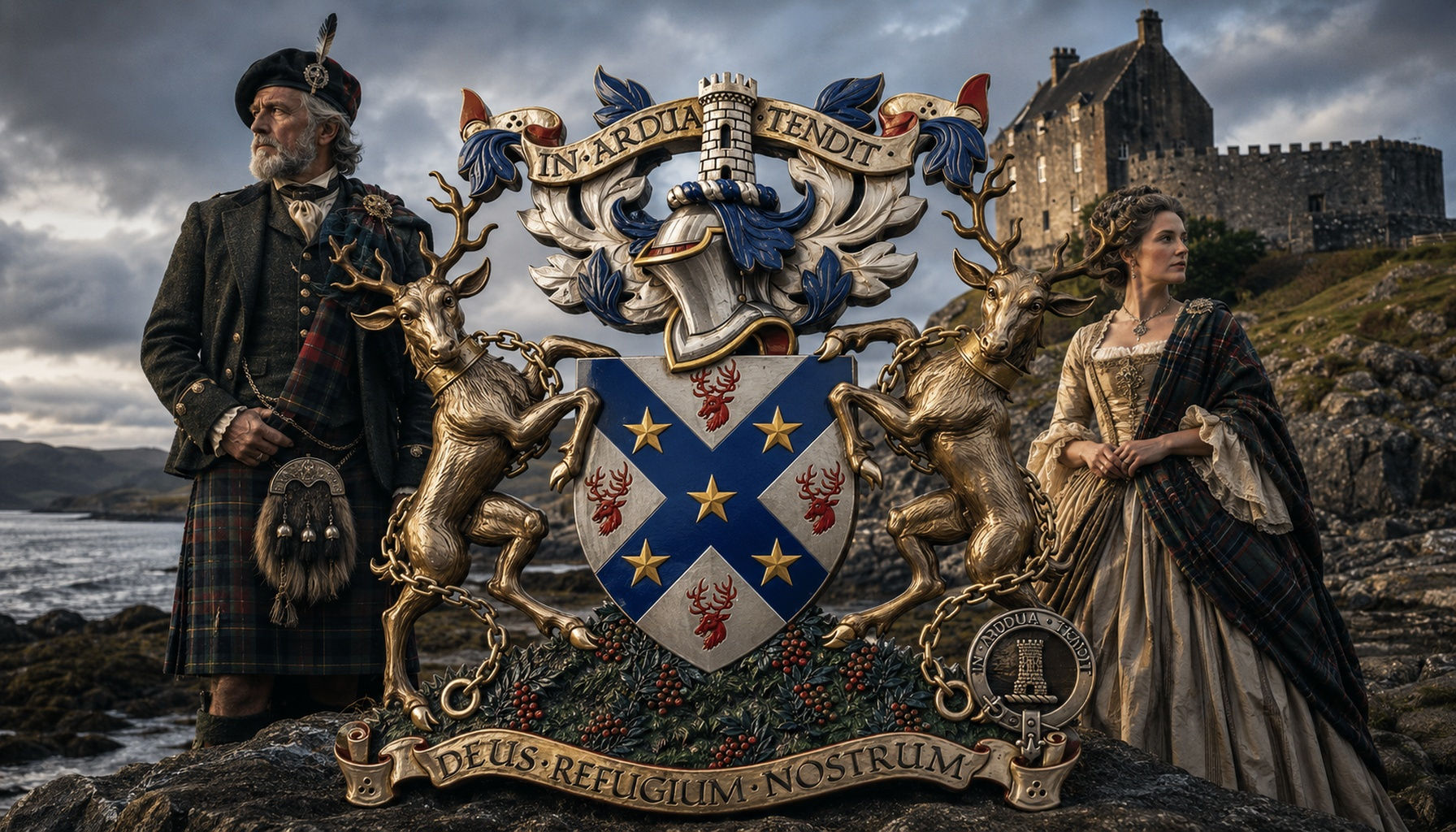
Clan MacCallum was a Highland Scottish kindred rooted in Argyll and the Gaelic west, shaped by the world of sea lochs, local lordship, church tradition, and fiercely remembered family ties. The name is generally understood as meaning son of Columba, or follower of Columba, which immediately places the family in that deeply Gaelic habit of binding identity to revered Christian names. In historical terms, the MacCallums belong to a very recognisable Highland pattern: a clan built not from abstract genealogy alone, but from kinship, landholding, service, reputation, and the stubborn preservation of ancestral memory. Primary family haplogroup: R1b1a1b1a1a1c1b.
That matters because Highland surnames were never just labels. They were social worlds. A name like MacCallum carried religion, language, locality, and loyalty all at once. In Argyll, where Norse, Gaelic, and later Scottish royal power all brushed up against one another, families such as the MacCallums emerged in a landscape where identity was both personal and political. One early named figure is Ronald MacCaullum, recorded in 1510, a reminder that by the early 16th century the family was already visible in the documentary record of western Scotland.
Read more about Clan MacTavish
A useful location anchor for MacCallum heritage is Duntrune Castle in Argyll, on the north side of Loch Crinan. It stands in one of those classic west Highland settings where geography does half the storytelling for you: sea access, control of movement, visibility across the loch, and close connection to the wider Argyll power network. Duntrune is regarded as one of the oldest continuously occupied castles on the Scottish mainland, with medieval origins and later rebuilding. Historically it became associated above all with the Campbells, particularly the Campbells of Duntrune, and its long life reflects the changing fortunes of Argyll itself, from Gaelic lordship to the age of fortified tower houses and early modern clan politics. The castle is also wrapped in local legend, including the famous tale of the piper of Duntrune, exactly the sort of story that clings to old Highland buildings because they were never merely defensive structures, but theatres of memory. As a heritage site, Duntrune Castle can still be seen and visited from the outside, and the surrounding area remains a rewarding stop for anyone tracing Argyll family history.
The MacCallum primary family haplogroup, R1b1a1b1a1a1c1b, sits within a very broad and historically important western Eurasian paternal branch. That does not prove direct descent from any specific excavated individual, and it is important not to pretend otherwise. What it does offer is a wider genetic backdrop, linking the clan's paternal line to related or linked ancient samples spread across Celtic, Roman, Germanic, medieval, and early modern Europe. Among those linked examples are Gallo-Celtic Switzerland Pont de Cornaux-Les-Sauges (3430), Bronze Age Unetice Thuringia Leubingen Sommerda Germany (LEU007), Celtic Iron Age Austria Hallstatt (CGG101214), Belgic Suessiones Iron Age France Bucy-le-Long (CGG022456, CGG022463, CGG022431, CGG022425, CGG022438), Gallic France Bucy-le-Long (CGG022419), Batavi Germanic Tribe Netherlands Valkenburg Marktveld (CGG107754), Imperial Roman Viminacium Serbia Pecine Necropolis (I15527), Roman-period Germanic Warrior Mursa Croatia Third Century Crisis (OSIJ003), Viking Age Sigtuna Sweden (urm160, urm160x), Saxon England North Yorkshire West Heslerton Vale of Pickering (I11583, I11584), Early Anglo Saxon Cemetery West Heslerton Yorkshire (I20644, I20671, I20677, I20652), Early Anglo Saxon Period Buckland Dover England (BUK012, BUK060, BUK064, BUK070), Anglo Saxon Oakington England (OAI006) and Germanic Oakington England (OAI013), Norman Invasion Medieval Lincolnshire Lincoln Castle (S3044), Lombard Warrior Elite Collegno Northern Italy (COL_069, COL_069x) and Lombard Era Collegno Northern Italy (COL_069b), Longobard Haeven Mecklenburg-Vorpommern (HVN004, HVN005) with Celto-Longobard Haeven Mecklenburg-Vorpommern (HVN003), Ferenc Bathory Hungarian Knight Pericei (PER03-1), Hungarian Conqueror Karos III (K3per1_GE), Hungarian Late Conqueror (K3per13_GE), Danii Tribe Denmark Sjaelland Kalundborg Simonsborg (CGG106724), Battleaxe Sweden L Beddinge 56 (RISE98), Late Neolithic Vlaardingen or Corded Ware Netherlands Mienakker (I12902), Bell Beaker De Tuithoorn North Holland (I4070), Etruscan Tarquinii Italy (TAQ013), Iron Age Briton Cambridgeshire England (I11149), Medieval Belgium Sint-Truiden Onze-Lieve-Vrouwekerk (ST0024, ST1232, ST0323, ST0786) and Carolingian Belgium Sint-Truiden Groenmarkt (ST2969). Taken together, these linked samples show just how wide the historical canvas is behind one Highland paternal signature.
Explore ancient DNA and Celtic origins
If you carry the MacCallum name, or suspect roots in Argyll and the Gaelic west, DNA can add another layer to the story, not replacing records or family tradition, but enriching them. Upload your DNA to MyTrueAncestry and see whether you match Clan MacCallum, or any of the related ancient DNA samples linked with haplogroup R1b1a1b1a1a1c1b.






Comments