The House of Grey
– 3 min read


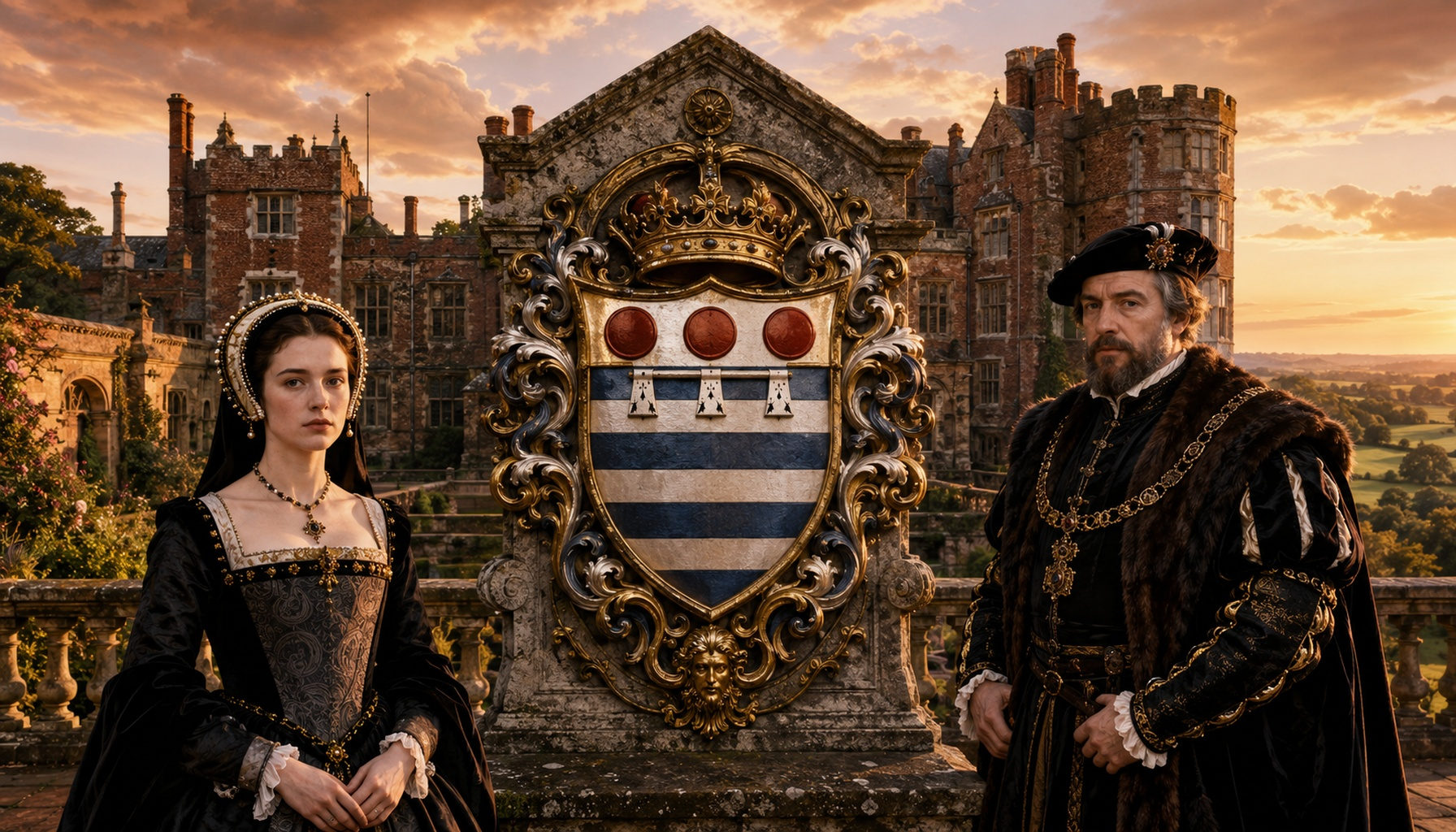
The House of Grey was one of the great noble families of England, a dynasty shaped by land, war, royal favour, and careful marriage. Their name is usually traced to a Norman place-name, most often linked with Graye-sur-Mer in Normandy, and like so many English magnate houses they came into sharper focus in the aftermath of the Norman Conquest, when military service and landed reward remade the ruling class of England. For this family, the primary linked Y-DNA haplogroup is R1b1a1b1a1a2a, a branch within the wider R1b lineage long associated with much of western Europe.
The Greys are a very English story in the grandest sense: hereditary lordship, castle-building, heraldry, feuds, court office, and proximity to the throne. From early figures such as Anchetil de Greye (1052-1086), the family grew into several powerful branches, producing barons, earls, and lines tied into the highest politics of medieval and early modern England. Their history runs through the Marches, the shires, and the royal court, but it is perhaps most famous in public memory for its tragic royal connection through Lady Jane Grey, the so-called Nine Days Queen, whose brief reign turned the Grey name into part of one of Tudor England's most dramatic dynastic crises. In that sense the House of Grey is not just a family, but a pattern of how English aristocratic power worked across centuries.
One of the most evocative places associated with the family is Rotherfield Greys Castle in Oxfordshire, better known today as Greys Court. The site began as a medieval fortified manor rather than a vast military fortress, with origins in the 14th century when the de Grey family established themselves there. It developed around a moated and defended residence, later altered and enlarged over the centuries as tastes shifted from hard-edged feudal defensibility to noble comfort and display. What makes the place so interesting is precisely that layered quality: it carries the memory of a medieval lordly seat while also showing the afterlife of aristocratic property in Tudor, Stuart, and later English country-house culture. The estate passed through later owners and was extensively reshaped, but the Grey association remained stamped on both the name and the local historical memory. Yes, it can still be visited today, and that survivability matters. It means the Grey story is not confined to parchments and pedigrees; it still sits in the landscape, in stone, earthworks, and the long afterlife of noble residence.
From a genetic history point of view, the Grey-linked haplogroup R1b1a1b1a1a2a belongs to an old and widespread western European paternal network rather than to one uniquely "Grey" signature frozen in time. That is why ancient DNA is useful when handled carefully: it shows related or linked deep ancestry patterns, not a neat labelled queue of future noblemen. Relevant linked samples appear across a strikingly broad arc of time and place, including Celtic and elite burials in Germany such as Magdalenenberg MBG013, Asperg-Grafenbuehl APG001 and APG003, Hochdorf HOC001, HOC001b and HOC001c, Roman and Iron Age Britain including Cambridgeshire samples NWC009, FEN008, ARB003 and DUX003, Durotriges individuals from Winterborne Kingston such as WBK103, WBK106, WBK17 and WBK36, and medieval western European contexts like Las Gobas in northern Spain with ldo066, ldo037, ldo046 and ldo048, along with medieval English samples from Cherry Hinton and St John's Hospital in Cambridge. Taken together, these do not prove direct descent from any one ancient individual to the Grey family. What they do suggest is that the paternal line associated here belongs to a deep and durable European story, moving through Bronze Age, Celtic, Roman, post-Roman and medieval worlds before appearing in later aristocratic lineages of England.
If the House of Grey catches your imagination, that is really the point of family history at its best: not just names on a tree, but people moving through castles, courts, rebellions, marriages, and moments of catastrophe. Uploading your DNA to MyTrueAncestry can help you see whether you match the House of Grey story more closely, or whether your results connect you with related ancient DNA samples from Roman Britain, Celtic Europe, or medieval England and Iberia.



Comments