The House of Montmorency
– 3 min read


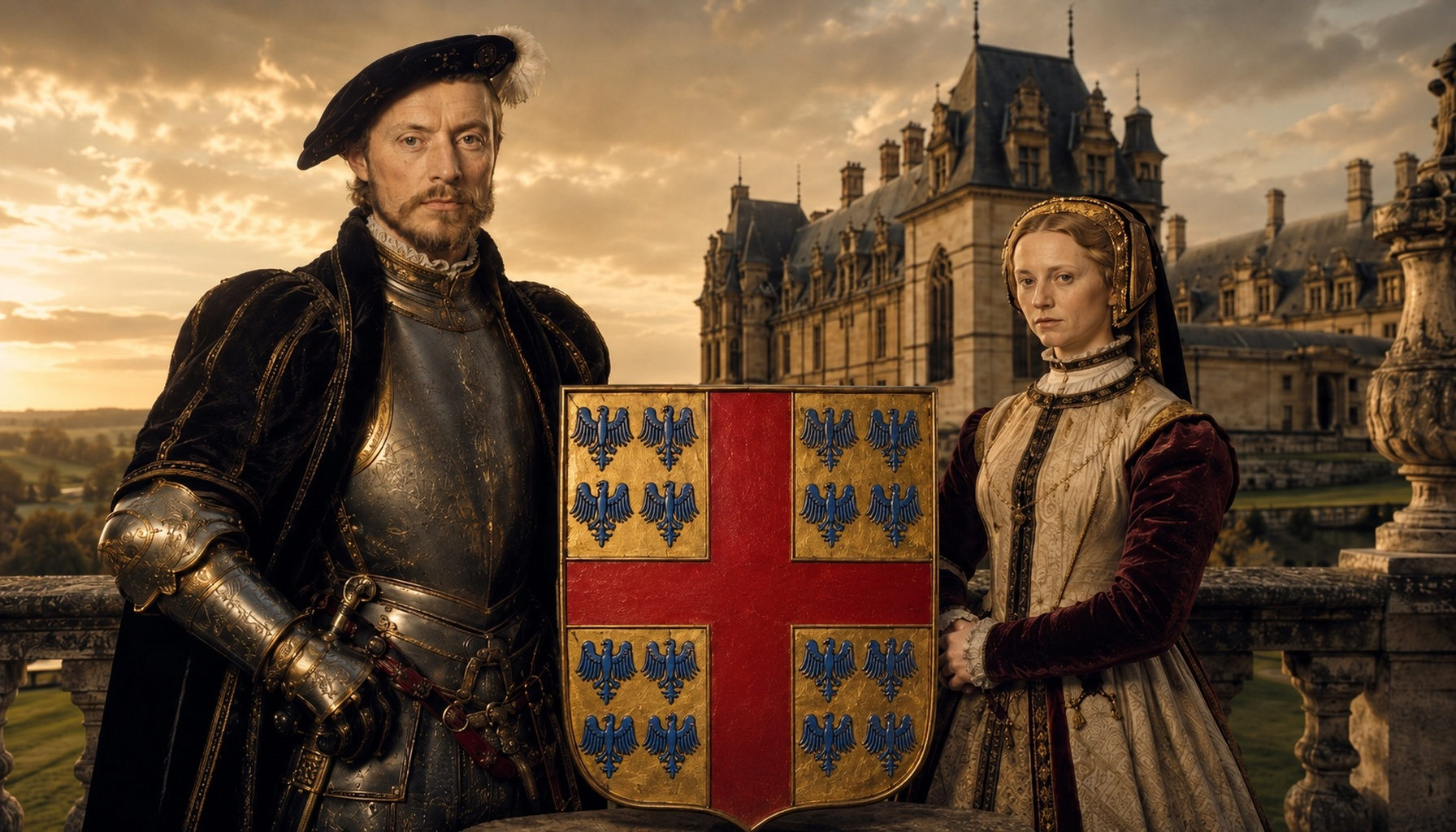
The House of Montmorency was one of the grand old noble houses of France, rooted in the world of medieval lordship, royal service, and aristocratic memory. Their name is linked here with the haplogroup R1b1a1b1a1a2a1b, presented as the primary family haplogroup tag. Historically, the Montmorencys emerged from the feudal landscape north of Paris, in the Ile-de-France orbit where proximity to the Capetian kings could turn landed power into national importance. They were not simply local lords who happened to do well. They became one of those families whose name came to stand for rank itself: old blood, military office, court prestige, and the kind of status that made chroniclers take notice.
What makes the Montmorencys so distinctly French is the pattern of their rise. Landholding gave them a base, but service gave them scale. Over centuries they built power through loyalty to kings, martial leadership, advantageous marriages, and careful occupation of the high offices that mattered. Their heritage includes castles, heraldic identity, patronage, and a reputation burnished in war and politics. Among their most famous figures were Anne de Montmorency (1493-1567), the formidable constable of France under Francis I and Henry II; Francois de Montmorency (1530-1579), who carried the family standing into the next generation; and Henri I de Montmorency (1534-1614), another major noble figure in the turbulent politics of later sixteenth-century France. In them you can see the house at full height: powerful, visible, and woven into the machinery of the kingdom.
Explore the Royal House of Capet
A useful location anchor for this heritage is the Chateau de Montmorency at Montigny-en-Ostrevent, in northern France. The site, as described in the historical record, reflects the long afterlife of aristocratic naming, landholding, and regional seigneurial presence associated with the Montmorency name. The chateau known today is not a simple untouched survival from the great feudal centuries, but part of that layered French story in which noble sites were rebuilt, reshaped, and reinterpreted over time. That, in a way, is exactly the point. A noble house is not only a bloodline on parchment; it is also a geography of memory, with estates, architectural remains, and local traditions attaching the family name to the landscape. The Chateau de Montmorency helps fix the family in a real place, in a real region, amid the broader northern French world that fed the power of many high aristocratic lineages. Based on its status as a recognized historic site, it is reasonable to say the location can still be visited, though visitors should always check current local access and opening conditions before making a trip.
Read more about House Lusignan
From a DNA perspective, the haplogroup tag R1b1a1b1a1a2a1b places the Montmorency story within a very broad and very old western European paternal landscape. It does not prove direct descent from any ancient individual, and it should not be read that way. What it does offer is a set of related or linked ancient comparisons stretching across time and region. Samples associated with this wider lineage include Medieval Northern Spain Las Gobas individuals such as ldo066, ldo037, ldo048, and ldo062; Gallo-Roman individuals from Metz Lunette Sablon including R2055a, R2055b, R2055c, R2055d, and R2055e; the Roman Era Fenstanton Cambridgeshire sample FEN008; elite Celtic burials from Asperg-Grafenbuehl and Ludwigsburg Roemerhuegel in Germany such as APG001, APG003, and LWB001; the Merovingian Period Frankish sample EV8 from Eltville; and a range of Bell Beaker, Bronze Age, Iron Age, medieval, and migration-era samples from France, Iberia, the Low Countries, Britain, Central Europe, and beyond. In plain terms, this is the sort of lineage one repeatedly meets in the archaeological genetics of western and central Europe, which suits a family like Montmorency whose historical identity was deeply embedded in the old aristocratic heartlands of France.
If the House of Montmorency speaks to your own family story, the next step is to test that connection in the broadest historical sense. Upload your DNA to MyTrueAncestry and see whether you match the Montmorency family profile or any of the related ancient DNA samples linked to haplogroup R1b1a1b1a1a2a1b. It is a fascinating way to place personal ancestry against the deeper backdrop of medieval nobility, Iron Age Europe, and the long human story written into the landscape of France.


Comments