The Royal House of Capet
– 3 min read


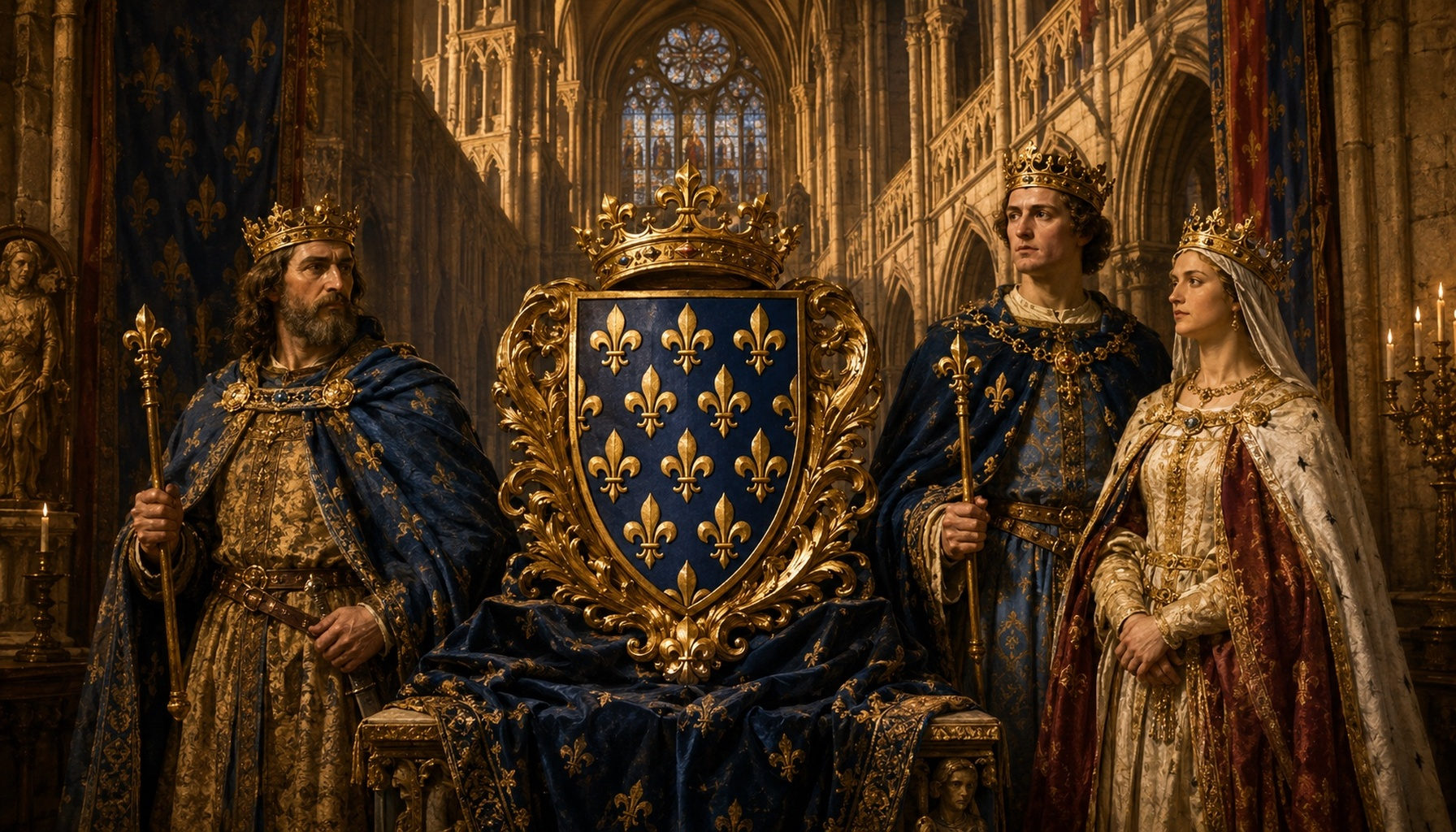
The House of Capet was the great foundational royal dynasty of medieval France, the family that began with King Hugh Capet of France and went on to shape the kingdom for centuries. Their roots lay in the heart of West Francia, especially the Ile-de-France and the lands around Paris and Orleans, in a world still deeply marked by the collapse of Carolingian power, the bargaining of great lords, and the constant question of who really held authority. In that setting, the Capetians emerged not as instant masters of all France, but as one ambitious royal house among many, gradually turning a fragile crown into something much stronger. In haplogroup tagging here, the primary family haplogroup linked with this profile is J1a2b1b2c1.
What makes the Capet story so striking is that it is really the story of monarchy being built piece by piece. Hugh Capet, elected king in 987, did not inherit a neat, centralized state. He inherited a title, a prestige, a sacred aura, and a realm in which dukes and counts were often far more powerful on the ground than the king himself. Yet over generations the Capetians tightened succession, promoted the idea of sacred kingship, strengthened royal justice, expanded administration, and slowly pulled territory into the orbit of the crown. Paris grew with them, becoming not merely a residence but a center of government and symbolism. From this line came not only French kings, but cadet branches whose dynastic reach spread across Europe, making the Capetians one of the most consequential ruling houses in medieval history.
Explore the Princely House de Dreux
A particularly vivid Capetian-linked place to anchor this story is the Palace of the Kings of Navarre at Olite, in northern Spain. The building we see today is largely a 13th- to 15th-century royal complex, later expanded into one of the most remarkable Gothic palaces in Iberia. It became especially associated with the Navarrese monarchy, including the Evreux line, a cadet branch of the Capetians. In other words, this is not just a beautiful palace: it is a reminder that Capetian dynastic power was not confined to France alone, but radiated outward through marriages, inheritances, and branch lines into neighboring realms. Olite's palace, with its towers, courtyards, galleries, and once-famous gardens, gives a real sense of late medieval kingship as theater as well as government. It can still be visited today, and it remains one of the most atmospheric surviving royal sites connected to the wider Capetian world.
Read more about House Lusignan
For the DNA side of the story, the J1a2b1b2c1 tag should be handled carefully. It does not by itself prove direct descent from the Capetians, nor do the ancient samples below represent the dynasty itself. Rather, they are related or linked examples that help place this paternal line in a much deeper historical landscape across West Asia and the eastern Mediterranean. Among useful J1a2b1b2c1-linked samples are Late Bronze Age Caucasus Ginchi Gatyn-Kale (GTK001), Iron Age Iran Hasanlu Period (I4354), Bronze Age Armenia Dzhoghaz Cemetery (I14340), Bronze Age Armenia Dzhoghaz Cemetery (I14341), Byzantine Period Mardin Southeast Anatolia (I4533), and Roman Empire Casale del Dolce (R128). Together they show that this branch has a long archaeological footprint stretching across regions central to ancient movement, trade, empire, and frontier society. That is the fascination of ancient DNA: not a fairy tale of guaranteed royal descent, but a wider map of how lineages travel through time.
Explore the Spanish House of Bourbon
If the House of Capet captures your imagination, the next step is obvious: test the story against your own DNA. Upload your results to MyTrueAncestry and see whether you match the House of Capet profile or any related ancient DNA samples linked to haplogroup J1a2b1b2c1. Medieval dynasties, royal branches, and deep archaeological lineages often become much more interesting when they are no longer just names in a chronicle, but part of your own genetic exploration.





Comments