House Lusignan
– 3 min read


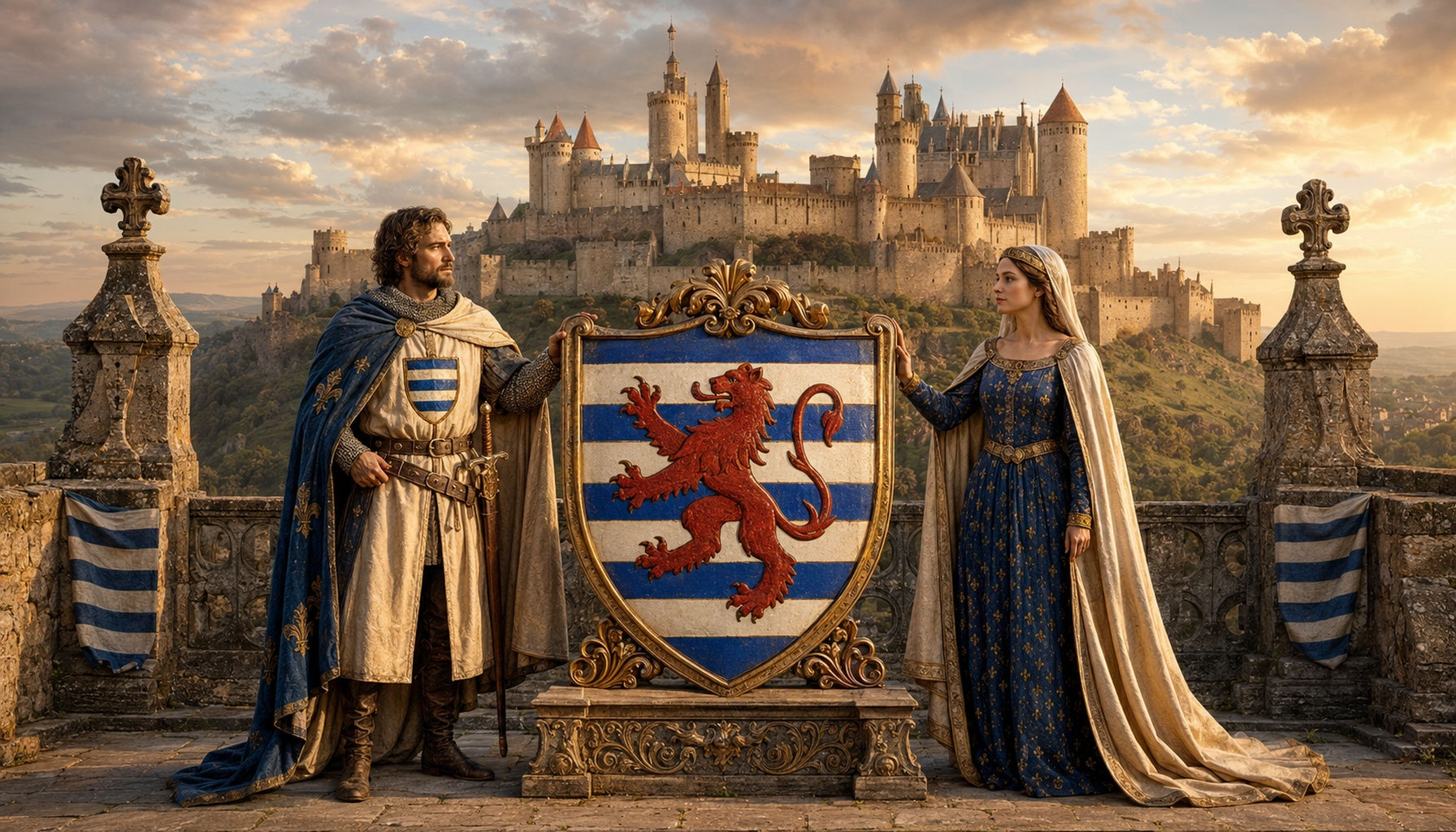
House Lusignan was a medieval French noble family from Poitou in west-central France, remembered for turning a local lordship into one of the most far-flung dynastic stories of the Middle Ages. Their traditional genetic tag here is the haplogroup R1b1a1b1a1a2a4, a branch associated in many ancient DNA datasets with long-running western and central European paternal lines. Historically, the Lusignans began as castellans and regional lords rooted in the landscape around Lusignan, but through warfare, crusading, careful marriage, and sheer opportunism they rose into the politics of kingdoms far beyond France.
And what a rise it was. This was not merely a family with a good castle and a few ambitious sons. The Lusignans became enmeshed in the great engine of medieval expansion: feudal rivalry in France, the crusades in the Levant, and the marriage politics of Latin Christendom. Guy Lusignan (1150-1194) is the most famous name, largely because his career carried him all the way to the kingdom of Jerusalem, where his rule became tied to one of the most dramatic crises of crusader history. Hugh I of Lusignan (1215-1253), by contrast, belongs to the later phase of the dynasty, when the family had become firmly embedded in the royal world of Cyprus. Across generations, the Lusignans gained crowns in Jerusalem, Cyprus, and eventually Armenia, showing how a Poitevin lineage could become an eastern Mediterranean dynasty without ever quite losing the memory of its French origin.
The great anchor of family identity was the Chateau de Lusignan in the town of Lusignan, in modern Nouvelle-Aquitaine. In medieval terms this was not just a residence but a statement in stone: the seat from which the family projected authority into Poitou, and the place around which their memory and legend gathered. The castle was famous enough to enter romance as well as history, especially through the Melusine tradition, which linked the dynasty to a supernatural founding myth of noble origins, part fairy tale and part political self-advertisement. Architecturally and strategically, the fortress occupied an important height above the surrounding area and was enlarged over centuries into one of the notable strongholds of the region. Although the medieval castle was largely destroyed after the early modern period, the site of the Chateau de Lusignan remains part of the historic townscape and can still be visited today as an archaeological and heritage location, with surviving traces, earthworks, and viewpoints that preserve the setting in which the family first rose to prominence.
Read more about the Royal House of Capet
From an ancient DNA perspective, the Lusignan family's tagged paternal line R1b1a1b1a1a2a4 sits within a broad and very old European pattern rather than something unique to one castle or one dynasty. Related or linked samples under this branch appear across a striking range of contexts: Early Bronze Age France at Saint-Martin-la-Garenne in Yvelines (SMGB54) and les Pointes et les Grevottes in Aube (BRE445FK), elite Celtic burials in Germany such as Asperg-Grafenbuehl (APG001, APG003) and Ludwigsburg Roemerhuegel (LWB001, LWB002), Gallo-Roman France at Metz Lunette Sablon (R2055a-e), Roman Era Fenstanton in Cambridgeshire (FEN008), and medieval northern Spain at Las Gobas (ldo066, ldo037, ldo046, ldo048, ldo062, ldo040). The point is not to claim direct descent from any of these individuals, still less to make them "Lusignans" before the fact, but to show that the Lusignan-linked haplogroup belongs to a paternal landscape with deep roots in Iron Age, Roman, and medieval western Europe. That fits rather neatly with a dynasty born in Poitou and then launched outward into the crusader world.
If House Lusignan is part of your family story, or if you are simply curious whether your DNA connects with this wider western European and crusader-era genetic world, you can upload your DNA to MyTrueAncestry and compare yourself with the family context and related ancient samples. It is a wonderful way to put names, places, and buried populations back into the long human story.
Comments