The House of de Malain
– 3 min read


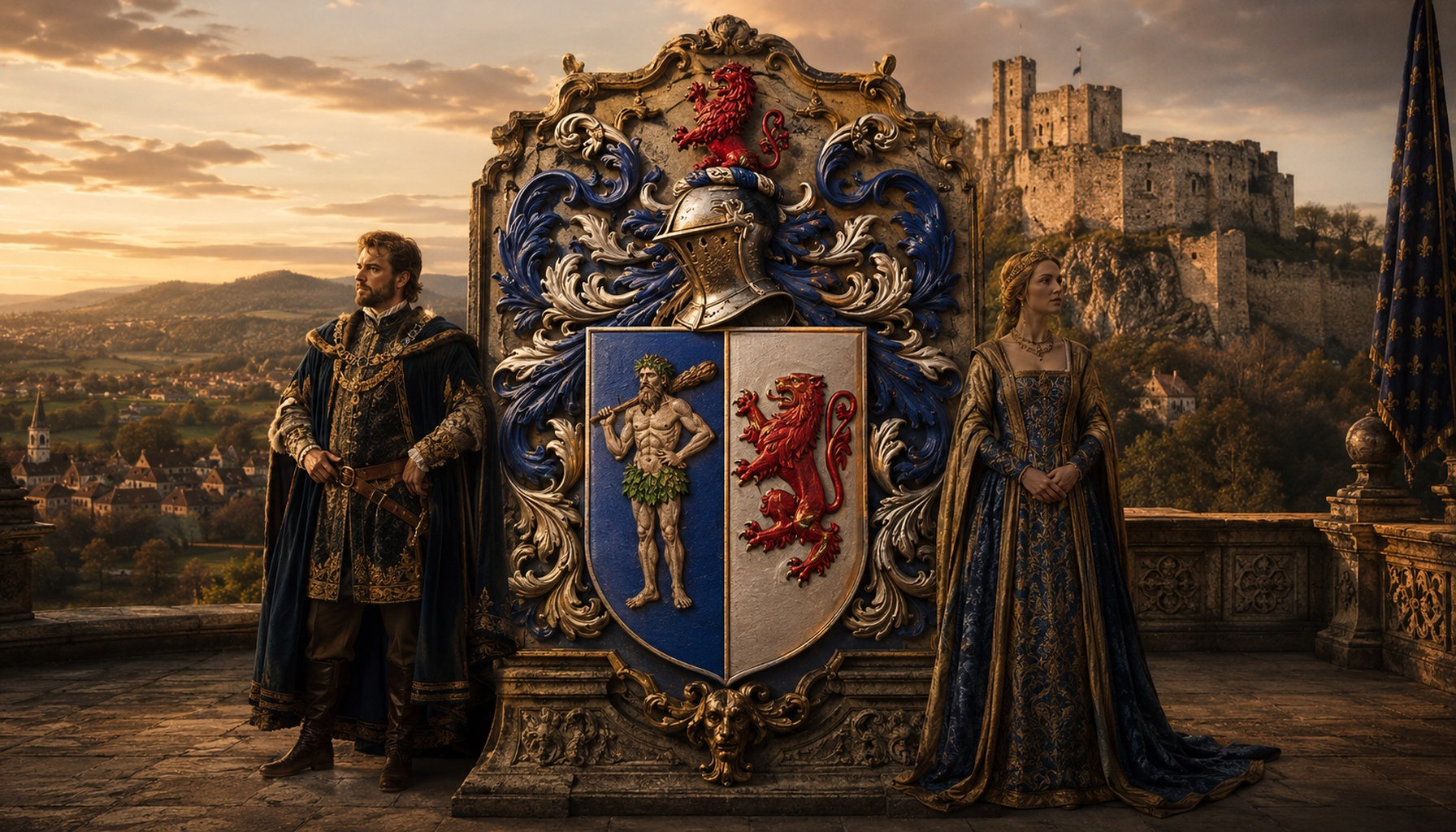
The House of de Malain was a French noble family of Burgundy, rooted in the old seigneurial landscape west of Dijon and remembered through lordship, land, and heraldic identity. Their name is plainly territorial: de Malain means that this family drew its standing from the place of Malain itself, a classic pattern in medieval France where lineage and locality were tightly bound together. In that sense, the de Malains belong to the great provincial nobility of Burgundy, families whose authority rested not only on ancestry but on the long control of estates, local justice, military obligation, and recognition among neighboring noble houses. Haplogroup tag: R1b1a1b1a1a2b4, the primary family haplogroup linked here.
Historically, the family fits the enduring Burgundian model of noble continuity: a house built from regional lordship, reinforced through service, marriage alliances, and memory preserved in arms and record. Burgundy, of course, was never some sleepy backwater. It was one of the most politically charged and culturally rich regions of medieval and early modern France, a land of castles, abbeys, ducal power, and tightly layered feudal relationships. Within that world, names associated with Malain appear early, including Gui de Mediolano in 1075, showing the deep medieval roots of the lineage or at least of the place-based identity from which it emerged. Later references such as Francis Malin in 1653 suggest the name's persistence into the early modern period, when many provincial noble families were adapting from purely martial lordship into roles shaped by administration, legal status, and local prestige.
The great location anchor for this heritage is the Chateau de Malain, which dominates the village of Malain in the Cote-d'Or of Burgundy. Perched above the settlement, the castle reflects the strategic logic of medieval lordship perfectly: height, surveillance, defense, and visible authority over the surrounding territory. The site developed over centuries, with medieval fortification and later adaptation, and it stands as the clearest material expression of the de Malain world, where power was not abstract but built into stone walls, towers, enclosures, and command of the local landscape. Like so many Burgundian castles, it speaks both of conflict and continuity, of feudal control but also of the long afterlife of noble memory. It is not merely a ruin in the romantic sense; it is a historical landmark tied to the identity of the place and the family name. It can still be visited, which makes Malain unusually tangible as a family location anchor: not just a name in a charter, but a real hilltop fortress that still allows visitors to stand inside the geography of Burgundian nobility.
From a DNA perspective, the de Malain story is here tagged with haplogroup R1b1a1b1a1a2b4. That does not prove direct descent from any ancient individual, and it should not be presented that way, but it does place the family within a broader web of related or linked paternal lines found across western and central Europe over a very long timespan. Among the relevant linked samples are Early Bronze Age France Saint-Martin-la-Garenne Yvelines Ile-de-France (SMGB54), Early Bronze Age France les Pointes et les Grevottes Greviandes Aube (BRE445FK), Gallo Roman France Metz Lunette Sablon (R2055a, R2055b, R2055c, R2055d, R2055e), Early Medieval France Burgundy Camp du Chateau (CGG023630, CGG023658), Belgic Suessiones Iron Age France Bucy-le-Long (CGG022421, CGG022436, CGG022464), Gallic France Les Moidons (CGG023708, CGG023710), and Gallic France Sainte Colombe-sur-Seine (CGG023637). Beyond France, the same broader lineage cluster appears in Medieval Northern Spain Las Gobas samples such as ldo066, ldo037, ldo046, ldo048, ldo040 and Dark Ages ldo062, in Celtic Durotriges England at Winterborne Kingston (WBK106, WBK36), in elite Celtic burials from Germany such as Asperg-Grafenbuehl (APG001, APG003) and Ludwigsburg Roemerhuegel, and in many later medieval contexts across Belgium, England, Iberia, and central Europe. In plain terms, this is a lineage with deep roots in the same broad European world that shaped Burgundy itself: Bell Beaker and Bronze Age foundations, Iron Age Celtic and Gallic horizons, Roman provincial society, and the medieval populations from which noble houses like de Malain emerged.
If you carry the Malain name, have Burgundian roots, or simply want to see how your family history may connect to the deeper human past, upload your DNA to MyTrueAncestry and explore the ancient populations linked to your heritage.
Comments