The House of de Correia

– 3 min read


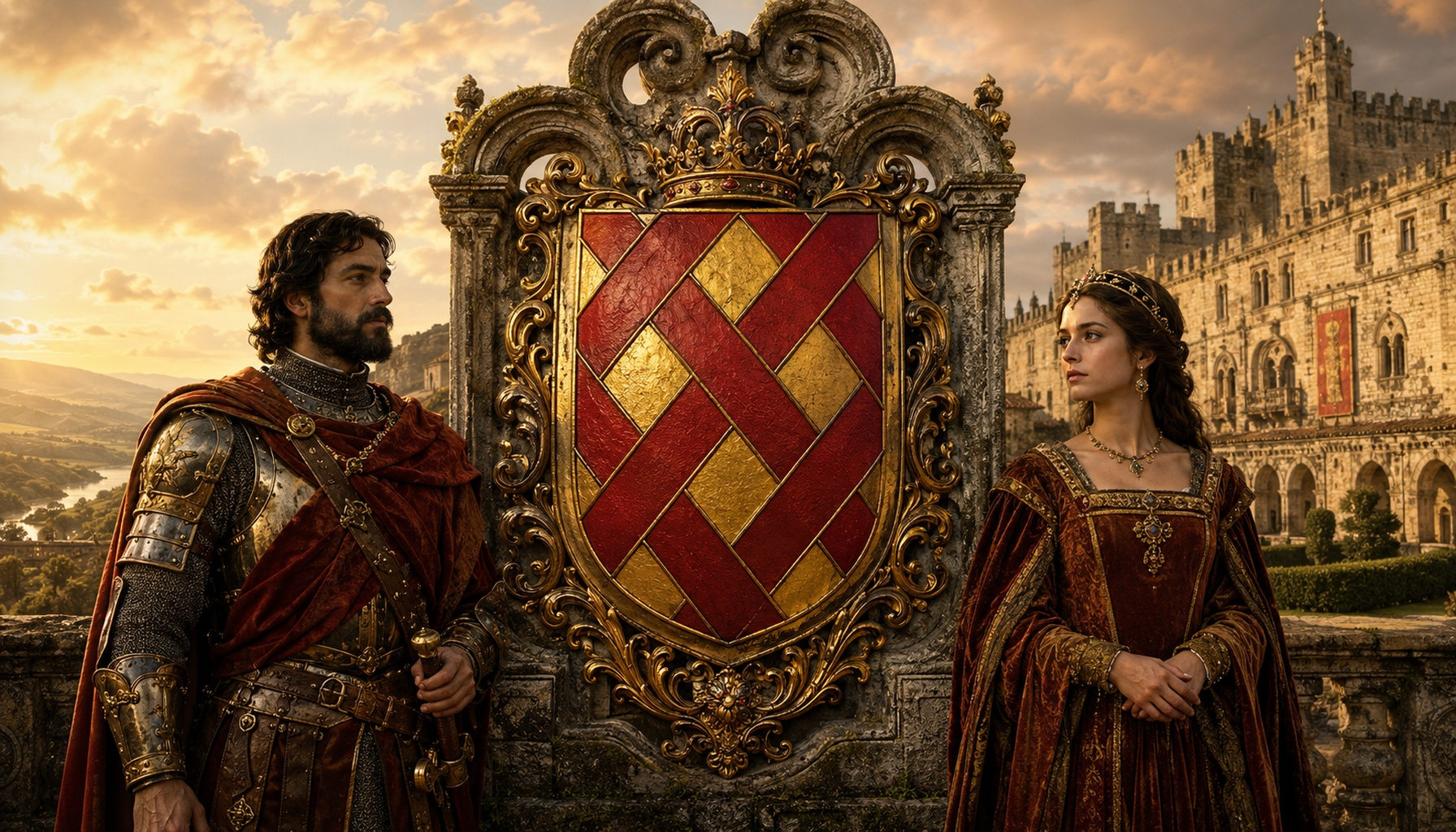
The House of de Correia belongs to the long and layered story of Portuguese and Iberian nobility: a family world built from regional roots, royal service, military duty, heraldic memory, landholding, and strategic marriage. In that sense the de Correia family is not just one lineage among many, but a very recognisable example of how noble identity worked in medieval and later Portugal. Their name is associated above all with Portugal, with service in frontier and crown affairs, and with the durable prestige of heraldic tradition. In genetic tagging terms, the primary family haplogroup linked here is R1b1a1b1a1a2c1a3, a branch found within the wider Atlantic and western European story.
The family background sits in the historic landscape of southern Portugal, especially the old frontier zone shaped by war, lordship, and the Christian expansion into lands long contested between Islamic and Christian powers. This was a world where noble houses rose through action as much as ancestry: holding fortresses, serving kings, fighting in military orders, and tying themselves to particular places that gave a family its public face. Among the best known figures of the name stands D. Paio Peres Correia, born around 1205 and dying in 1275, remembered as a major noble and master of the Order of Santiago, closely connected with the Reconquista in the south. He gives the de Correia name real historical weight: not merely a heraldic echo, but a family embedded in the practical business of conquest, rule, and regional authority.
A fitting location anchor for the de Correia story is the Castle of Mertola in the Alentejo, one of those places where Portuguese history feels almost compressed into stone. Mertola stands high above the Guadiana River, in a position that has mattered for centuries because it linked inland routes, river traffic, trade, defence, and political control. The site preserves layers from late antiquity, the Islamic period, and the Christian reconquest, which is exactly why it matters so much for understanding noble families formed in this frontier world. The present castle includes medieval fortifications and a keep associated with the period after the town passed into Christian hands in the 13th century, when Mertola became part of the wider restructuring of the south under royal and military-order authority. It is the sort of place that reminds us that noble houses such as de Correia were anchored not only in names and coats of arms, but in real strategic landscapes of walls, towers, rivers, and contested borders. Yes, it can still be visited today, and it remains one of the most evocative historic sites in Portugal for anyone interested in the medieval south.
For readers interested in deeper population history, the haplogroup tag R1b1a1b1a1a2c1a3 connects the de Correia profile to a broad network of ancient and medieval samples from Atlantic Europe and beyond. These are not evidence of direct descent from any particular excavated individual, and it is important not to pretend otherwise. Rather, they are related or linked reference points showing where this paternal line appears across time. Particularly striking are multiple Celtic Durotriges samples from Duropolis at Winterborne Kingston in England, including WBK12, WBK20, WBK29, WBK41, WBK05, WBK30, WBK43, WBK06, WBK08, WBK18 and WBK191. The same broader lineage also appears in Roman Era Cambridge Vicars Farm (VIC016), Dark Ages and Medieval Las Gobas in northern Spain (ldo039, ldo052, ldo242), Late Roman Conimbriga in Portugal (R10488), Roman villa Tarragona (I6492), post-Reconquista Granada (I3809), Iron Age and Bronze Age Britain from Kent, Wiltshire, Yorkshire, Somerset, Oxfordshire, Cornwall, Scotland and Orkney, as well as later contexts from Belgium, Germany, Ireland, Sweden, Hungary, Croatia, Austria, Iceland and even an antebellum Maryland burial identified as I8096. What this suggests, in broad terms, is that the de Correia haplogroup sits inside a very old western European male-line horizon, one that moved through Celtic, Roman, post-Roman, early medieval and medieval societies before appearing in later Iberian noble contexts. For a Portuguese house, that is rather apt: local in identity, but connected to a much wider Atlantic and European past.
If you are curious whether your own family story may connect with the wider world behind the House of de Correia, from Portuguese noble memory to deeper ancient-DNA links, upload your DNA to MyTrueAncestry and explore the matches for yourself.


Comments