Haplogroups and Noble Lines Haplogroup R1b1a1b1a1a2a1b1a At Wetwang Slack in East Yorkshire, two men dated to around 225 BC, sample IDs I36774 and I36777, carry the Y-DNA haplogroup R1b1a1b1a1a2a1b1a. That is a very precise paternal label, but the setting is broader and easier to picture: Iron Age Yorkshire, in territory associated archaeologically with the Arras culture By Jamie L • 5 min read
Haplogroups and Noble Lines Haplogroup R1b1a1b1a1a2c1a2a At Wetwang Slack in East Yorkshire, several men buried in the centuries just before the Roman conquest have become unexpectedly important for the history of one paternal line. Among them are I36970, I31009, and I30904, all dated to around 225 BC and associated with the Iron Age community often described By Jamie L • 5 min read
Haplogroups and Noble Lines Haplogroup N1a1a1a1a1a At Janakkala in Kanta-Hame, an early medieval burial dated to around AD 1190 produced an individual labelled JAN001. That find matters because it places the Y-DNA haplogroup N1a1a1a1a1a in a firmly northern setting at the close of Finland's medieval transition, when local communities were tied into both Baltic By Jamie L • 5 min read
Haplogroups and Noble Lines Haplogroup J2a1a1a2b2a2b2 At Amiternum in Abruzzo, two men buried in the early medieval cemetery of Santa Maria in Civitate, ASM_S34 and ASM_S35, offer the clearest starting point for thinking about Y-DNA haplogroup J2a1a1a2b2a2b2. They date to around AD 800 and AD 876, in a landscape where Roman urban life had By Jamie L • 5 min read
Haplogroups and Noble Lines Haplogroup H1a1a4b At Gonur in Bronze Age Turkmenistan, one ancient male sample stands out for anyone interested in haplogroup H1a1a4b: I10409, dated to around 2000 BC. Gonur was one of the major centers of the Oxus Civilization, also known as the Bactria-Margiana Archaeological Complex, a world of fortified settlements, irrigation, and long-distance By Jamie L • 4 min read
Haplogroups and Noble Lines Haplogroup R1b1a1b1a1a2c1a1n At West Heslerton in North Yorkshire, a cluster of Bronze Age men dated to around 1800 BC gives us an unusually focused glimpse of one paternal line in ancient Britain. The sample set includes KD070 and the closely associated individuals KD070_1, KD070_2, KD070_3, KD070_4, and KD070_ By Jamie L • 4 min read
Haplogroups and Noble Lines Haplogroup G2a2b2a1a1a1a At Mursa in Roman-era Croatia, one ancient man dated to around AD 200 appears in the record as sample I26753. On its face that is a small fact: one male burial, one Y-chromosome line, one point on the map of the empire. But it becomes more interesting when the paternal By Jamie L • 5 min read
Haplogroups and Noble Lines Haplogroup E1b1b1b2a1 At Viminacium in Serbia, the vast cemeteries of a major Roman city have been yielding a rather Roman lesson: empire was not a tidy ethnic box. One man from the Pirivoj necropolis, dated to around AD 225 and identified as I15502, carried the Y-DNA haplogroup E1b1b1b2a1. That matters because Viminacium By Jamie L • 5 min read
Haplogroups and Noble Lines Haplogroup J2a1a1b2a1b1 At Viminacium in Serbia, the great Roman city and military center on the Danube, one man buried in the Pirivoj necropolis around AD 225 appears in this record set as sample I15517. He is a useful place to begin because Viminacium was not some sleepy provincial corner. It was one By Jamie L • 6 min read
Haplogroups and Noble Lines Haplogroup R1b1a1b1a1a2a1a At Cherry Hinton in medieval England, one male dated to about AD 1055, sample ATP_PSN_950, carries the paternal line reported here as R1b1a1b1a1a2a1a. That bare fact is more interesting than it first appears. This is not a haplogroup pinned to one neat people, kingdom, or migration tale; instead, By Jamie L • 5 min read
Haplogroups and Noble Lines Haplogroup N1a At Minino in the Vologda region of Russia, one Mesolithic man dated to around 7618 BC, sample NEO538, preserves an unexpectedly important clue to the deep history of Y-DNA haplogroup N1a. Minino lies in the forest zone north of the great East European river corridors, and that matters. This is By Jamie L • 5 min read
Haplogroups and Noble Lines Haplogroup R1b1a1b1b1 At Offord Cluny in Roman Britain, a small cluster of men dated to about AD 177 has become unexpectedly important for the history of Y-DNA haplogroup R1b1a1b1b1. The individuals labelled C10271a, C10271f, C10271, and C10271h were identified as "outsiders" in the archaeological-genetic study of the cemetery: men who By Jamie L • 5 min read
Haplogroups and Noble Lines Haplogroup N1a1a1a1a3 At Kunpeszer in Hungary, an early seventh-century elite Avar grave identified as KUP003 has become one of the clearest signposts for the Y-DNA haplogroup N1a1a1a1a3 in the early medieval Carpathian Basin. The date, around AD 609, places this man in the first generations of Avar power in the region, when By Jamie L • 5 min read
Haplogroups and Noble Lines Haplogroup I1a2a2a At Trelleborg in the Kingdom of Denmark, one excavated Viking Age individual dated to about AD 975, sample CGG106824, has been associated with the Y-DNA haplogroup I1a2a2a. That is immediately interesting, not because one man can stand for all Vikings, but because Trelleborg is one of the most recognisable places By Jamie L • 5 min read
Haplogroups and Noble Lines Haplogroup I1a3a1 In the early 11th century, a high-status man was buried at Bodzia in central Poland. He is known to genetic researchers as VK157, and his grave has become one of the more intriguing windows onto the Viking Age world east of the Baltic. For anyone interested in Y-DNA haplogroup I1a3a1, By Jamie L • 5 min read
Haplogroups and Noble Lines Haplogroup H1a1a4b2a In 1493, in the city of Mechelen in present-day Belgium, several individuals buried at St. Rombouts left behind an unusually tight little cluster of evidence for the Y-DNA haplogroup H1a1a4b2a. The sample IDs STR025a, STR025b, STR025c, STR025d, STR025e, and STR025f all come from this late medieval setting. That is immediately By Jamie L • 5 min read
Haplogroups and Noble Lines Haplogroup R1b1a1a2a1a2 One of the clearest anchors for haplogroup R1b1a1a2a1a2 in this set of evidence is a man from medieval Sigtuna in Sweden: sample mbs092, dated to around AD 1100. Sigtuna was no obscure village. It was one of the first towns of the Swedish kingdom, a place where royal authority, Christianity, By Jamie L • 5 min read
Haplogroups and Noble Lines Haplogroup Q1b1b1 At Kumy in the Kharkiv region of Ukraine, one Early Iron Age individual dated to around 919 BC, sample UKR066, puts Y-DNA haplogroup Q1b1b1 in a setting that is immediately intriguing. This is a landscape of steppe movement, horse-based lifeways, and cultural contacts across the north Pontic zone, and yet By Sven • 4 min read
Haplogroups and Noble Lines Haplogroup R1a1a1b1a2b3a3a1a At Modling-An der Goldenen Stiege in the Vienna Basin, two men buried in the Avar period around AD 650 stand out for more than their chronology. Their sample IDs, MGS003 and MGS005b, place the very specific Y-DNA branch R1a1a1b1a2b3a3a1a in an early medieval frontier world where steppe power, post-Roman landscapes, By Sven • 5 min read
Haplogroups and Noble Lines Haplogroup E1b1b1a1b1a10 At Csokorgasse in the Vienna Basin, one early medieval burial stands out not because it was lavish or famous, but because it helps pin a very specific paternal line to a very unsettled century. The individual labeled CSK016, dated to around AD 650, belongs to the cluster of finds that By Sven • 5 min read
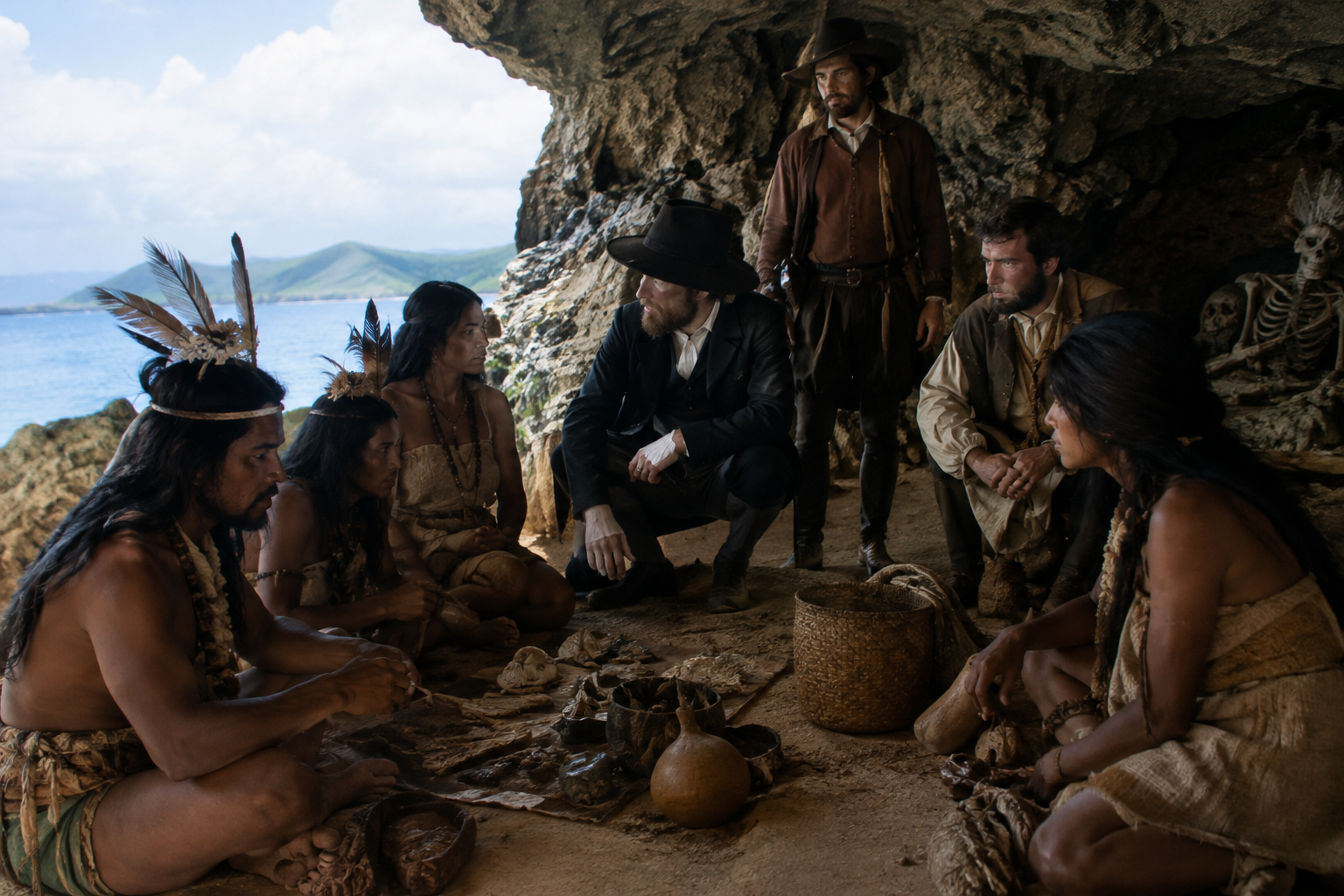
Haplogroups and Noble Lines Haplogroup Q1b1a1a1 At Lavoutte on St. Lucia, several men buried before European conquest carry a paternal line reported here as Q1b1a1a1. The dates are strikingly late: LAV001 is placed around AD 1169, while LAV002 and LAV003 fall around AD 1491, right on the edge of the Caribbean's world-changing encounter with By Sven • 4 min read
Haplogroups and Noble Lines Haplogroup C2b1a1b1 At Longtoushan in northern China, one ancient male identified as 91KLM2 carries us a very long way back. He belongs to the Upper Xiajiadian horizon, dated here to around 2700 BC, and he is the earliest sample in this set linked with Y-DNA haplogroup C2b1a1b1. That matters because it places By Sven • 5 min read
Haplogroups and Noble Lines Haplogroup I2a1b1b1 At Mon-Aime in northern France, a group of Neolithic burials from the late 4th millennium BC preserves an unusually clear little cluster for Y-DNA haplogroup I2a1b1b1. Two men from Mon-Aime hypogee I, samples 1H07 and 1H13, and two more from Mon-Aime hypogee II, 2H10 and 2H17, are dated to roughly By Sven • 4 min read
Haplogroups and Noble Lines Haplogroup Q1a2a1c At Berel in the Kazakh Altai, a cluster of burials spans a remarkable stretch of steppe history. Among the ancient men associated here with Y-DNA haplogroup Q1a2a1c are BRE002, dated to around 270 BC and identified with the Saka-Scythian world of the Pazyryk necropolis, BRE005 from about 50 BC at By Sven • 4 min read