Haplogroup N1a

– 5 min read


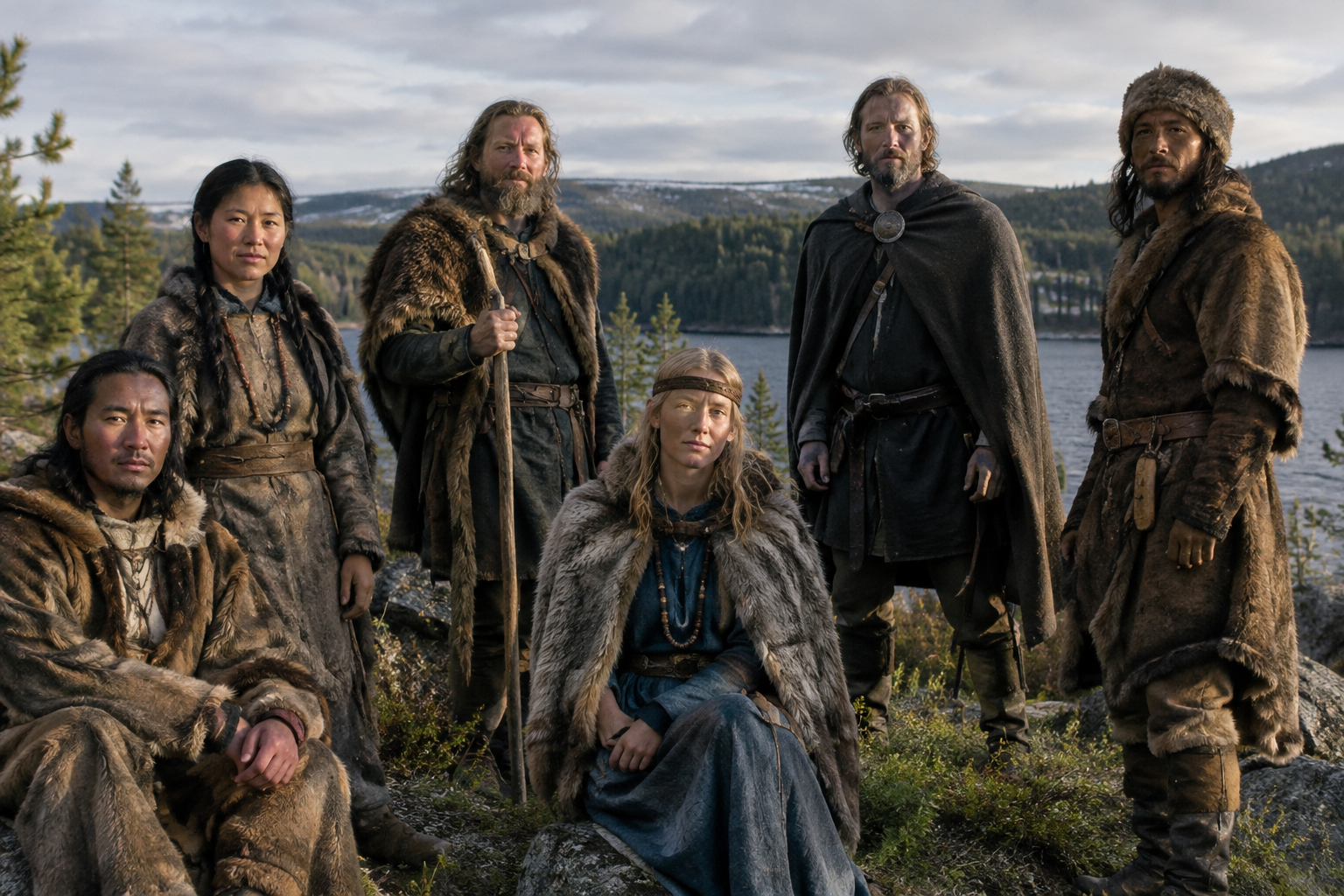
At Minino in the Vologda region of Russia, one Mesolithic man dated to around 7618 BC, sample NEO538, preserves an unexpectedly important clue to the deep history of Y-DNA haplogroup N1a. Minino lies in the forest zone north of the great East European river corridors, and that matters. This is not a steppe chieftain from a famous mound or a king from a named dynasty, but an early hunter-fisher from northern Eurasia whose paternal line helps place N1a in a world far older than medieval peoples and modern national borders.
That is really the striking thing about N1a in the ancient record supplied here: it appears first in prehistoric northern Eurasia, then later turns up across regions tied to Uralic-speaking and northeastern European histories, including Finland, Sweden, and the Trans-Ural zone. Y-DNA follows one direct paternal line only, not a person's whole ancestry, but when the same branch appears in widely separated northern settings, archaeologists have reason to pay attention.
The Minino find is the earliest sample in this group and so the natural place to begin. Around the eighth millennium BC, this was a landscape of lakes, rivers, forest resources, and mobile foraging communities. In that setting, NEO538 shows that a paternal line associated here with N1a was already present far to the northeast of the farming worlds that would later transform much of Europe.
This does not mean that one man from Minino can be made the ancestor of every later N1a lineage, nor that a single burial explains the entire spread of the haplogroup. But it does show that the history of this branch belongs in the long story of northern Eurasia, not only in later medieval ethnography. That point fits well with broader ancient-DNA work on northern populations, including research published in a major study of ancient genomes from Eurasia, which helped clarify how deeply structured these northern populations were over time.
Forest hunter-gatherers of ancient Russia
If Minino gives us age, the two Zjindo samples from Western Transbaikalia give us geography. NEO115, dated around 5600 BC, and NEO117, dated around 5706 BC, come from a region east of the Yenisei and west of Lake Baikal's broader sphere, in southern Siberia. That places N1a not just in the forests of European Russia, but also in the eastern reaches of northern Eurasia in the Neolithic period.
Again, one must be careful. A shared broad haplogroup label is not proof that the Zjindo men and the Minino man belonged to the same recent paternal clan. What the pattern does suggest is that lineages within or associated with N1a were part of a very wide northern zone stretching from eastern Europe into Siberia. That is exactly the sort of distribution that has made haplogroup N, and some of its descendant branches, so important in discussions of population history across the forest belt and Uralic-speaking regions.
The archaeological significance is straightforward enough. These are not isolated medieval curiosities. They show that the paternal ancestry later found in far northwestern Europe had older eastern roots or parallels in prehistoric Siberia. Research on ancient northern Eurasian populations has increasingly emphasized these long-distance connections, and the Zjindo samples fit that broader picture rather neatly.
Lake Baikal prehistory and ancient DNA
The next leap in time is a large one, but it is an illuminating one. Sample lov002 from Viken, Lovo, near Stockholm in Sweden, dated to around AD 520, places N1a in an Early Vendel Age Scandinavian context. That does not make N1a a specifically "Swedish" lineage, still less a marker of any single culture or language. It does show, however, that by the early first millennium AD, this paternal branch had become part of the human landscape around the Baltic.
This is a useful corrective to overly tidy maps of ancient ancestry. Early medieval Scandinavia was not genetically uniform, and neither were the communities around the Baltic Sea. A man carrying N1a in eastern central Sweden reminds us that Scandinavian history was shaped not just by movement westward into the Atlantic, but also by older and ongoing eastern and northeastern connections.
Those Baltic connections become even clearer in medieval Finland. Sample PKN009, described as a Medieval Finland outlier from Tavastia at Paelkaene and dated around AD 1250, shows N1a in a region where archaeologists and geneticists have long been interested in the meeting points of Finnic, Scandinavian, and broader northeastern European histories. Here the label "outlier" is important: it signals that this individual stood out in some way within the study context, and so should not be used as a shortcut for the entire population of medieval Tavastia.
Still, the appearance of N1a in medieval inland Finland is historically apt. Tavastia sat in a zone shaped by trade, frontier politics, and overlapping cultural worlds. An ancient DNA study focused on Finland's early medieval population history, discussed in research on ancient individuals from the region, has highlighted precisely this complexity.
Early medieval Finland and Baltic links
Sample Uyelgi16, dated around AD 900 from Uyelgi in the Trans-Ural region of Russia, is perhaps the most historically suggestive sample in this set. The Trans-Urals are exactly the kind of contact zone where forest, steppe, and Uralic-linked histories intersect. A paternal line classified here under N1a fits the broader impression that this haplogroup belonged to networks extending across northern Eurasia rather than to one neatly bounded people.
Uyelgi has attracted interest because sites in the southern Ural and Trans-Ural regions matter for understanding early medieval mobility, including movements connected with populations east of Europe proper. But caution is essential. N1a at Uyelgi does not automatically identify a language, an ethnicity, or a named tribe. What it does provide is another well-placed data point between Siberia and northeastern Europe, one that makes the long continuity of northern paternal lines harder to ignore.
Seen alongside Minino, Zjindo, Lovo, and Paelkaene, Uyelgi16 makes N1a look less like a regional oddity and more like a durable northern lineage appearing in different societies over many millennia. The contexts change dramatically: Mesolithic foragers, Neolithic Siberian communities, early medieval Baltic populations, and Trans-Ural groups. The paternal signal persists.
The southern Urals in early medieval history
So what kind of haplogroup story is this? Not a royal one, and not one that can be reduced to a single migration arrow on a map. The ancient evidence here places N1a in a northern Eurasian frame stretching from Mesolithic Russia to Neolithic Siberia and onward into the Baltic and Trans-Ural medieval world. That is a remarkable span, and it gives the haplogroup a distinctive archaeological character: old, northern, and repeatedly present in regions where eastern and northeastern connections mattered.
For someone researching N1a today, the most responsible takeaway is not that one can claim descent from any one ancient man, but that this paternal line has a demonstrably deep history across the forested north of Eurasia. In these samples, N1a appears not as a fleeting episode, but as part of a very long human presence linking Siberia, Russia, Finland, and Sweden across thousands of years.






Comments