Haplogroup R1a1a1b2a2

– 6 min read



At Wolkshausen in Germany, an Early Bronze Age man dated to about 2387 BC, sample RISE440, carries a clue to a lineage with a surprisingly long and mobile archaeological trail. He is one of the earliest individuals in this set associated with R1a1a1b2a2, a branch nested inside the wider R1a family that turns up again and again across later steppe worlds, from Andronovo horizons to Saka and Scythian burials, and on into the age of Huns, Gepids, Byzantines, and medieval nomads.
That does not mean one uninterrupted tribe, still less one ethnicity, marching across 3,000 years. Y-DNA tracks one direct paternal line only. But when the same paternal branch appears in such different archaeological settings, it becomes a useful thread: not a whole tapestry, but a stitch that helps hold several very large historical changes together.
The German finds matter because they place this lineage in a Central European Bronze Age setting quite early. Alongside RISE440 from Wolkshausen, there is also RISE434 from Tiefbrunn, dated to about 2680 BC. These are not steppe tombs in Kazakhstan or elite burials on the Eurasian grasslands, but individuals from Bronze Age Germany, showing that the paternal history behind R1a1a1b2a2 was already part of the wider world created by the great movements and mixtures of the 3rd millennium BC.
That wider background is familiar from ancient DNA research on Bronze Age Eurasia: expansions linked to steppe-derived ancestry, Corded Ware-related populations, and the complicated reshaping of Central and Eastern Europe. One major ancient DNA study of Eurasian population history helped establish just how important these Bronze Age transformations were for later paternal lineages, including branches within R1a, even though any exact downstream subclade must be handled carefully at sample level. See the broader context in this ancient DNA study of Eurasian population formation.
Late Bronze Age Central Europe
So the first thing this haplogroup article can say responsibly is that the branch has deep roots in the Bronze Age zone where Central Europe and the steppe were increasingly connected. That is historically important, because many later peoples who appear in written history as sharply distinct were, in genetic terms, drawing on populations already linked by much older movements.
The next strong cluster comes from the Bronze Age and early Iron Age steppe corridor. Sample I0507 from the Andronovo context in the Bayan-Zherek Mountains, dated to about 1750 BC, and I11541 from the Andronovo Culture at Georgievsky Bugor, around 1300 BC, show this paternal line in a setting often associated with the eastern spread of steppe pastoralist traditions.
The Andronovo horizon has long attracted attention because it sits at a major crossroads in Eurasian prehistory: metallurgy, herding, mobility, and connections running from the Urals toward Central Asia and southern Siberia. Finding R1a-related paternal lines here is hardly surprising in the broad sense, but what matters for this article is the narrower continuity of this particular reported branch across later eastern steppe groups.
By the Iron Age, that pattern becomes much clearer. Sample DA17, labelled simply as Eurasian Steppes Saka/Scythian and dated around 780 BC, sits neatly beside several more precisely located individuals from Kazakhstan: BIR007 from a Tasmola-period Scythian grave at Birlik in Pavlodar, dated about 781 BC; SHI009 from Shilikty in East Kazakhstan, around 650 BC; KOT001 from the elite Saka site of Koktubek II, also around 650 BC; and ESZ010 from Eleke Sazy, around 267 BC.
What is striking here is not simply one stray paternal lineage in one nomad burial, but repetition across several Saka and Scythian contexts in eastern Kazakhstan and the surrounding steppe. Research on Iron Age nomads has repeatedly shown that these communities were not biologically uniform; they were mixtures of ancestries shaped by earlier Bronze Age populations and later mobility. But the recurrence of this branch suggests that some paternal lines were quite durable within those eastern steppe societies.
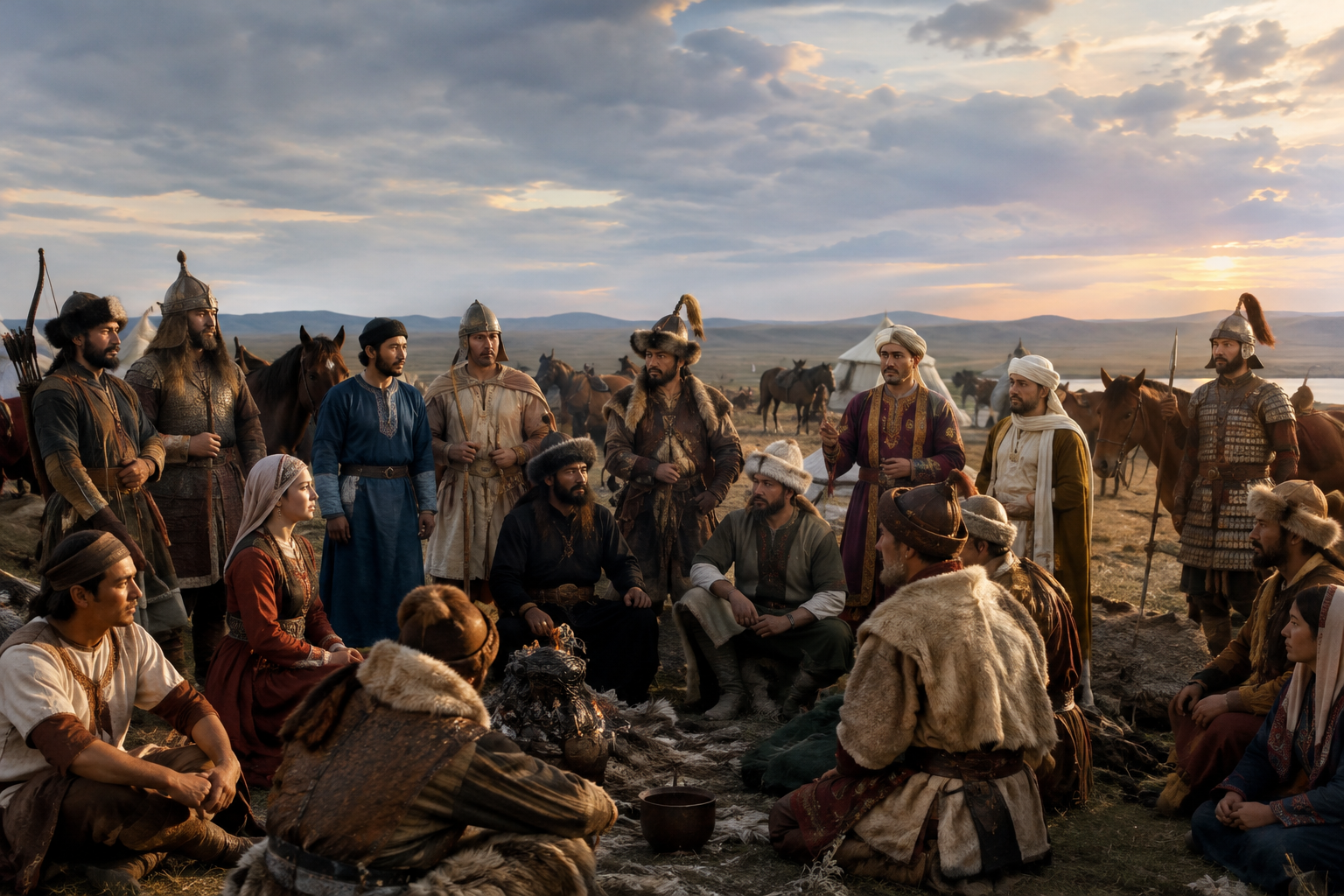
There is a temptation, whenever one sees a haplogroup repeated in Saka and Scythian graves, to talk as if a single "Scythian bloodline" has been found. That is far too simple. "Scythian" and "Saka" are historical and archaeological umbrella terms, used for a wide range of steppe peoples across enormous distances. They shared certain cultural features, but they were never one tidy genetic block.
Still, the eastern Kazakh samples do tell us something concrete. At sites such as Koktubek II and Eleke Sazy, lineages associated here with R1a1a1b2a2 appear in individuals connected to high-status or clearly steppe-nomadic contexts. That does not prove a ruling dynasty, but it does fit a pattern in which paternal lines from Bronze Age steppe-derived populations remained prominent among later Iron Age mobile elites and warrior communities.
A useful companion piece here is MyTrueAncestry's discussion of Scythian genetic origins, which explores the broader population picture behind labels that classical authors often made to sound far more uniform than they really were.
Another eastern example broadens the map further: CGG021496 from Aymyrlyg in southern Siberia, dated about 209 BC. Aymyrlyg has long been important for the archaeology of the steppe-forest frontier, and this sample shows that the lineage was not confined to one corner of Kazakhstan. It belonged to a bigger world stretching across the interior of Eurasia.
The later part of the sample set is a reminder that paternal lines can outlast dramatic political collapse. By late antiquity and the early medieval period, individuals associated with this branch appear in contexts tied to the Hunnic and post-Roman world of Central and Southeastern Europe.
One of the most eye-catching is HUNper3, described as a wealthy Hunnic male from Arpas-Szeruskert in Hungary, dated to about AD 450. Another is Pr10, a Sarmatian individual from southwestern Russia around AD 350. Neither sample should be treated as proof of a single ethnic essence for Huns or Sarmatians; both labels cover mixed populations and political confederations. But together they show this branch still circulating in the steppe-connected societies that pressed into, traded with, or ruled parts of late Roman Europe.
A particularly revealing case is I27296 from Jakovo-Kormadin near Belgrade, dated about AD 511 and classified to the Gepid period. This is exactly the sort of context where archaeogenetics has transformed the story. Older narratives liked to separate Romans and "barbarians" into neat boxes. The DNA evidence from post-Roman Europe keeps wrecking that tidy scheme. A paternal lineage with deeper Bronze Age and steppe associations can turn up in communities settled inside former Roman territory, showing how thoroughly mixed the frontier world had become.
That is one reason the later finds matter. They are not merely aftershocks of steppe migration. They belong to the remaking of Europe after empire, when military followings, federate groups, local provincials, and newcomers all interacted. MyTrueAncestry's article on Roman-Barbarian blending on the German frontier is useful here because it captures exactly this kind of entanglement.
A few samples in this set show just how far a paternal branch can travel without giving us permission to invent a simple migration tale. I12844, from Motya in western Sicily and dated about 195 BC in the Roman Republic era, places the lineage in a Mediterranean context far from the steppe heartlands usually associated with R1a-rich histories. I4475, from Byzantine-period Mardin in southeast Anatolia around AD 725, does something similar for upper Mesopotamia and the eastern Roman world.
These are reminders that by classical and medieval times, male lineages had been redistributed by trade, war, colonization, enslavement, marriage, and service in armies over many centuries. One ancient DNA paper on Iron Age nomads and their descendants has been especially influential in showing that steppe populations produced long-distance demographic effects that cannot be reduced to one event or one people; the research trail associated with these nomad burials can be followed in this study on Iron Age nomads of the Eurasian steppe.
The latest sample here, ZAM001 from Late Medieval Zambaga Khairkhan in Mongolia, dated about AD 1400, is almost a final flourish. Not because it proves continuity from every earlier individual, which it cannot, but because it underlines the geographical durability of the wider paternal tradition to which this branch belongs. Across the Eurasian interior, some lines remained stubbornly present through repeated political reorganization.
For someone researching R1a1a1b2a2, the most distinctive point is not a claim to one famous tribe or dynasty. It is the branch's repeated appearance in a chain of archaeological settings running from Bronze Age Central Europe into the Eurasian steppe, then onward into the mixed military and frontier societies of late antiquity and the medieval world. In other words, this is a lineage with a strong history in the great interaction zone between Europe and Inner Asia.
That is the proper historical value of the evidence: not romance, but reach. From RISE434 and RISE440 in Bronze Age Germany to Saka burials in East Kazakhstan and later Hunnic, Gepid, Byzantine, and Mongolian contexts, R1a1a1b2a2 looks less like the badge of one people than the durable paternal signature of several connected worlds.





Comments