Haplogroup R1a1a1b1

– 6 min read



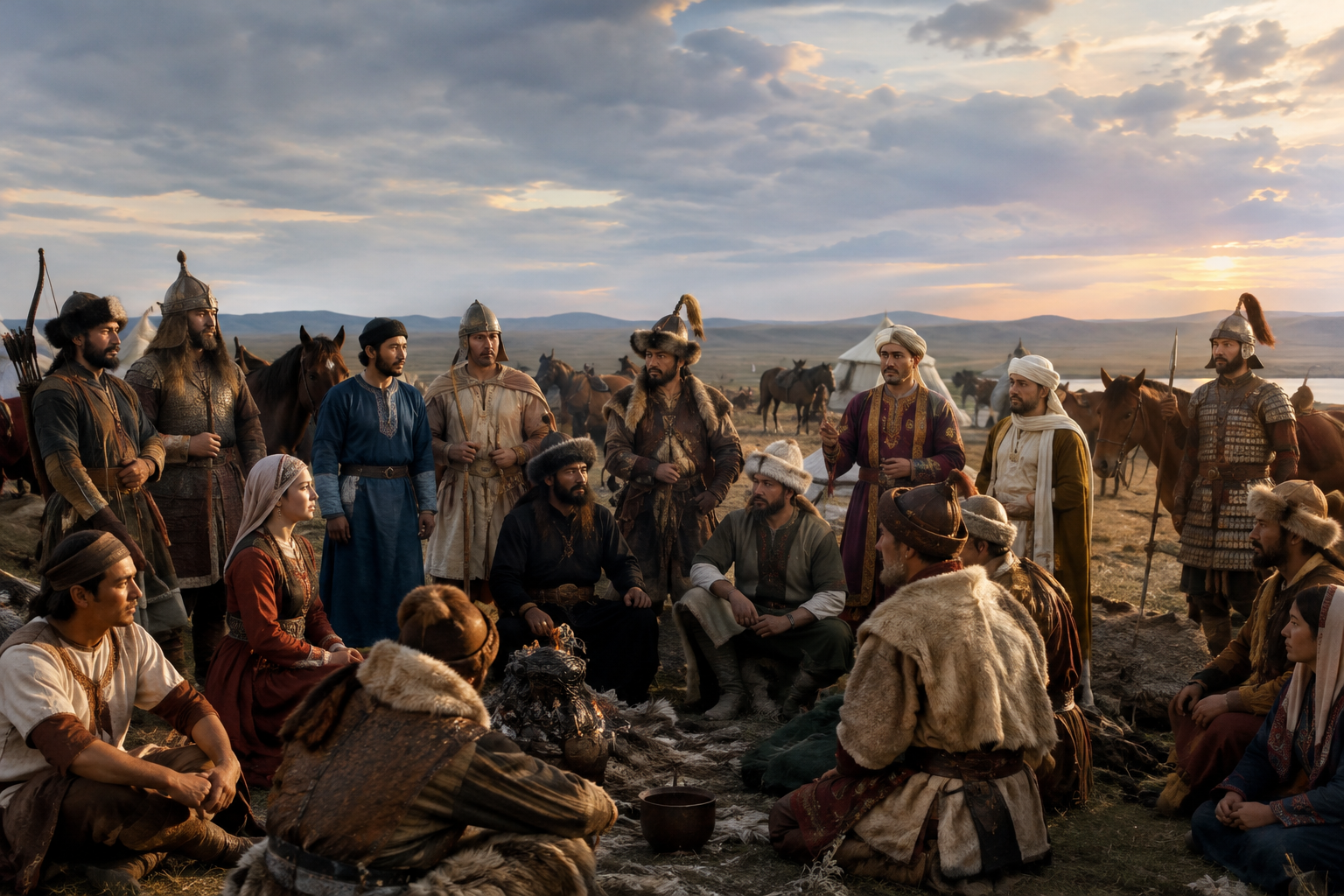
At Medvyn Tract Girchakiv Lis in central Ukraine, one Iron Age man dated to about 650 BC, sample UKR035AB, helps anchor a striking pattern for haplogroup R1a1a1b1. He is classified as Scythian, which immediately puts this paternal line into one of the most mobile and historically visible worlds of the first millennium BC: the horse-borne societies of the north Pontic steppe. That matters because this is not a haplogroup appearing in just one corner of medieval Europe. In the evidence here, it turns up in steppe, Central European Bronze Age, Baltic, and medieval Polish settings.
That does not mean every man carrying R1a1a1b1 belonged to the same people, spoke the same language, or shared the same way of life. Y-DNA follows one direct paternal line only. But when the same branch appears in burials spread from Bronze Age Austria and Germany to Scythian Ukraine, Piast-era Poland, and even conquest-period Hungary and the eastern steppe, it becomes historically interesting for exactly the right reason: it shows continuity of male lines across very different archaeological worlds.
The Medvyn individual, UKR035AB, sits in a region that was never a quiet backwater. The north Pontic zone linked forest-steppe, open steppe, the Black Sea coast, and the wider Eurasian interior. A study of mobility in ancient Ukraine, including this broad region, underlines just how connected these landscapes were across the Bronze Age and later periods; the point is not that one burial explains everything, but that the archaeological setting itself was a corridor of movement and mixture rather than an isolated homeland in research on the North Pontic crossroads.
For R1a1a1b1, UKR035AB is important because it places the lineage within a documented Scythian context in Ukraine. Scythian communities were not genetically uniform, and ancient DNA has made that plain again and again. Still, the appearance of this branch in an Iron Age steppe burial fits a broader picture in which some paternal lines associated with earlier eastern and central European populations continued into the nomadic and semi-nomadic societies of the first millennium BC.
If we move back in time, the sample list shows R1a1a1b1 in several Bronze Age settings west of the steppe. One of the clearest is LEU027, dated to about 1950 BC at Leubingen in Thuringia, Germany, within the Unetice world. Unetice was one of the great early Bronze Age societies of Central Europe, marked by emerging elites, long-distance exchange, and increasingly formal burial traditions. A paternal line found in such a context tells us that this branch was already embedded in the social landscapes of Bronze Age Central Europe long before classical authors ever wrote about Scythians.
Austria adds another early appearance. Sample DSH014, from Drasenhofen and dated to around 2000 BC, places the same broad branch in Lower Austria. Drasenhofen has also drawn attention for evidence connected with early plague research, and the archaeological discussion around the cemetery helps place these burials in a wider early Bronze Age setting rather than treating them as isolated genetic datapoints in research focused on the Drasenhofen graves. Nearby in chronology is poz790 from Hrebenne in the Lublin region of Poland, dated to about 2130 BC, along with poz556 from Zubowice and poz711 from Pielgrzymowice.
Taken together, these are not a tidy little clan story. They are something more archaeologically useful: repeated appearances of the branch across the Bronze Age belt running through Central Europe into east-central Europe. That suggests R1a1a1b1 was part of the paternal repertoire of communities shaped by the post-Corded Ware and early Bronze Age transformations of the region, even if the exact sub-branch history still needs careful resolution sample by sample.
Late Bronze Age Central Europe
The branch also appears further north. In Estonia there are two relevant individuals: 0LS11 from Harju Jelhtme, dated to about 974 BC, and V16, a Late Bronze Age Estonian sample dated around 660 BC. In Norway, CGG105610 from Sund belongs to the Early Nordic Bronze Age and is dated to about 1681 BC. There is also CGG107512 from Tybjerg Mose on Sjaelland in Denmark, dated to about 387 BC and described as Germanic Tribe Denmark.
These northern appearances matter because they show that R1a1a1b1 was not confined to one political or cultural horizon. Bronze Age Estonia and Norway were not Scythian, and they were not Piast Poland either. Yet the same paternal branch, or a lineage associated with it in the available classification, appears in all these settings. That is exactly the sort of pattern ancient DNA is good at revealing: not a single tribe marching across a map, but lineages persisting as cultures changed around them.
It also helps explain why Y-DNA results can feel both very specific and very broad. A man may belong to one exact paternal branch, but the archaeological history of that branch can cross many later ethnic labels. In the case of R1a1a1b1, the current sample set points strongly toward a long northern and east-central European presence, with steppe connections rather than a narrowly local story.
Baltic connections in the north
The medieval evidence is especially notable in Poland. Several individuals from Piast-era or Piast Dynasty contexts are associated with this haplogroup: PCA0393 from Santok on the Lubusz-Greater Poland border, PCA0216 from Greater Poland, PCA0564 from Milicz in Silesia, and PCA0317 from Plonsk in Masovia, all dated around AD 1100. That is not one stray burial. It is a cluster spread across regions central to the formation of the medieval Polish state.
This does not by itself prove that R1a1a1b1 was the Piast dynasty lineage in any simplistic sense; dynasties, courts, and kingdoms always included many unrelated men. But a concentration in Piast-era Poland is historically meaningful. It places the branch in the male population of a kingdom emerging from earlier Slavic and regional foundations into one of medieval Europe's durable polities.
Even more usefully, the Polish samples show how ancient DNA can connect broad political history with ordinary burial evidence. The Piast realm is often told through rulers, bishops, and wars. Here, by contrast, the genetic pattern is coming from excavated individuals in regional contexts. That makes the branch part of the lived demographic history of medieval Poland, not just a dynastic footnote.
Two later medieval and late antique finds widen the picture further. GYS048 comes from Arrabona, Szechenyi Square in Hungary and is dated to about AD 425, in Late Antique Pannonia. NDW013 comes from Niederwuensch in Sachsen-Anhalt, Germany, dated around AD 1100 and described as a western Slav settler. Both are frontier-zone finds in regions where political power, language, and identity were in flux.
The branch also appears in sample K2per36_GE from Karos II, dated to about AD 900 and associated with the Hungarian Conqueror period. Separate research on Y-chromosome haplogroups from Hun, Avar, and conquering Hungarian contexts has drawn attention to the diversity of paternal lines present in the Carpathian Basin during these centuries. That is the proper frame for this sample: not a magical ethnic signature, but one paternal lineage among the mixed populations involved in the making of early medieval Hungary.
Furthest east in this group lies NAI002 from Naimaa Tolgoi in Mongolia, dated to about AD 50 and classified as Late Xiongnu. This is perhaps the most provocative appearance in the whole set. One sample does not let us redraw the map of the Xiongnu world, but it does remind us that some paternal lines linked mainly in modern imagination with eastern Europe also circulated much further across the steppe zone. The Eurasian steppe was a zone of repeated contacts, absorptions, and political recombinations, not a set of sealed ethnic boxes.
For someone researching R1a1a1b1 today, the strongest insight from these ancient finds is not a single origin legend. It is the branch's repeated presence across Bronze Age Central Europe, the Baltic north, Scythian Ukraine, and medieval east-central Europe, with additional appearances in steppe-linked contexts farther east. In other words, this paternal line seems at home in the long history of the European and Eurasian north-east, especially in regions shaped by Bronze Age expansion, steppe interaction, and later Slavic and medieval state formation.
That is a good historical result: concrete, wide-ranging, and properly limited. It does not turn one Y-DNA line into a complete identity, but it does place R1a1a1b1 in a real archaeological landscape populated by Bronze Age villagers, Iron Age steppe peoples, frontier settlers, and medieval Poles.





Comments