Haplogroup N1a1a1a1a3a2

– 5 min read



At Kunszallas-Fulop Jakab in Hungary, a cluster of men buried in the Avar period around AD 650 has become one of the clearest signposts for the Y-DNA haplogroup N1a1a1a1a3a2. The site is striking not because it gives us one famous individual, but because it gives us many: KFJ021, KFJ013, KFJ017, KFJ025, KFJ020, KFJ010, KFJ048, KFJ050, KFJ024, KFJ030, KFJ040, KFJ012, KFJ044, KFJ007, and KFJ016 are all associated with this same paternal branch in the material provided here.
That concentration matters. Y-DNA tracks one direct paternal line only, not a whole person's ancestry, but when the same branch appears repeatedly in one cemetery and period, it suggests that a particular male lineage was strongly represented in that local Avar-era community. In this case, the pattern points us toward the steppe-facing world of the early medieval Carpathian Basin, where political power, migration, military organization, and family structure were all being renegotiated after the collapse of Roman authority.
Kunszallas-Fulop Jakab stands out because the evidence is not a lone curiosity. It is a repeated signal from a single Avar-period burial ground in Hungary, dated here to around AD 650. Even with no need to invent grave stories or kinship charts, that sheer repetition tells us something important: haplogroup N1a1a1a1a3a2 was not an accidental arrival represented by one isolated man, but part of a broader paternal presence at the site.
This is precisely the sort of pattern ancient DNA is good at exposing. Archaeology can show us a cemetery, a date, and a cultural setting. Genetics adds another layer, showing whether the men buried there were drawing repeatedly from the same paternal background or from a more mixed pool. At Kunszallas, the answer appears to be emphatically repetitive.
An ancient DNA study of Avar-period elites and related communities in the Carpathian Basin helped bring this wider picture into focus, linking some early Avar groups to eastern Eurasian and steppe-connected ancestry patterns rather than treating the Avar realm as a simple, uniform population. That broader research context is important for understanding why a lineage like N1a1a1a1a3a2 appears so prominently in this setting: research on Avar-period genomes has shown that at least some sectors of Avar society preserved strong eastern connections.
European Huns and eastern steppe origins
The name is a mouthful, but the important point is that N1a1a1a1a3a2 is a very specific sub-branch within the wider haplogroup N family. One should be careful here. The broad N umbrella has a long and varied history across northern Eurasia, and it would be bad history to dump all of that vast geography onto this narrower branch without direct evidence.
What the present samples do allow us to say is more focused: this subclade appears here in an early medieval Avar context in Hungary, and it also appears in other Avar-associated individuals listed from the same century. So for this article, the historically secure setting for N1a1a1a1a3a2 is not a vague map of all northern Eurasia, but a specific moment in the seventh-century Carpathian Basin, among communities tied to the Avar world.
That is already interesting enough. The Avar Khaganate was one of the great powers of early medieval Europe, sitting at the junction of the steppe, the Balkans, and central Europe. A paternal branch that turns up repeatedly inside that political sphere belongs to a story about power and population movement, not merely about distant prehistoric origins.
Kunszallas is not alone. Another listed individual, SZOD1-554 from Early Avar Period Szegvar-Oromdulo, dated here to around AD 650, shows that the branch was present beyond one cemetery. That matters because it broadens the picture from a single burial ground to a wider Avar-period landscape within Hungary.
Szegvar-Oromdulo has long been important to archaeologists studying the early Avar period on the Great Hungarian Plain. When a haplogroup appears at both Kunszallas and Szegvar, the question shifts. We are no longer asking whether one local family carried this line. We are asking how widely this paternal branch circulated within Avar-period communities, and whether it was linked especially to particular social groups, migrant strata, or regional networks.
One should not leap from two sites to a grand ethnic formula. Still, the recurrence across named Avar-period contexts is enough to suggest that N1a1a1a1a3a2 formed part of a real and recognizable paternal component in the population of the khaganate's Hungarian heartland.
The most socially pointed sample in the list is A1801, described as a High Ranking Elite Retinue of Khagan from Avar-period Budapest, again around AD 650. Now that is a genuinely useful detail. It does not prove that every bearer of N1a1a1a1a3a2 was noble, militarily important, or close to the ruling house. But it does show that this paternal branch could appear in a highly placed Avar context.
That is the kind of clue historians like, because it joins social rank to genetic pattern without forcing certainty where none exists. If the same lineage is present in a high-ranking retinue member and in multiple men from Kunszallas, then N1a1a1a1a3a2 belongs within the lived structure of Avar power, not simply at its fringes.
Another study relevant to the early medieval Carpathian Basin has explored elite burials and steppe-connected ancestry in Hungary more broadly, helping frame how such lineages persisted and reappeared in later medieval contexts: research on elite and conquest-period genomes in Hungary. Even where the precise historical episodes differ, the larger lesson is similar: the Carpathian Basin repeatedly absorbed, preserved, and reshaped eastern-linked paternal lines across centuries.
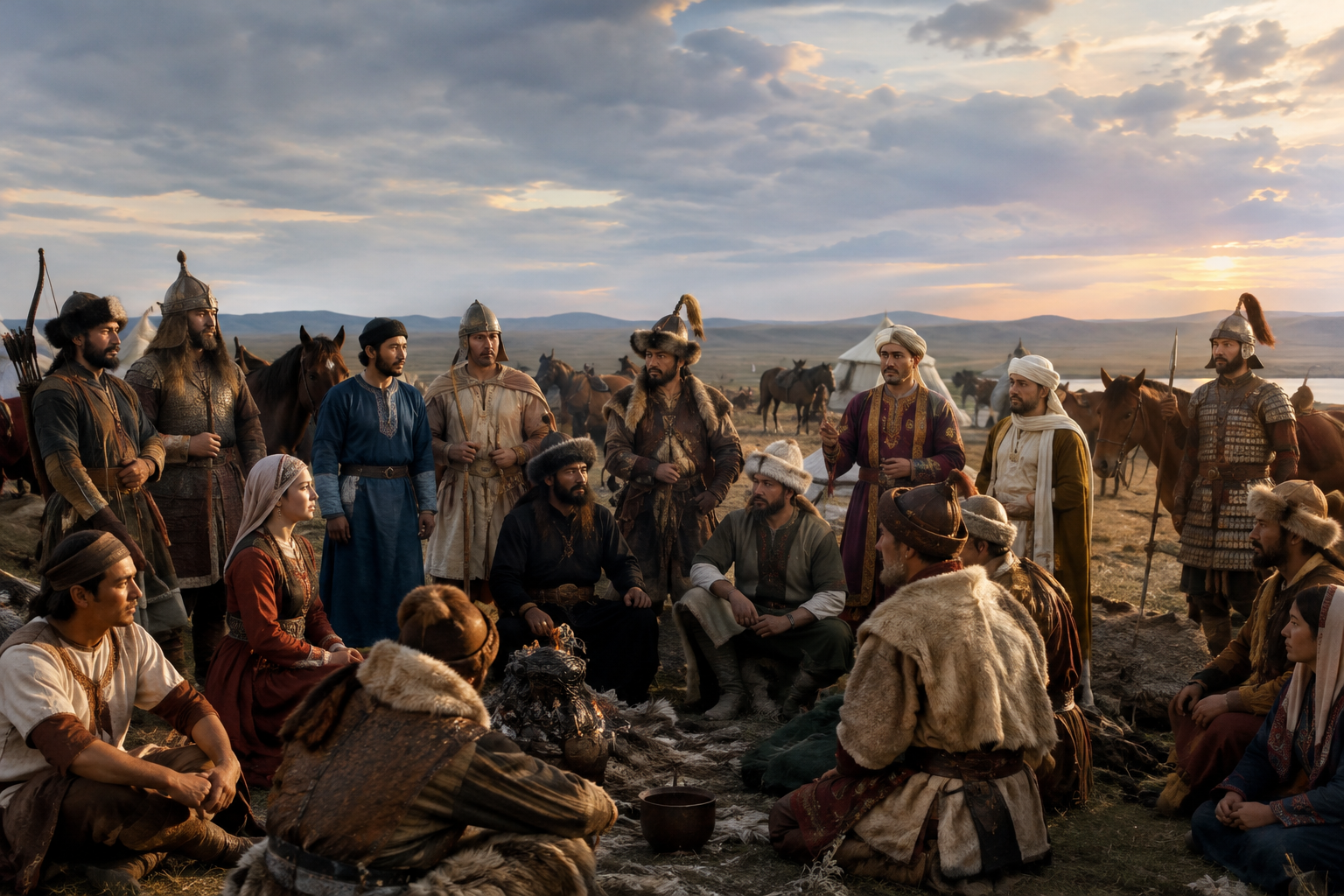
The Avars arrived in central Europe in the later sixth century and established a khaganate that endured for more than two hundred years. Written sources describe them through the eyes of their rivals, especially Byzantines and Franks, which means the historical picture can be oddly flat: mounted warriors, raiders, khagans, tribute. Archaeology and DNA make that picture less stereotyped and more human.
A cemetery such as Kunszallas shows that the Avar world was not merely a passing war band. It had communities, local continuity, and repeated paternal lines. The appearance of N1a1a1a1a3a2 in so many men from one site suggests stable male descent groups embedded in the Avar-period population of Hungary.
That in turn helps correct an old habit in history writing, which was to treat steppe polities as if they appeared suddenly and vanished just as suddenly, leaving little demographic trace. These burials suggest something more grounded: some paternal lines connected with the Avar sphere were established enough to be archaeologically visible within cemetery populations.
Medieval Hungary's elite genomes
For someone who belongs to N1a1a1a1a3a2 today, these ancient samples offer a rather crisp historical association. The branch is documented here in multiple seventh-century Avar-period men in Hungary, including individuals from Kunszallas-Fulop Jakab, an early Avar burial at Szegvar-Oromdulo, and one man from a high-ranking elite retinue in Budapest. That does not make every modern carrier "Avar" in any simple sense, but it does place this paternal line firmly inside the political and demographic world of the early medieval Carpathian Basin.
In other words, this is a haplogroup with a visible foothold in one of Europe's great steppe-era societies. Not a legend, not a costume-drama fantasy, but a set of excavated men with sample IDs, dates, and places.





Comments