Haplogroup R1b1a1b1a1a2a1b1a

– 5 min read


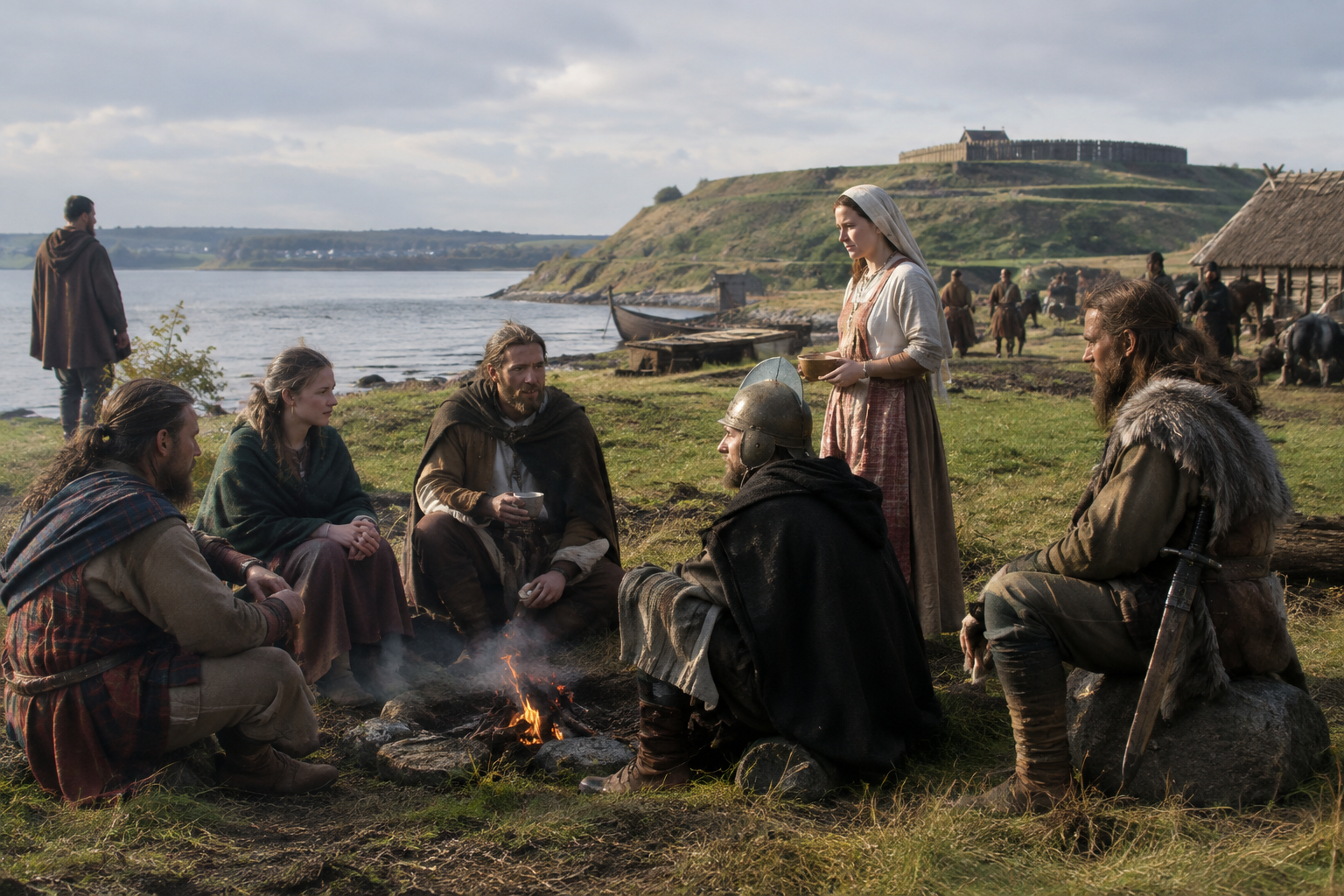
At Wetwang Slack in East Yorkshire, two men dated to around 225 BC, sample IDs I36774 and I36777, carry the Y-DNA haplogroup R1b1a1b1a1a2a1b1a. That is a very precise paternal label, but the setting is broader and easier to picture: Iron Age Yorkshire, in territory associated archaeologically with the Arras culture and historically with the Parisi. What matters here is not a fantasy of tribal purity, but the fact that the same paternal branch appears more than once in a tightly defined Iron Age landscape.
That makes Wetwang Slack a useful place to begin. Y-DNA follows one direct male line only, not a whole person's ancestry, yet repeated appearances of the same branch in Iron Age Britain give us something concrete to work with. In this case, the story does not stay in Yorkshire. The same lineage also turns up in Iron Age Hampshire, in northern France, in Viking Age Denmark, and even in a 17th-century colonial cemetery in Maryland. The result is not a neat tale of one people marching across Europe, but a more interesting pattern of continuity, movement, and survival.
Wetwang Slack has become one of the most important windows onto Iron Age eastern Yorkshire. The two men identified here, I36774 and I36777, belong to the Celtic Parisi setting of the region, and their date around 225 BC places them in the later pre-Roman Iron Age. The significance of their shared Y-line is modest but real: it suggests that this branch was present among men living in that local community, rather than appearing as a one-off stray result.
That matters because eastern Yorkshire has long occupied a special place in British archaeology. Burial customs in this region, especially the famous Arras culture tradition, have prompted decades of debate about continental links, local development, and elite identities. A recent ancient DNA study of Iron Age Britain, linked to some of these discussions, has helped sharpen the picture by showing that kinship, mobility, and ancestry patterns in Britain were often more locally textured than older grand narratives allowed. For readers interested in that wider context, see Ancient DNA and matrilineal kinship in Iron Age Britain.
We should be careful, though. Two men from one site do not prove a ruling dynasty, nor do they define the whole Parisi population. But they do show that this branch of R1b was embedded in Iron Age eastern England before Rome, and that is already more historically useful than vague claims about "Celtic DNA".
A second British appearance comes from sample I20982, dated to around 250 BC from the Iron Age hill fort at Suddern Farm in Hampshire. Now the picture broadens geographically. We are no longer in Yorkshire but in southern England, and that matters because it suggests that the paternal branch was not confined to one regional pocket.
Hill forts in southern Britain were not all the same, nor were they permanently occupied in identical ways, but they sit squarely within the social world of later prehistoric Britain: defended places, focal sites, and landmarks in landscapes shaped by farming, exchange, and status competition. Finding the same haplogroup in both East Yorkshire and Hampshire hints that this paternal line belonged to the wider male population of Iron Age Britain, or at least to several communities spread across it.
This is where ancient DNA becomes especially useful to archaeology. It does not replace artefacts or landscapes; it adds another layer. A hill-fort-associated man in Hampshire and two men from Iron Age Yorkshire need not have shared language, politics, or immediate ancestry in any simple way. But their shared branch tells us that a paternal line within the wider R1b family was present across distinct parts of pre-Roman Britain.
Another sample, I21399, dated to around 250 BC, comes from Chemin de Coupetz in Marne, France, in a Gallic context. This is perhaps the most intriguing comparison in the set, because it places the same haplogroup on both sides of the Channel in the later Iron Age. It would be tempting to turn that into a dramatic migration story. Better not.
What can safely be said is that R1b1a1b1a1a2a1b1a appears in Iron Age communities in both Britain and northern Gaul, and that this fits a larger archaeological reality: the Channel was not a hard barrier. Goods, styles, people, and ideas moved back and forth. Whether the line spread earlier, whether it reflects Late Bronze Age roots, or whether particular families crossed in the Iron Age is another matter, and this evidence alone cannot decide it.
Still, the cross-Channel pattern is striking. Research on ancient population history in Britain and nearby parts of Europe has repeatedly shown that later prehistoric identities emerged from deep local roots mixed with periodic movement and contact. One important study in this field is this ancient DNA research on the genomic history of Britain, which helps frame why an Iron Age lineage can be both locally established and part of a broader northwest European story.
For a wider discussion of how genetics intersects with arguments about Celtic dispersals, another relevant MyTrueAncestry feature is below.
The lineage does not disappear with the Roman world. Sample VK87, dated to about AD 875, comes from Hesselbjergmarken in Denmark in a Viking context. That is a large chronological jump, and one must resist the urge to draw a single unbroken historical line from Gallic or British Iron Age men to one Viking Age individual. But the Danish result shows that this paternal branch remained in circulation in northern Europe many centuries later.
This is exactly the sort of finding that makes haplogroup history both useful and slippery. Useful, because it tracks one line over long stretches of time; slippery, because the societies involved changed beyond recognition. By the time of VK87, the world was one of Scandinavian seafaring, raiding, trading, and settlement. The same Y-line now lived inside a very different cultural order.
That does not mean the lineage was "Viking" in origin. It means that one branch within the wider R1b spectrum was present among Viking Age men in Denmark, just as it had earlier been present among Iron Age men in Britain and Gaul. If you want to place this in a broader Scandinavian genetic setting, see the MyTrueAncestry article on Viking Age genetics.
The most recent sample in this group is I35265 from the Chapel Field Cemetery at Historic St. Mary's City, Maryland, dated to around AD 1634. Here the story shifts dramatically again. We are in the early English colonial Chesapeake, where European settlers, Africans, and Indigenous peoples were drawn into a harsh and rapidly changing world.
In this context, the haplogroup is a reminder that colonial populations carried deep Old World paternal histories with them. A man buried in 17th-century Maryland might belong to a lineage already attested in Iron Age Britain and Gaul and later in Viking Age Scandinavia. That does not identify his surname, region of origin, or social status by itself. But it does show how ancient European paternal branches were transplanted into Atlantic colonial settings.
MyTrueAncestry has covered this cemetery's broader significance in The genetic legacy of the 17th-century colonial capital of St. Mary's City, which is the right sort of comparison here: not a claim of direct descent from any one ancient man, but an example of how lineages persisted through enormous historical change.
On the evidence here, R1b1a1b1a1a2a1b1a looks like a northwest European paternal branch with clear ancient appearances in later Iron Age Britain and Gaul, a later presence in Viking Age Denmark, and survival into the early colonial English Atlantic. The most distinctive point is not prestige or mythic antiquity, but repeated visibility in real archaeological settings tied to major chapters of European history: pre-Roman Britain, continental Celtic Europe, the Viking world, and colonial North America.
If this is your Y-line, the responsible takeaway is that your direct paternal ancestry may belong to a branch long established in the North Sea and Channel worlds. That is a historically rich zone: one of local continuity, cross-Channel contact, and later migration overseas.






Comments