Haplogroup E1b1b1a1b1a10

– 5 min read


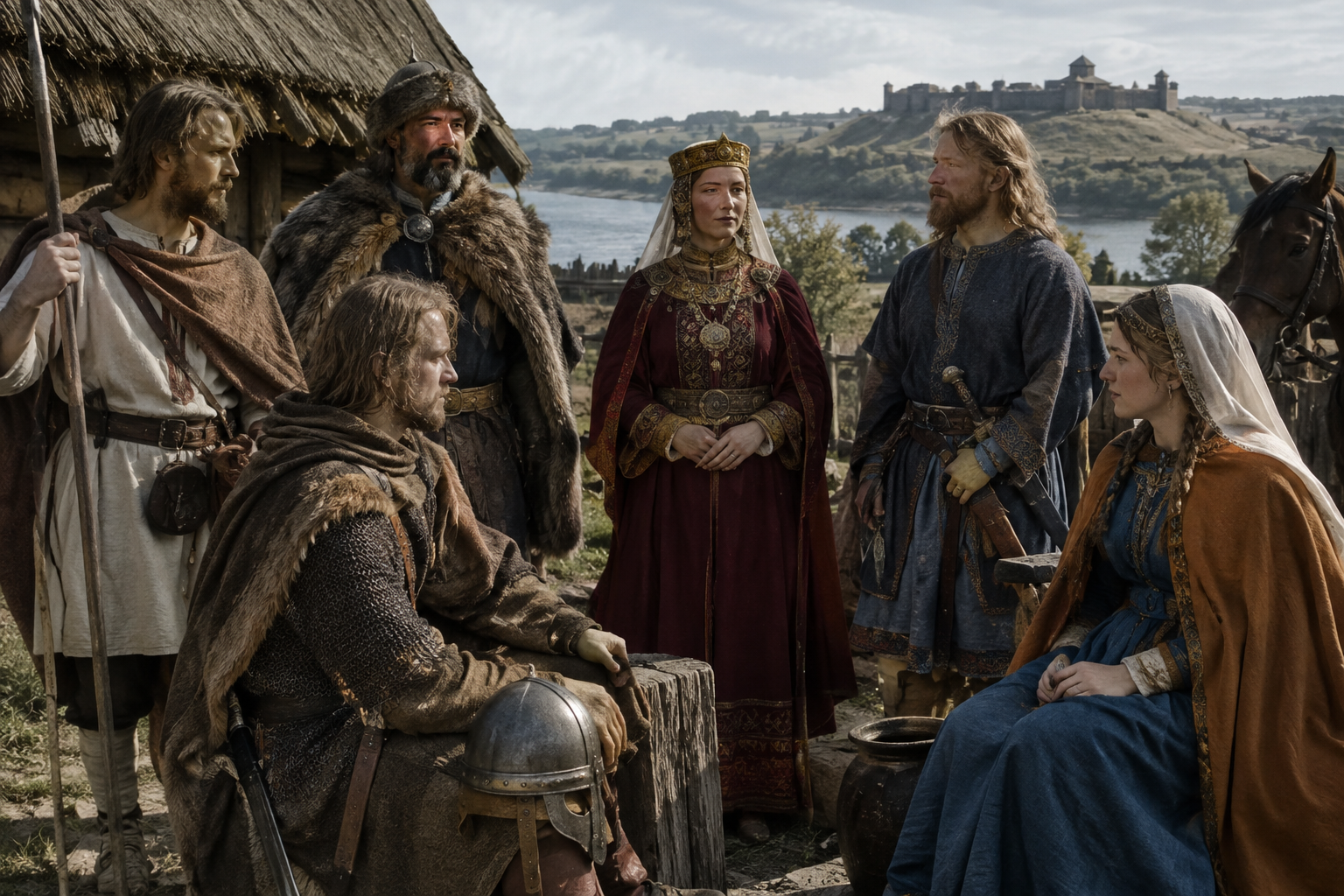
At Csokorgasse in the Vienna Basin, one early medieval burial stands out not because it was lavish or famous, but because it helps pin a very specific paternal line to a very unsettled century. The individual labeled CSK016, dated to around AD 650, belongs to the cluster of finds that place Y-DNA haplogroup E1b1b1a1b1a10 in the Avar-period world of the Middle Danube.
That matters because this is not a lineage turning up in only one grave or one neat ethnic box. In the small set of ancient examples linked here, the same haplogroup appears in early medieval Austria, in elite-period burials in Hungary, in central Germany around the Migration Period, and later in medieval western Ukraine. Y-DNA traces one direct paternal line only, not a person's whole ancestry, but even so, this is a striking distribution: not a single isolated point, but a chain of appearances across the post-Roman and medieval heart of Europe.
The best place to begin is the Vienna Basin, where two of the listed samples come from closely related historical ground: CSK016 from early medieval Austria at Csokorgasse and MGS006 from an Avar Period grave at Moedling-An der Goldenen Stiege, both around AD 650. This was a frontier zone in the broadest sense: once Roman, then drawn into the political world shaped by the Avar Khaganate, neighboring Slavic groups, and the remains of older provincial populations.
That is exactly the sort of landscape where archaeology and genetics have become especially revealing. A major ancient DNA study of the region and period, published on early medieval populations connected with the Carpathian Basin, helped show just how mixed these communities could be. What older histories described in large collective labels, the graves increasingly break down into households, local communities, newcomers, descendants of earlier inhabitants, and people whose identities were likely political or social as much as biological.
So when haplogroup E1b1b1a1b1a10 appears here, it should not be read as a badge of one simple ethnic origin. Rather, it is evidence that this paternal line was present within the networks that tied the Vienna Basin to the wider Danubian world in the seventh century.
The most socially loaded sample in this group is RKC041, described as Avar Elite from Rakoczifalva in Hungary, again around AD 650. The phrase "elite" tends to invite grand stories, but here caution is important. A prestigious burial context does not mean that a haplogroup was the lineage of an entire ruling people, nor that every man in power shared the same paternal ancestry.
Still, the presence of E1b1b1a1b1a10 in an elite-period Avar context is important. It shows that this line was not confined to one social level or one marginal edge of settlement. It could appear in burial populations associated with the centers of early medieval power in the Carpathian Basin, a region that brought together steppe-derived political traditions, local European populations, and migrants moving through the remains of the Roman world.
This also fits a broader lesson from Avar-period archaeogenetics: rank and ancestry do not map onto each other in a tidy way. Some burial groups show strong eastern connections, others much more local or mixed profiles. A paternal line like E1b1b1a1b1a10 may therefore mark participation in that world without telling us, by itself, whether its bearers came recently from afar or belonged to a lineage already established in the region.
The chronology becomes more interesting when we move slightly earlier and westward. Two samples tied to this haplogroup are listed from Germany around AD 500: OBM013 from Obermoellern, associated with the Thuringii, and RTW003 from Rathewitz in Saxony-Anhalt, described more broadly as Migration Period.
These finds matter because they show that the line was already present in central Europe in the generations when Roman imperial control in the west had collapsed and new kingdoms were taking shape. The Thuringii were one of several political groupings emerging in that world, and the Rathewitz burial belongs to the same broad age of mobility, alliance, and reorganization. This is not the clean march of a single people; it is a patchwork of communities under pressure and in contact.
If anything, these German samples make the Austrian and Hungarian evidence more convincing. They suggest that the appearance of E1b1b1a1b1a10 in the Middle Danube was not a one-off anomaly. The paternal line was part of the wider human landscape of central Europe during the fifth to seventh centuries, exactly when written sources become noisier and archaeology more indispensable.
For readers interested in how mixed such frontier and post-Roman communities could be, the German-side picture is explored from another angle in this related feature on Roman-Barbarian blending on the German frontier, 400-700 CE.
The latest sample in this set, KRW002, comes from Korolivka in Ukraine and is dated to around AD 1250, within the era of the Principality of Halych-Volhynia. By this point we are well beyond the Migration Period and the Avar age. The political map had changed repeatedly; trade, dynastic connections, warfare, and ecclesiastical networks had all redrawn eastern Europe's human geography.
Yet the same paternal branch appears again. This does not prove an unbroken local dynasty, but it does suggest durability. A lineage seen in central Europe around AD 500-650 was still present in a medieval polity to the east some six centuries later. That kind of persistence is one of the most useful things ancient Y-DNA can show: not fame, but survival.
The sample also sits neatly beside wider discussions of medieval mobility in the northern Black Sea and adjacent regions. Anyone following these movements into eastern Europe may find useful context in this MyTrueAncestry post on Ancient DNA and Migrations in the Northern Black Sea Region.
The awkwardly long name matters. E1b1b1a1b1a10 is a narrow branch within the much broader E1b1b paternal family, a lineage with a deep history stretching across parts of Africa, the Mediterranean, and western Eurasia. But one must not simply import the entire story of E1b1b into this more specific subclade. The ancient evidence here is far narrower and much more historically situated.
What the listed samples show securely is an early medieval concentration in the Middle Danube and central Europe, with one later medieval appearance in western Ukraine. That pattern may reflect older Mediterranean or Balkan-connected movements somewhere further back in time, but these particular graves do not let us specify a single route. They do, however, show that by the post-Roman centuries this paternal line was fully part of Europe's lived history north of the Alps and across the Carpathian world.
There is also a practical point here for anyone comparing ancient matches. A precise modern haplogroup label can look as if it should map directly onto one ancient people, one language, or one royal house. The archaeology says otherwise. The same branch can pass through different cultural settings, and the same cemetery can contain multiple paternal histories.
Balkan Roots and Medieval Mixing
For E1b1b1a1b1a10, the ancient trail is not enormous, but it is unusually suggestive. Instead of a single glamorous burial, we have a sequence: central Germany around AD 500, the Vienna Basin and Rakoczifalva around AD 650, and Halych-Volhynia around AD 1250. That is enough to place this paternal line inside some of the most important reshufflings of European history: the end of Roman order, the formation of post-Roman societies, the Avar-period Middle Danube, and the medieval east-central European world.
For someone researching this haplogroup today, the strongest supported takeaway is not a claim to one tribe or one kingdom. It is that this paternal line appears in real archaeological communities spread across central and eastern Europe, especially in the centuries when populations, allegiances, and identities were being remade.






Comments