Haplogroup R1a1a1b1a2b3a3a1a

– 5 min read


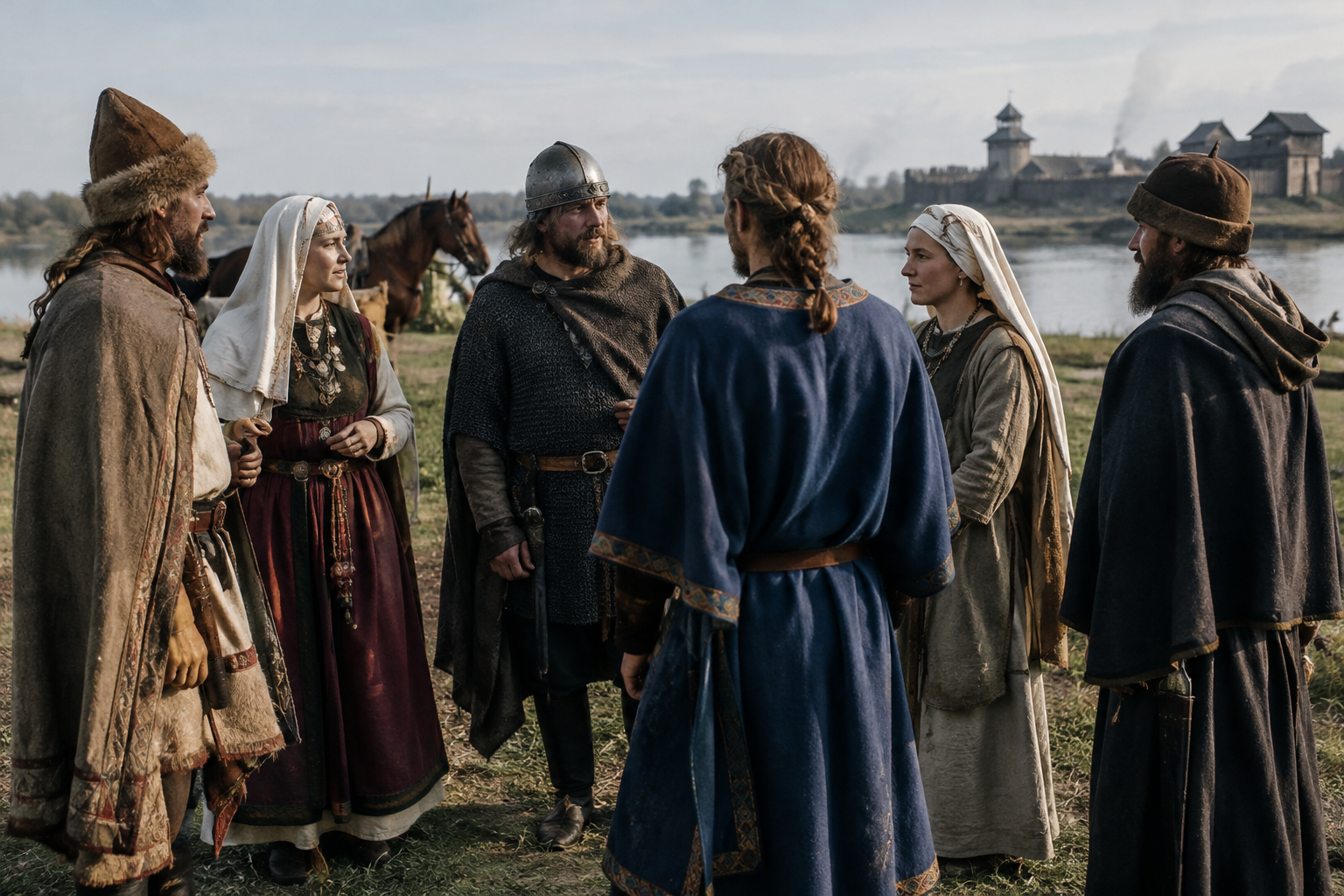
At Modling-An der Goldenen Stiege in the Vienna Basin, two men buried in the Avar period around AD 650 stand out for more than their chronology. Their sample IDs, MGS003 and MGS005b, place the very specific Y-DNA branch R1a1a1b1a2b3a3a1a in an early medieval frontier world where steppe power, post-Roman landscapes, and local European communities met each other face to face. That is already an interesting combination: not a lineage sitting still in one neatly bounded people, but one turning up where empires and migrations overlapped.
The branch name is forbiddingly long, but the historical point is simple enough. This is a narrow paternal line within the much broader R1a family, and Y-DNA traces only one direct male line rather than a person's whole ancestry. Even so, when the same branch appears in Avar-period Austria, medieval Hungary, medieval Poland, and the lands of Halych-Volhynia, it gives us a useful clue about continuity and movement across central and eastern Europe between the 7th and 13th centuries.
The earliest samples here, MGS003 and MGS005b, come from Avar-period graves in Austria at Modling-An der Goldenen Stiege, dated to about AD 650. That date matters. The mid-7th century Vienna Basin was not some remote backwater but part of a larger political zone shaped by the Avar Khaganate, with strong connections into the Carpathian Basin and beyond.
It is tempting, when a burial is labelled "Avar period", to imagine that the Y-chromosome must neatly identify an "Avar" in an ethnic sense. Ancient DNA has steadily warned us against that kind of shortcut. Archaeological periods describe contexts; paternal lineages describe one inherited line; neither is a tidy synonym for language, identity, or political allegiance. In this case, the value of these Austrian burials is precisely that they show this branch present in an early medieval setting usually associated with intense mixture and mobility.
An ancient DNA study of post-Roman populations in the region has helped underline just how complex this world was, with biological diversity sitting alongside the familiar labels of Roman, Avar, Germanic, or Slavic in research on the ancient population of the Carpathian Basin and its neighbors. For this haplogroup, Modling offers an early anchor point west of the Hungarian plain, in a corridor that connected the Alps, the Danube, and the steppe.
By around AD 1000, the same haplogroup appears in AHPS187W from medieval Hungary, described as Carolingian-period Székesfehérvár-Sárkeresztúri. The historical setting has changed sharply. We are now in the age when the old Avar order was long gone, the Carolingian frontier had reshaped parts of the region, and the Kingdom of Hungary was emerging as a Christian monarchy.
That does not mean a straight family line can be drawn from Modling to Székesfehérvár; the evidence does not allow that. What it does suggest is persistence. A paternal branch seen in a 7th-century Avar-period burial also appears in the medieval Carpathian world several centuries later, after major political transformations. That is exactly the kind of pattern ancient DNA is so good at revealing: not the survival of one "tribe", but the survival of lineages through changing regimes and identities.
This is also where the broader history of Hungarian population formation becomes useful. The region absorbed steppe newcomers, local post-Roman communities, and later medieval populations into a society that was never biologically uniform. A lineage like R1a1a1b1a2b3a3a1a fits that picture rather well: present, durable, and embedded in different historical settings rather than confined to one dramatic migration episode.
The branch then appears in two medieval Polish contexts: PCA0302 from Opole in Silesia, dated around AD 1100, and PCA0233 from Poznan in Greater Poland, also around AD 1100. These are especially valuable because they place the same paternal line in two important Piast-era regions of medieval Poland.
Silesia and Greater Poland were not interchangeable provinces. Greater Poland was one of the core areas of early Piast state formation, while Silesia sat in a more exposed western and southwestern zone, tied into Bohemia, the Empire, and regional frontier dynamics. Finding the branch in both settings suggests it was not an isolated local curiosity.
Here again, caution improves the history rather than dulling it. These burials do not prove membership in a ruling house, nor do they allow us to label the men as "Piast line" simply because they lived under Piast rule. But they do show that this paternal branch had a place in the male population of medieval Poland at the time when towns, bishoprics, and dynastic rule were taking firmer shape.
Research on medieval Polish dynastic and regional genetics has made clear that paternal lineages can illuminate how political centers drew on wider population pools rather than a single closed bloodline. That wider medieval Polish context is well worth exploring alongside these graves.
The easternmost sample in this set, KRW008, comes from Korolivka in Ukraine and is dated to about AD 1250, in the period of the Principality of Halych-Volhynia. This is a very different political world again: a Rus' principality operating between Central Europe, the steppe, and the shifting pressures of the Mongol age.
What makes Korolivka so useful is that it extends the map without forcing a fantasy of one endless migrant clan. By the 13th century, this branch appears in a region deeply connected to Slavic princely society, trade routes, and frontier warfare. In other words, the same Y-line is turning up not only in the old Avar-Carpathian orbit and in medieval Poland, but also in the western Rus' sphere.
A broader genetic study of medieval and earlier eastern European populations has increasingly shown that these borderlands were not sealed compartments. Populations mixed, institutions changed, and yet some paternal lines can be followed across several centuries of upheaval. For R1a1a1b1a2b3a3a1a, the important point is distribution through historically connected regions from Austria to Ukraine, not ownership by any one medieval identity.
If we stand back from the sample IDs, a clear pattern appears. This branch is documented in early medieval Austria under Avar-period conditions, in medieval Hungary after the old steppe empire had vanished, in two Piast-era Polish regions, and in the principality of Halych-Volhynia. That is not evidence for a single dynasty or a neat ethnic label. It is evidence for a paternal line that belonged to the long-lived human fabric of central and eastern Europe during the early and high Middle Ages.
One useful comparison comes from work on eastern European mobility and mixture more generally, where ancient DNA keeps revealing how easily historical labels can hide biological variety. Avar-period men need not all share one origin; medieval Polish or Rus' communities were not genetically uniform; and a narrow Y-branch can persist through all these settings while the wider ancestry around it changes substantially.
For someone researching R1a1a1b1a2b3a3a1a today, that is the real takeaway. The ancient evidence points toward a lineage at home in the connected worlds of the Carpathian Basin, Poland, and western Rus' between roughly AD 650 and 1250. It is a branch with a distinctly medieval east-central European footprint, visible not in legend but in excavated graves and recoverable DNA.






Comments