Haplogroup H1a1a4b2a

– 5 min read


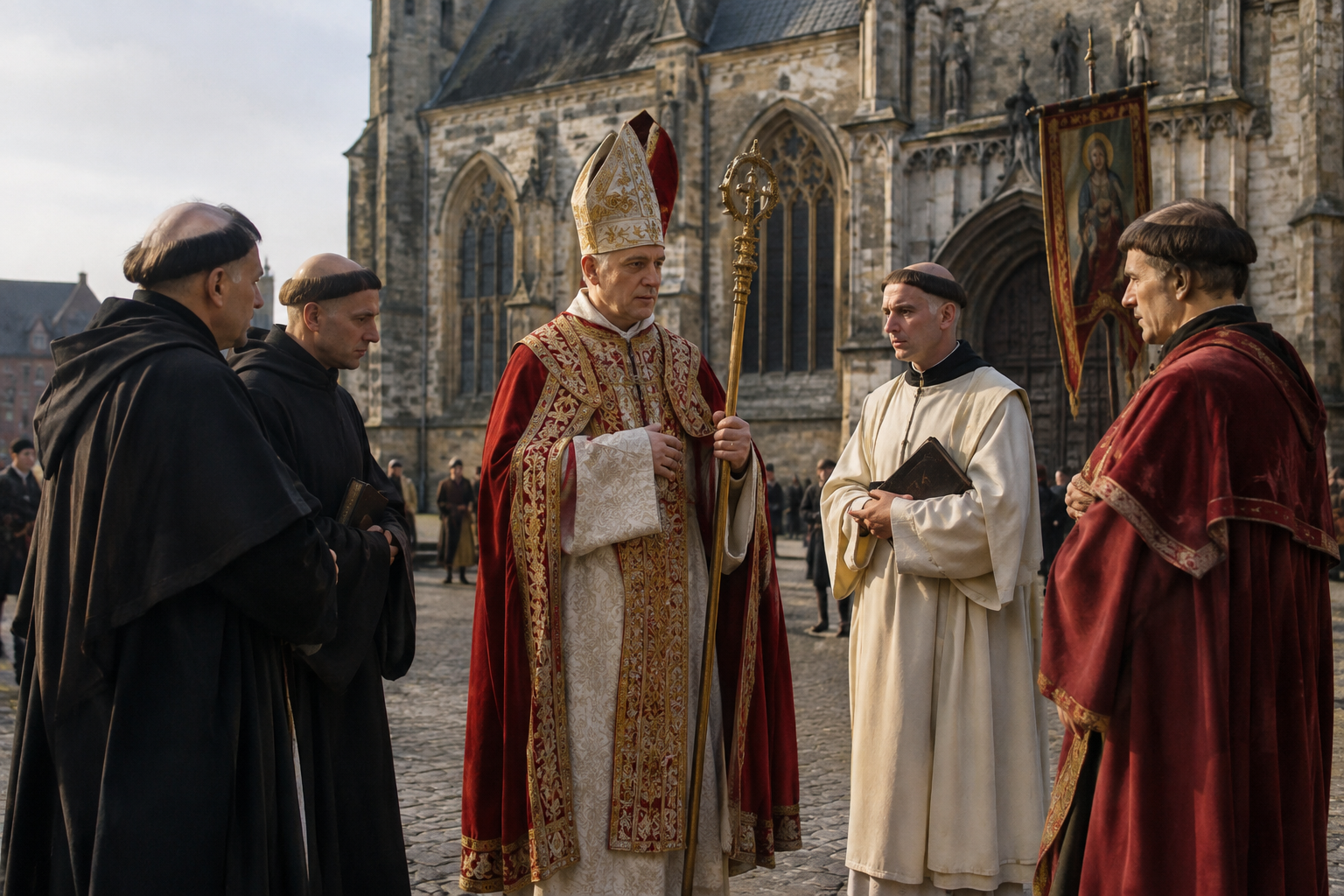
In 1493, in the city of Mechelen in present-day Belgium, several individuals buried at St. Rombouts left behind an unusually tight little cluster of evidence for the Y-DNA haplogroup H1a1a4b2a. The sample IDs STR025a, STR025b, STR025c, STR025d, STR025e, and STR025f all come from this late medieval setting. That is immediately interesting, not because six burials can somehow stand for a whole region, but because a rare-looking paternal branch appears repeatedly in one specific urban context at one specific moment.
That makes St. Rombouts less a story of sweeping migration than of local historical texture. Y-DNA tracks one direct paternal line only, so it is never the whole ancestry of a person. But when the same branch turns up again and again at one site, it suggests a real paternal thread moving through the lived world of a late medieval town: kin networks, neighborhood continuity, or a locally rooted male line present within the community around the end of the fifteenth century.
The heart of the evidence here is straightforward. All six ancient individuals linked with this article's haplogroup come from Late Medieval Belgium, St. Rombouts, dated to 1493 AD: STR025a, STR025b, STR025c, STR025d, STR025e, and STR025f. Even without embellished burial detail, that concentration matters. Archaeology often gives us scattered single appearances; here, instead, we have repetition within one church-centered urban setting.
St. Rombouts is not an obscure backwater. Mechelen was an important town in the Low Countries, tied into the political and commercial life of the Burgundian and then Habsburg Netherlands. A paternal lineage found repeatedly here belongs, at the very least, to that urban medieval world of parishes, workshops, markets, and church institutions rather than to a purely rural or isolated setting.
The caution is just as important as the attraction. A cluster like this does not automatically mean all six were close relatives, nor does it prove that H1a1a4b2a was common across medieval Flanders. What it does give us is something more archaeologically solid: a documented instance of the branch appearing multiple times in one community at the same date horizon.
That label is very precise, and precision can be deceptive if we rush. H1a1a4b2a is a narrow terminal-style branch name, while haplogroup H itself is a much broader paternal lineage with a long and complicated history across Eurasia. It would be bad history to pour the entire ancient story of parent haplogroup H straight into this much smaller medieval branch.
So the sensible approach is modest. For this article, the secure point is that the reported branch associated with these St. Rombouts individuals is H1a1a4b2a. The useful historical question is not "where did all of haplogroup H come from?" but rather "what does it mean to find this specific paternal line clustered in late medieval Mechelen?"
The answer is that by the late fifteenth century, this lineage was present enough in that community to appear several times in the burial record. That places the branch within the social history of the Low Countries at a moment when towns were dense, mobile, and interconnected, yet still capable of preserving local family continuities over generations.
One ancient sample can be tantalizing but ambiguous. Six from the same place and year are different. They do not solve the lineage's deeper origin, but they do tell us that this was not a one-off stranger passing through the cemetery record. Repetition suggests the branch had some staying power in or around Mechelen.
In practical terms, that could reflect related men buried through the same ecclesiastical institution, or a broader pool of men descending from an older paternal founder line in the town. Medieval urban populations were constantly replenished by migration from nearby countryside and neighboring regions, so "local" did not mean static. Yet churches and their burial grounds also capture the durable side of town life: households, craft communities, and lineages that remained anchored to place.
This is one reason ancient DNA is so useful for late medieval history. Written sources tend to privilege elites, officeholders, and exceptional events. A cemetery like St. Rombouts lets us glimpse ordinary paternal structure below that level. Research on ancient populations in the region, including work published in Nature, has helped show how genetics can illuminate such local communities without reducing them to simple ethnic labels.
Lower Rhine biomolecular community
It is worth pausing over the date. Around 1493, Mechelen stood in a world shaped by commerce, dynastic politics, and ecclesiastical authority. The Low Countries were among the most urbanized parts of Europe, and towns like Mechelen sat inside a dense web of movement stretching across Brabant, Flanders, the Rhine corridor, and beyond.
That wider setting makes a finding like H1a1a4b2a intriguing in a specifically medieval way. Urban life can blur old local distinctions, but it can also preserve them. A paternal branch may survive through guild families, property-holding households, or clusters of kin buried within the same religious sphere. Without documentary genealogy we cannot identify the exact mechanism, yet the archaeological context encourages us to think about continuity inside a bustling town rather than imagine a dramatic long-distance migration for every unusual lineage.
This also fits a broader lesson from ancient DNA in northwestern Europe: medieval communities were neither genetically sealed nor endlessly fluid. They were structured. They had patterns. A repeated Y-lineage at one site is one of those patterns.
Lower Rhine-Meuse deep history
If your own paternal line falls under H1a1a4b2a, the St. Rombouts burials offer something unusually concrete: a documented late medieval foothold for this branch in Belgium, represented not by one man but by a small cluster of men from the same place and date. That does not mean every modern carrier of the branch descends from Mechelen, still less from one of these exact individuals. But it does mean the lineage was part of the historical population of the late medieval Low Countries.
For family historians, that is often the most valuable kind of ancient connection: not a mythical founder, not an invented dynasty, but a real community with a date, a place, and a set of burials that anchor the branch in the historical record. In this case, H1a1a4b2a appears not as a grand imperial signature, but as the trace of men living and dying in one of Europe's most urbanized regions at the close of the Middle Ages.
The distinctive insight from this haplogroup is its concentration at St. Rombouts in 1493 AD. STR025a through STR025f do not give us a heroic saga, but something better grounded: evidence that H1a1a4b2a was present within a late medieval urban community in Belgium, and present there more than once. For anyone tracing this paternal line today, that is a meaningful historical anchor - a reminder that even a narrow Y-DNA branch can sometimes be glimpsed not in legend, but in the cemetery record of a real town.






Comments