Haplogroup I1a2a2a

– 5 min read


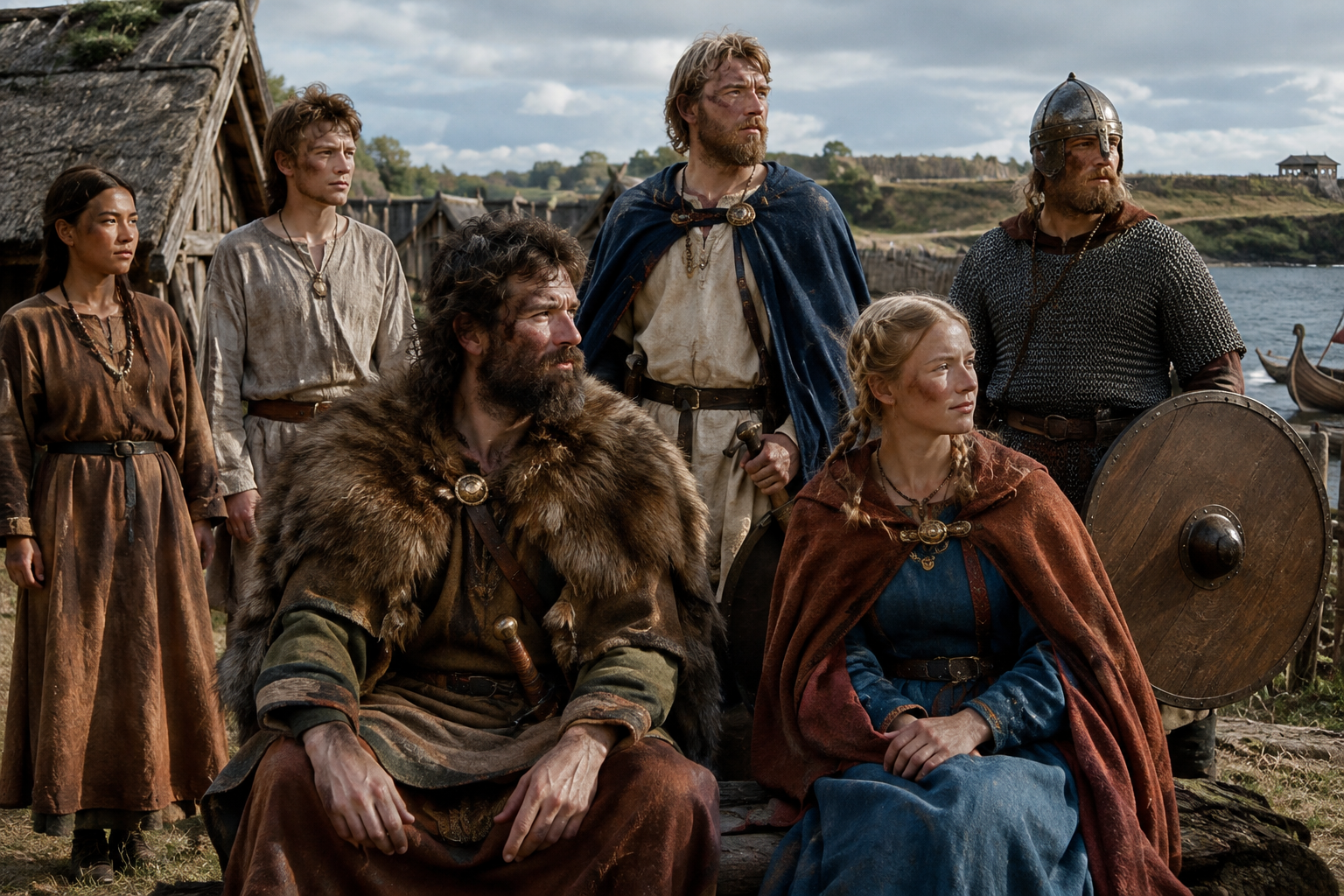
At Trelleborg in the Kingdom of Denmark, one excavated Viking Age individual dated to about AD 975, sample CGG106824, has been associated with the Y-DNA haplogroup I1a2a2a. That is immediately interesting, not because one man can stand for all Vikings, but because Trelleborg is one of the most recognisable places in late 10th-century Scandinavia: a fortress world of kingship, military organisation, and movement around the Baltic. When a paternal line appears there and also turns up in earlier Iron Age Denmark and later Migration-Period and Merovingian-era contexts farther south, it begins to look less like a single local curiosity and more like part of a durable northern European male lineage.
The evidence here is unusually suggestive in its spread. The same haplogroup is linked in the sample set not only to Viking Age Denmark, but also to Iron Age eastern Sjælland, Iron Age Funen, a Gothic-associated burial context at Masłomęcz in present-day Poland, Migration Period Hungary, and an elite late Merovingian grave in Bavaria. Y-DNA traces one direct paternal line only, not a person's whole ancestry, but even that narrow line can tell a surprisingly historical story when it recurs in the right places.
I1a2a2a is a fine-grained branch within the wider I1 haplogroup, a lineage strongly associated in many ancient-DNA studies with northern Europe, especially Scandinavia. It would be a mistake, though, to take everything known about broad I1 and simply paste it onto this smaller branch. What we can say more carefully is that the samples linked here place I1a2a2a in a convincingly northern sphere, with repeated appearances in contexts connected to southern Scandinavia and to the movements of people from that world during late antiquity and the early Middle Ages.
That pattern fits well with the broader direction of recent archaeogenetic work on Scandinavia and its neighbours. Research on ancient populations in Denmark has shown how the region preserves long-term demographic layers rather than one simple, single-origin story. For background on that deeper setting, see this piece on Denmark's Mesolithic-Neolithic transition.
The clearest place to start is actually before the Viking Age. Two earlier Danish samples connected with I1a2a2a come from Iron Age contexts: CGG107413 from Varpelev Vest in eastern Sjælland, dated around AD 375, and VK532 from Kragehaven Odetofter in Denmark, dated around AD 100. Even with only limited descriptive detail, the importance of these two men is plain enough. They place this paternal line in Denmark centuries before the great overseas expansions usually associated with Scandinavians in the ninth to eleventh centuries.
That matters because it gives the Trelleborg individual a plausible local background. He need not represent some sudden imported lineage. Instead, the simplest reading is continuity: a branch present in Iron Age Denmark also appears in a high-profile Viking Age Danish site. The forts, ships, and kings came later; the male line itself was already there.
An ancient DNA study examining Viking Age and earlier Scandinavian populations, published in research on ancient northern Europeans, has helped frame exactly this sort of question: how paternal lines, ancestry patterns, and historical mobility intersect without collapsing into one another. The crucial point is that lineages can persist locally even while the societies carrying them become increasingly outward-looking and politically complex.
One of the most intriguing appearances of I1a2a2a in this set is PCA0100, a Gothic-associated individual from Masłomęcz, dated around AD 300. Masłomęcz, in eastern Poland, has become one of the key sites for discussing Gothic-period communities in the late Roman age, not least because ancient DNA has reinforced what archaeologists long suspected: these were not biologically uniform "tribes" in any crude sense. They were mixed communities, shaped by mobility, intermarriage, and frontier life.
That makes the presence of a Scandinavian-associated paternal branch all the more valuable. It does not prove that this man was a migrant fresh off a boat from Sweden, nor that all Goths carried northern Y-DNA. What it does suggest is that paternal lines with northern roots could be present inside the social formations archaeologists call Gothic. In other words, the old written tradition about movements out of the Baltic world may preserve something real, but the genetics show that these movements produced composite communities rather than neat ethnic packages.
Masłomęcz is especially relevant here because it stops us from telling a simplistic migration tale. If you want the fuller context for that site, these companion discussions are worth reading.
And also:
The southern reach of this haplogroup becomes even clearer with two later samples. RKO007, from Rakóczifalva in Hungary and dated around AD 650, places I1a2a2a in the Carpathian Basin during the Migration Period or its aftermath. Then there is ErgDF2, from the late Merovingian Bavarian elite cemetery at Ergoldsbach-Doernbacher Feld in Germany, dated around AD 680.
These are not the same historical setting, and they should not be merged into one grand narrative. But together they show that this paternal branch had moved well beyond Denmark by the seventh century. That is historically plausible. The centuries after Rome's western imperial collapse saw intense movement across central Europe: soldiers, settlers, federates, traders, captives, and families shifting through a political landscape that was anything but stable. A northern paternal line in Hungary or Bavaria is therefore not surprising; what matters is seeing it appear in actual excavated individuals.
The Bavarian case is especially suggestive because Ergoldsbach-Doernbacher Feld is described here as an elite context. That does not let us build fantasies of a dynasty or warrior house from a single Y-chromosome result. It does, however, remind us that lineages associated with Scandinavia were not confined to marginal wanderers. By the later seventh century, men carrying this branch could be found within socially prominent communities deep in post-Roman Europe.
For readers interested in how genetics illuminates early medieval population mixture in this wider zone, this article offers a useful comparison:
Put these finds side by side and a coherent picture emerges. The oldest examples in this set, VK532 and CGG107413, anchor I1a2a2a in Iron Age Denmark. PCA0100 shows the branch within a Gothic-associated community east of the Roman frontier around AD 300. RKO007 and ErgDF2 place it farther south in the Migration Period and late Merovingian world. Finally, CGG106824 shows it still present in a major Viking Age Danish centre.
That sequence is not proof of one uninterrupted family tree connecting all six men. Archaeology rarely gives us such tidy stories. But it is strong evidence that this branch belonged to the broad human traffic linking southern Scandinavia to central and eastern Europe over many centuries. A genetic study of diverse seventh-century burials in Iberia has made a similar wider point in another region: early medieval Europe was full of movement, local continuity, and mixture all at once. The same caution applies here. A haplogroup is a line of descent, not a ready-made ethnic label.
Recent work on early medieval and post-Roman Europe continues to sharpen that picture, including research on ancient genomes from later first-millennium European contexts. The value of such studies is not that they turn archaeology into a list of genetic certainties, but that they let us see recurring patterns of kinship and mobility with much finer resolution than before.
For someone researching haplogroup I1a2a2a today, the most responsible takeaway is also the most interesting one. This is a branch with a clear ancient footprint in Denmark and a broader historical presence in the worlds touched by Scandinavian-linked mobility: Gothic-period communities, the Migration Period Carpathian Basin, Merovingian Bavaria, and Viking Age strongholds.
That does not make every modern carrier a Goth, a Viking, or the descendant of any one excavated man. But it does place your direct paternal line in a very specific historical theatre: the northern and central European societies that connected the Baltic, the frontier zone beyond Rome, and the political landscapes of the early medieval West.






Comments