Haplogroup Q1b1a1a1

– 4 min read


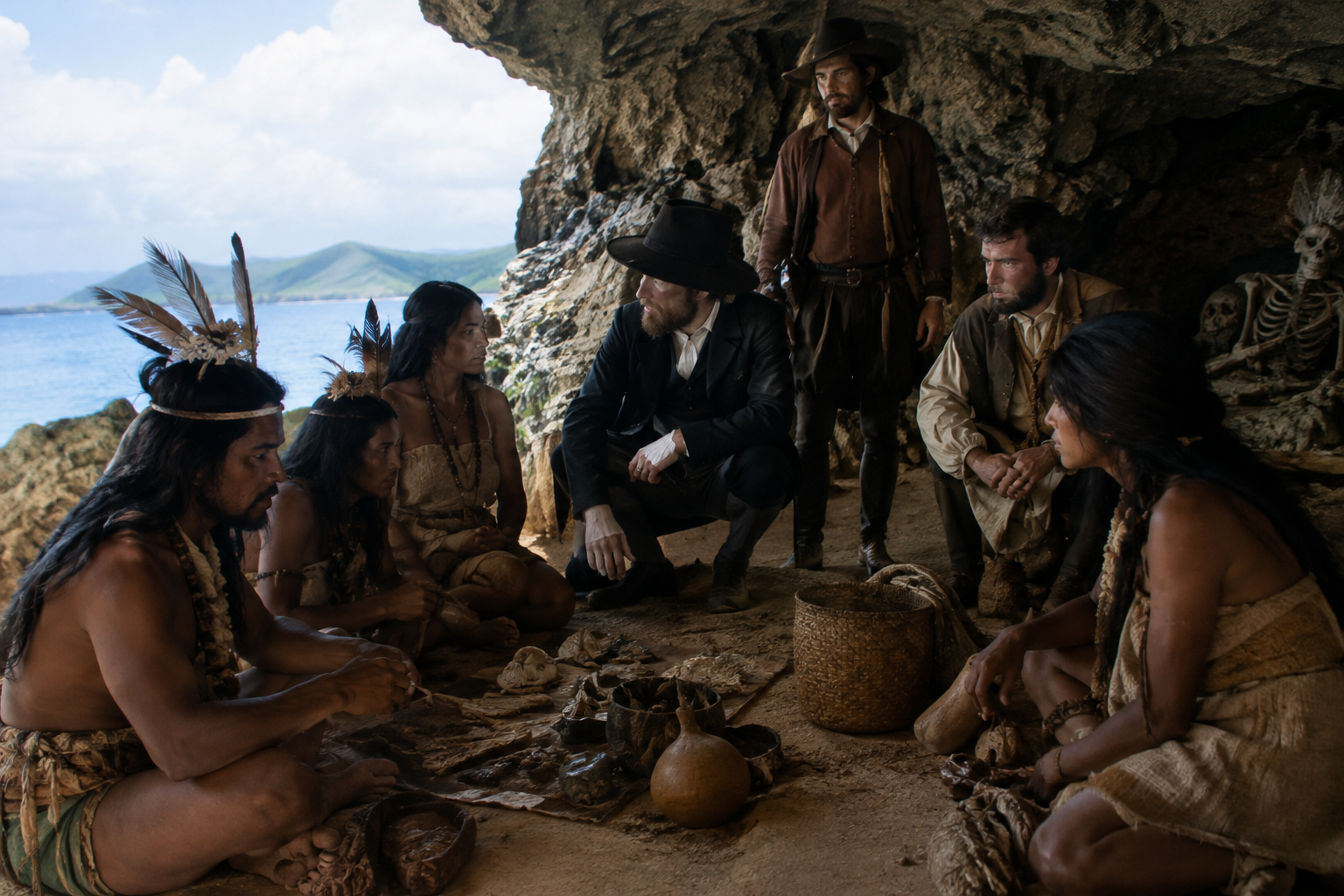
At Lavoutte on St. Lucia, several men buried before European conquest carry a paternal line reported here as Q1b1a1a1. The dates are strikingly late: LAV001 is placed around AD 1169, while LAV002 and LAV003 fall around AD 1491, right on the edge of the Caribbean's world-changing encounter with Europe. That makes this haplogroup interesting not as an abstract label, but as something recovered from real island communities living in the centuries immediately before colonization.
Q1 is a wider Y-chromosome lineage with deep roots in the peopling of the Americas, but the article haplogroup Q1b1a1a1 is a much narrower paternal branch. Y-DNA tracks one direct male line only, so it does not describe a whole person's ancestry, language, or identity. Even so, when the same branch appears across several ancient Caribbean males, it gives us an unusually sharp glimpse of paternal continuity in island societies that written records barely caught before they were transformed.
The Lavoutte samples are the clearest cluster in this set. LAV001, LAV002, and LAV003 come from pre-Columbian St. Lucia, spanning roughly the late first millennium AD into the very end of the fifteenth century. In practical terms, that means the same paternal branch appears on the island over several centuries, not as a one-off curiosity but as a repeated signal.
That matters because Caribbean history is too often told as if the islands were merely stepping stones in somebody else's voyage. Ancient DNA has been steadily correcting that picture by showing long-lived local populations with their own patterns of kinship, mobility, and continuity. A major ancient DNA study of the region, published in Science, helped establish just how much could still be learned from pre-contact Caribbean people despite difficult preservation conditions.
St. Lucia sits in the Lesser Antilles, a chain that was never isolated from the rest of the Caribbean world. Canoe travel linked islands to one another and to the South American mainland. So when a lineage like Q1b1a1a1 turns up repeatedly at Lavoutte, the important point is not that it proves one single migration tale, but that it fits a wider picture of durable Indigenous paternal ancestry circulating within Caribbean networks before 1492 and surviving locally into the last pre-Columbian generation.
The pattern does not stop at St. Lucia. LOI001 from Los Indios, Puerto Rico, dated around AD 1405, is another late pre-Columbian islander associated here with Q1b1a1a1. Puerto Rico lies well to the northwest of St. Lucia, so this is not just a hyper-local family signature at one cemetery. It suggests that the branch belonged to a wider Indigenous Caribbean world.
Here archaeology and genetics work best together when neither is asked to do too much. The genetics can show a paternal connection across islands; archaeology reminds us that these islands were tied together by exchange, seafaring, and shifting local histories. What it cannot do, from one Y-line alone, is tell us which language this man spoke or whether he would have identified with the same political community as the men at Lavoutte.
Still, the distribution is revealing. By the fifteenth century, Q1b1a1a1 was present in both the Lesser Antilles and the Greater Antilles, which is exactly the sort of pattern that makes ancient Y-DNA useful: not because it simplifies the past, but because it shows a recurring paternal line embedded in a broad archipelago of Indigenous communities.
The most historically charged samples in this group come from Cueva de los Esqueletos in Cuba. Three men from this colonial context, CDE003 around AD 1548, CDE005 around AD 1600, and CDE001 around AD 1684, are associated with the same haplogroup. That sequence is extraordinary because it runs deep into the colonial period, long after older histories assumed Indigenous Caribbean populations had simply vanished.
They did not vanish. What disappeared more readily was their visibility in colonial documents and later national myths. Ancient DNA has become one of the tools forcing a rethink, showing that Indigenous ancestry, including paternal lines, persisted through the upheavals of conquest, resettlement, disease, enslavement, and cultural change.
The Cuban cave context is therefore more than a list of sample IDs. It is evidence that an Indigenous male lineage could survive into the sixteenth and seventeenth centuries in the Caribbean. That does not mean every colonial-era man at the site belonged to one uninterrupted local dynasty, nor that the cave preserves a simple untouched community. It means that the paternal line itself endured across the colonial divide.
Pre-European Disease in the Americas
There is a temptation, with any haplogroup, to turn it into a grand arrow on a map. But for Q1b1a1a1 the more interesting story is smaller and more human. This branch appears in a set of island burials dated from about AD 1169 to AD 1684, crossing the line between pre-Columbian and colonial worlds. That gives it a special kind of historical value: it is not only ancient American, but demonstrably present in Caribbean men living through one of the most disruptive periods in Atlantic history.
In that sense, Q1b1a1a1 is a good example of what ancient Y-DNA can and cannot do. It can identify a direct paternal thread linking some ancient Caribbean males across different islands and periods. It cannot, by itself, reconstruct whole peoples. But when several samples from St. Lucia, Puerto Rico, and Cuba point in the same direction, the result is persuasive: this was a real Indigenous paternal lineage with staying power.
If your own Y-DNA falls within Q1b1a1a1, the ancient evidence here points most clearly toward an Indigenous American paternal background and, more specifically, one attested in the pre-contact and early colonial Caribbean. The most distinctive feature is not remote antiquity alone, but continuity: men carrying this branch appear before European arrival on St. Lucia and Puerto Rico and then again in colonial Cuba.
That is a modest claim, but a powerful one. Q1b1a1a1 does not hand you a named chiefdom, a language, or a royal pedigree. What it does offer is something firmer and, frankly, more interesting: a documented paternal line still visible in the bones of Caribbean islanders before and after conquest.
Comments