Haplogroup J2a1a1b2a1b1

– 6 min read


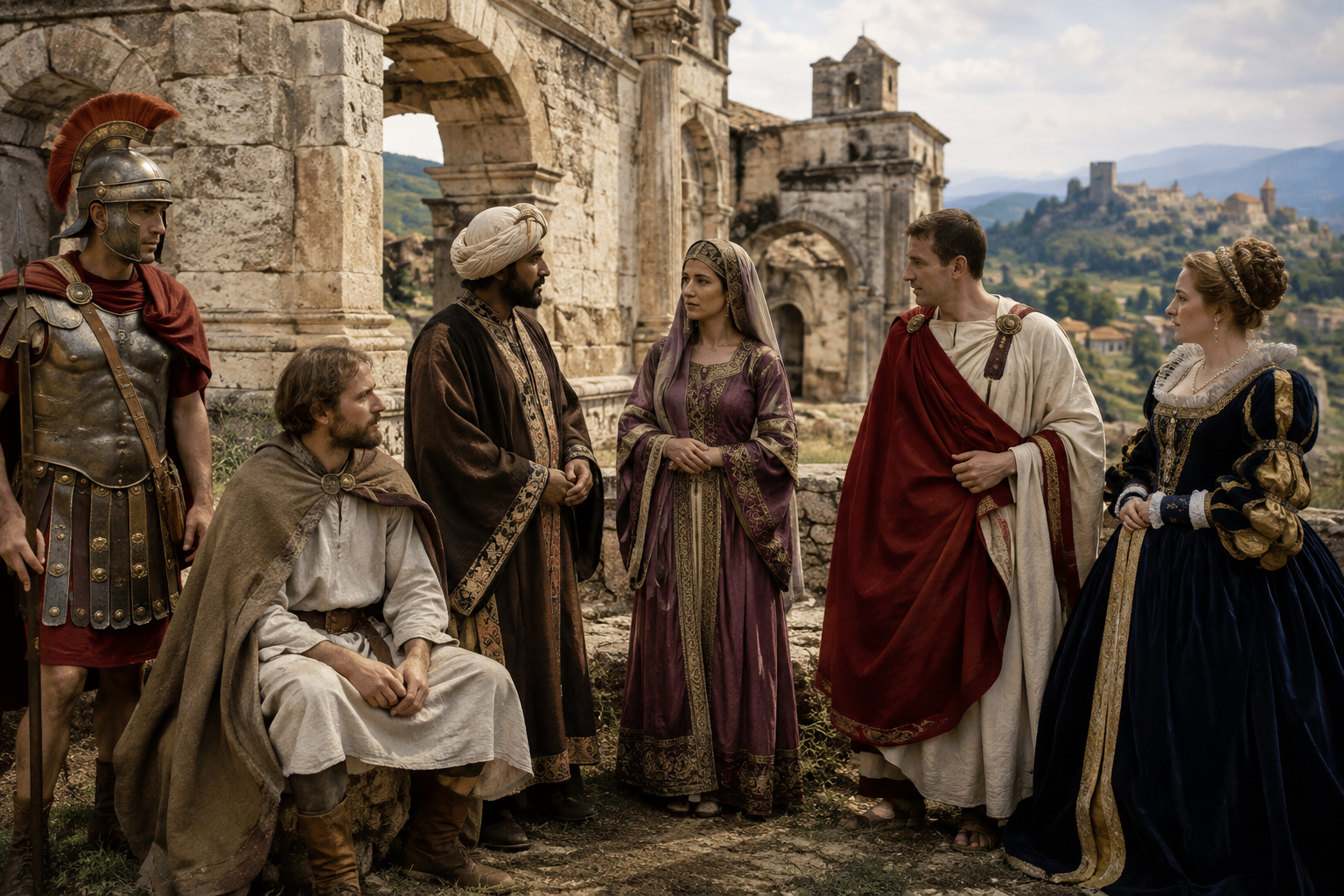
At Viminacium in Serbia, the great Roman city and military center on the Danube, one man buried in the Pirivoj necropolis around AD 225 appears in this record set as sample I15517. He is a useful place to begin because Viminacium was not some sleepy provincial corner. It was one of those Roman places where soldiers, traders, officials, families, and freed people could all meet, mix, settle, and die. When a Y-chromosome line such as J2a1a1b2a1b1 turns up here, it immediately raises a historical question: are we looking at a purely local Balkan continuity, a wider eastern Mediterranean connection, or simply the ordinary cosmopolitanism of empire?
The honest answer is that one Y-DNA result cannot do all that work on its own. Y-DNA traces one direct paternal line, not a person's full ancestry or identity. But when the same branch is reported in samples from Roman Serbia, imperial Italy, Byzantine and Ottoman-period Anatolia, medieval Germany, and even a late Renaissance context at Tivoli, it begins to look less like an isolated curiosity and more like a durable paternal thread running through the connected world of the Mediterranean and its northern frontiers.
This very specific label sits inside the wider haplogroup J2, a paternal lineage long associated in broad terms with parts of the Near East, Anatolia, the Aegean, and the Mediterranean. That does not mean every man in J2 shares the same historical path, and it certainly does not allow us to assign the narrower branch J2a1a1b2a1b1 a single tidy origin story without more evidence. What the samples here do suggest, though, is a branch comfortable in urban, imperial, and post-imperial landscapes where movement across seas, roads, and frontiers was common.
That matters because archaeology repeatedly shows that empires do not merely conquer territory. They create corridors: for marriage, service, commerce, pilgrimage, and resettlement. A paternal line can persist through all of that, sometimes in places that later national histories treat as separate worlds.
Sample I15517 from Late Roman-era Viminacium is the strongest opening example because the site itself is so historically rich. Viminacium stood near the Danube frontier, tied both to the Roman army and to the wider civilian life of the province. A man carrying this paternal line at Pirivoj does not have to be imagined as an immigrant from afar, nor as a purely local villager. In a place like this, both ancestry and identity could already be mixed over generations.
A major ancient DNA study on Viminacium and the surrounding region helped underline just how varied the biological backgrounds of people in this frontier zone could be, with individuals showing links across different parts of the empire and beyond it. That broader setting makes a lineage like J2a1a1b2a1b1 historically plausible in the central Balkans without any need for fantasy genealogy or simplistic labels about "Romans" and "barbarians." The Danube frontier was, in human terms, a meeting place. Research on these populations can be found here: https://www.sciencedirect.com/science/article/pii/S0092867423011352.
The Balkans are especially interesting for this haplogroup because they sit between Adriatic, Danubian, Aegean, and Anatolian worlds. A paternal branch found here in the Roman period could have older roots in southeastern Europe, or it could reflect earlier eastern Mediterranean movement into the region, or both. Roman administration did not erase local history; it layered new mobility on top of older population structures.
Another Roman-period example comes from Italy itself: R1557, dated around AD 221 from Imperial Rome-era Urbino Bivio. This matters because it places the branch not just on a frontier, but in the Italian peninsula during the age when Rome's political and cultural gravity still shaped much of the Mediterranean. Again, one sample cannot stand for all Italy. But paired with Viminacium, it hints that this paternal line was present within the imperial network on both sides of the Adriatic.
There is also a much later Italian appearance in R970, a sample from Tivoli Palace dated to around AD 1650 in the Late Renaissance. One must be careful here: a Roman-period man from Urbino and a Renaissance-era individual from Tivoli are separated by more than a millennium, and no direct descent can be assumed. Still, taken together they show that the branch was not fleeting in Italy. It remained part of the peninsula's male-line diversity through very different historical worlds: imperial, medieval, and early modern.
That continuity, or at least repeated presence, suits what we know about Italy as a zone of layered settlement. Roman colonization, late antique transformation, Byzantine enclaves, merchant mobility, and internal migration all contributed to a very mixed paternal landscape. For readers interested in how those shifts played out over time, MyTrueAncestry has also explored Roman to early medieval Italy at Amiternum.
If Viminacium and Urbino show the branch within Roman and Italian settings, Anatolia shows its staying power further east. Two samples are especially telling: I20144 from Byzantine-era Stratonikeia Church in Anatolia, dated around AD 975, and I14787 from Kilis in southeast Anatolia, listed here as Ottoman-period and dated around AD 1000. The label "Ottoman-period" sits awkwardly with that early date, so the safest approach is to treat Kilis primarily as a medieval Anatolian context rather than press the political terminology too hard.
Even with that caution, the pair is historically revealing. Stratonikeia belonged to the Byzantine world of western Anatolia, with its churches, towns, and deep classical past. Kilis, further southeast, lay in a region long shaped by contacts among Anatolian, Syrian, Mesopotamian, and later Turkish-speaking populations. Finding the same paternal branch in both areas suggests not a single ethnic story, but a line persisting through changing languages, states, and religious landscapes.
This is precisely the sort of thing ancient DNA is good at revealing. Political history likes clean breaks: Roman, Byzantine, Seljuk, Ottoman. Human lineages are much less obedient. Men with related paternal ancestry can be found living under very different regimes, speaking different languages, and participating in entirely different social worlds.
Perhaps the most intriguing outlier in this group is SDN006, a medieval individual from Steuden in Sachsen-Anhalt, Germany, dated around AD 1050 and described as a western Slav settler. This is where one has to resist the temptation to over-explain. The presence of J2a1a1b2a1b1 in a medieval Slavic-settler context does not mean the haplogroup was "Slavic" in origin, nor does it prove a recent move directly from Anatolia or the Balkans into Germany by this one man.
What it does show is that paternal lines with southern or southeastern European associations could be incorporated into communities further north during the medieval centuries. The Elbe-Saale region was one of those places where frontiers, colonization, cultural exchange, and population movement all overlapped. A western Slav context in central Germany is therefore exactly the kind of setting where an unexpected Y-line might turn up.
Research on early medieval central and eastern European populations has repeatedly shown that communities labeled in historical terms were not genetically uniform blocs. They were formed through mobility and mixture. That broader point sits well with SDN006, even if the precise family history behind the sample is now unknowable.
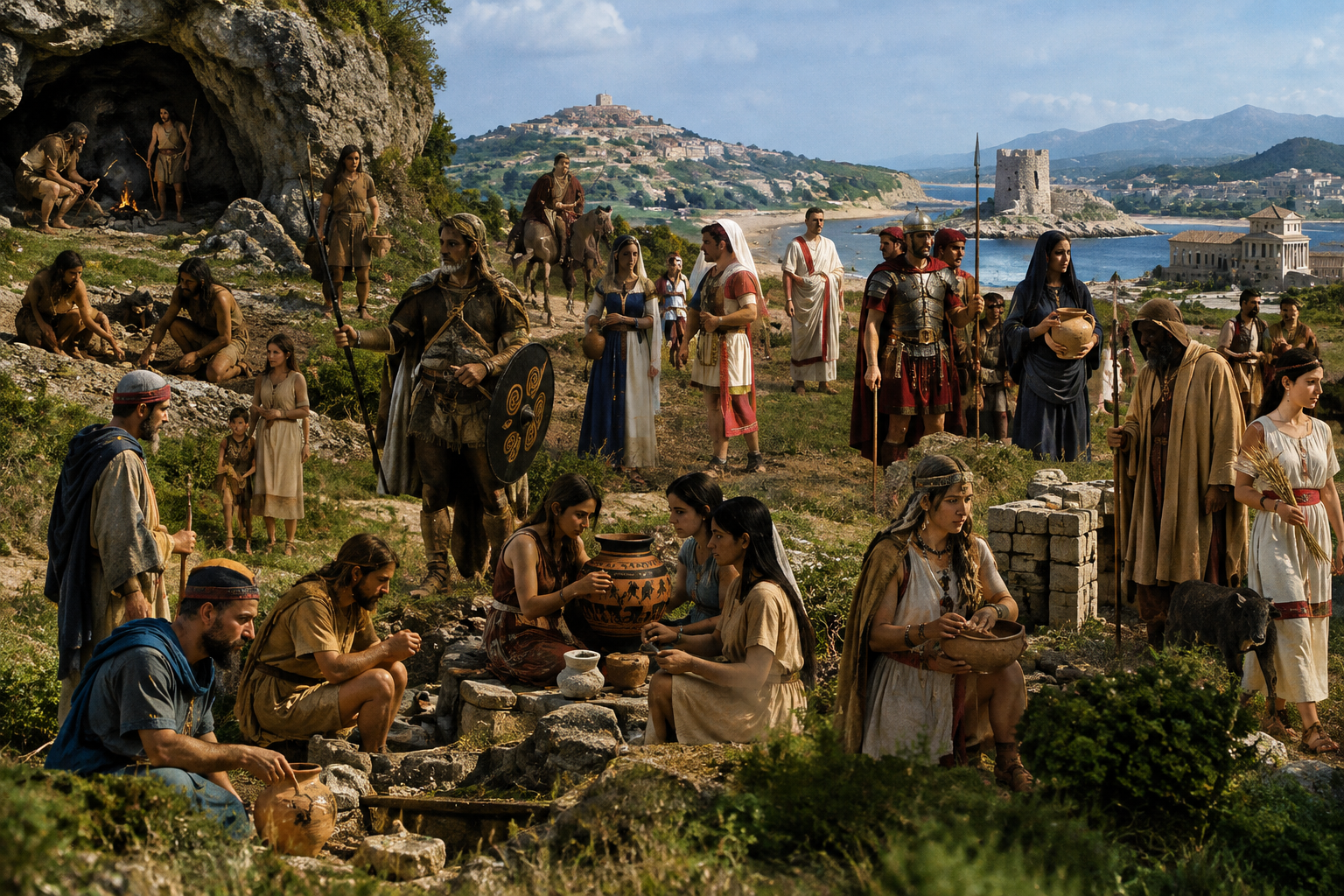
The most striking feature of J2a1a1b2a1b1 in this set is not sheer antiquity, but geography married to historical context. The branch appears in a Roman frontier city on the Danube, in imperial Italy, in Byzantine and medieval Anatolia, in a medieval Slavic-settler context in Germany, and again in Renaissance Italy. That is a pattern of connected zones rather than isolated dots.
It also fits a larger picture emerging from ancient DNA studies of the Roman and post-Roman worlds: empires, trade routes, military service, and resettlement produced populations far more mobile than older nationalist histories once assumed. A landmark study of the Roman imperial world and its population history helped establish just how much eastern Mediterranean-related ancestry circulated in Rome and its orbit, even if no single paper can answer every question for this narrow branch: https://science.sciencemag.org/content/366/6466/708.
If your paternal line belongs to J2a1a1b2a1b1, this sample set points toward a lineage that was at home in the interconnected worlds of the Balkans, Italy, and Anatolia, and that could also appear further north in medieval Europe. It does not hand you a ready-made identity or a royal pedigree. What it does offer is something better grounded: a picture of a paternal branch that repeatedly shows up where roads, ports, armies, churches, and towns linked people across regions for many centuries.
Comments