Haplogroup Q1b1b1

– 4 min read


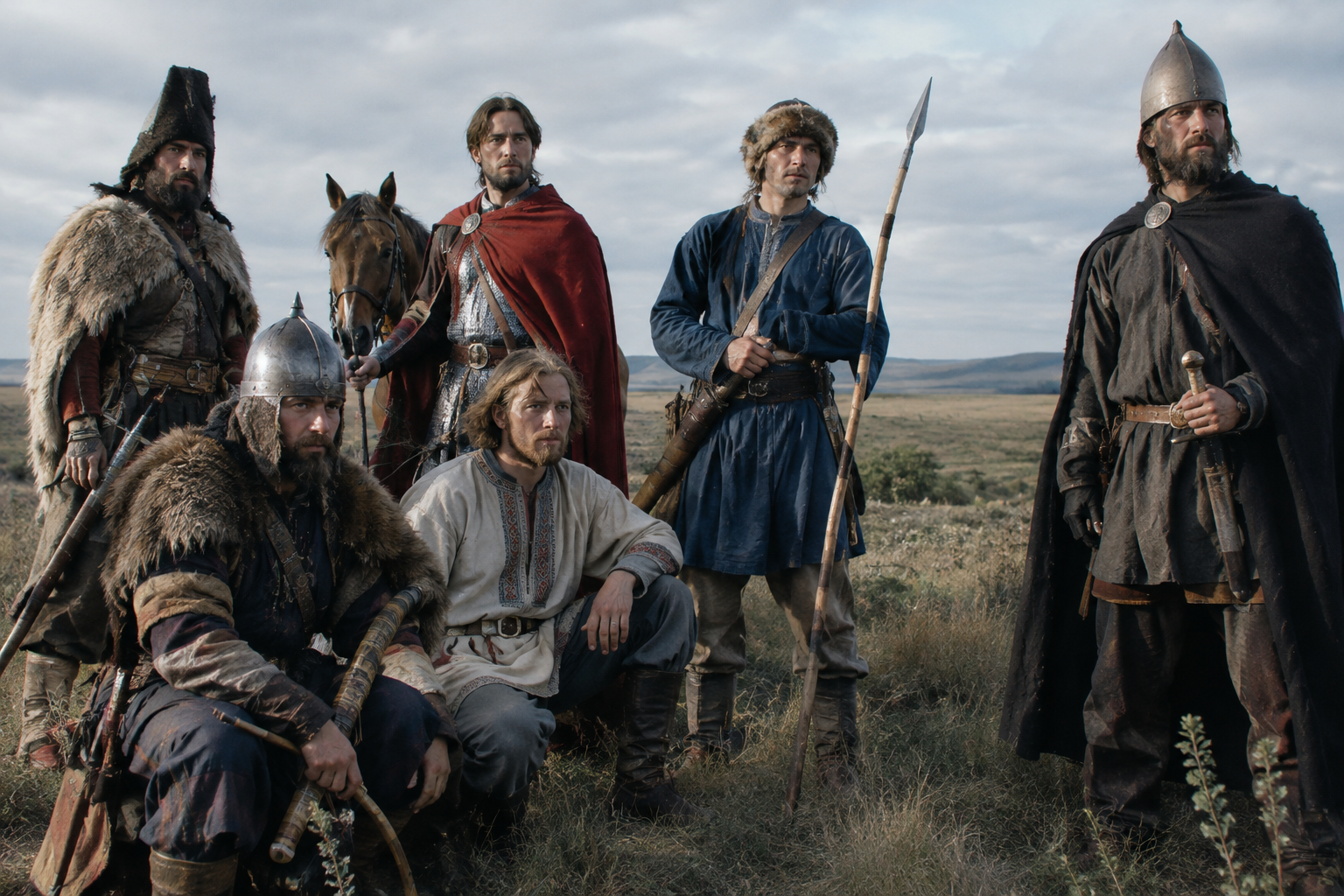
At Kumy in the Kharkiv region of Ukraine, one Early Iron Age individual dated to around 919 BC, sample UKR066, puts Y-DNA haplogroup Q1b1b1 in a setting that is immediately intriguing. This is a landscape of steppe movement, horse-based lifeways, and cultural contacts across the north Pontic zone, and yet the paternal line in question is one more often discussed in much broader Eurasian terms than in relation to specific graves in Iron Age eastern Europe.
That is what makes Q1b1b1 worth looking at carefully. Y-DNA follows one direct paternal line only, not a person's whole ancestry, but when the same branch turns up in several ancient males from the steppe, the Carpathian Basin, and medieval central Europe, it hints at a durable thread running through very different historical worlds.
The Kumy individual UKR066, dated to the Early Iron Age and described here as a Cimmerian-period burial from the Kharkiv area, belongs to a region that repeatedly acted as a corridor rather than a sealed frontier. The north Pontic steppe connected the forest-steppe, the Caucasus approaches, and the great open grasslands farther east. Archaeologically and historically, this was a zone where communities moved, merged, fought, traded, and borrowed from one another over long periods.
That wider setting matters because a haplogroup like Q1b1b1 should not be forced into a neat ethnic box. A man buried in a Cimmerian-era context is not made into a text-book "Cimmerian" by Y-DNA alone, and his paternal lineage does not tell us his language or full background. What it does show is that this branch was present among male lines circulating in the north Pontic world by the early first millennium BC. A regional genetic study focused on mobility in Ukraine helps frame exactly this sort of evidence in its proper archaeological landscape: https://www.researchgate.net/publication/380994383_North_Pontic_crossroads_Mobility_in_Ukraine_from_the_Bronze_Age_to_the_early_modern_period.
Two other ancient finds sharpen the picture. One is WAR001, a "Kurgan Elite Warrior Grave 37" individual dated to around 580 BC. The other is SHD001 from the Sargat culture at Shadrisk, dated around 400 BC. Even from these brief records alone, the important point is that Q1b1b1 appears in more than one steppe or steppe-adjacent archaeological setting.
The kurgan burial context of WAR001 places this paternal line in a funerary tradition associated with status, mounted warfare, and the social hierarchies of the Eurasian steppe. That does not prove a dynasty, and it certainly does not allow us to reconstruct one man's biography from a label like "elite warrior." But it does show Q1b1b1 in a burial environment tied to the political and military cultures that dominated so much of Iron Age inland Eurasia.
SHD001, by contrast, comes from the Sargat cultural sphere of western Siberia and the Trans-Ural zone, a region well known for mediating exchanges between steppe nomads and forest populations. Taken together, these two samples suggest something more interesting than a single tribal identity: Q1b1b1 turns up in the wider belt of interaction stretching from the Pontic steppe toward the inner Eurasian northeast.
That fits well with the broader archaeogenetic picture emerging from steppe research. One ancient DNA study that has been influential in showing how mobile and mixed Iron Age steppe populations could be is available here: https://advances.sciencemag.org/content/7/13/eabe4414. Its value in this context is not that it magically explains every sample listed here, but that it reminds us how often prestige burials and steppe identities were assembled from people with varied genetic histories.
The branch appears again in the Carpathian Basin, at Madaras in Hungary, where two Sarmatian-period individuals are listed: CGG021908 dated around AD 345 and CGG021917 dated around AD 375. This is a different historical theatre from Iron Age Kharkiv or a Sargat burial, but not an unrelated one. By late antiquity, the Carpathian Basin had become one of Europe's great receiving grounds for steppe-derived groups, local communities, and imperial frontier politics.
Sarmatian is, of course, an archaeological and historical label, not a genetic essence. Still, these Madaras individuals matter because they show Q1b1b1 surviving or arriving within populations associated with Iranian-speaking steppe traditions west of the Black Sea. The dates place them in the Migration Period world, when Roman influence, steppe movement, and regional restructuring were all pressing on the basin at once.
Two males from one site do not prove that Q1b1b1 was common among all Sarmatians, nor that every bearer of the branch moved west in the same migration stream. What they do provide is a concrete anchor for the haplogroup in late antique Hungary. For family historians, that is often more useful than grand theories: an actual pair of dated men, in an actual cemetery, within a documented frontier zone of Eurasian mobility.
The latest sample in this small but suggestive set is OBM038 from Obermoellern in Thuringia, Germany, dated around AD 1050. On first glance, a medieval central European burial may seem far removed from Iron Age Kharkiv or Sarmatian Hungary. Yet that is precisely why it is valuable. Haplogroups do not stay politely inside the historical categories archaeologists use for convenience.
By the eleventh century, central Europe had already absorbed centuries of Roman frontier movement, post-Roman migration, elite mobility, settlement expansion, and Christian reorganization. A Q1b1b1 paternal line in Thuringia need not point to one recent migration event. It may instead reflect the long afterlife of earlier Eurasian connections, transmitted through generations until the line surfaces in a medieval burial whose cultural setting is thoroughly European.
That broad distribution should make us cautious in the right way. Q1b1b1 is not a badge of one people. In the evidence here, it appears in an Early Iron Age north Pontic burial, a kurgan-associated warrior context, a Sargat culture individual, Sarmatian-period Hungary, and medieval Thuringia. The pattern is one of persistence across linked but changing worlds.
If your Y-DNA falls under Q1b1b1, the most responsible historical takeaway is not a single origin myth but a map of connections. The ancient evidence here places this paternal line in societies linked to the Eurasian steppe, then later in the Carpathian Basin and medieval Germany. In other words, it is a lineage that can appear in strongly mobile settings without belonging to only one named culture or ethnicity.
That is, in its own way, rather splendidly historical. The men carrying Q1b1b1 in these burials were not members of one frozen "tribe" moving through time unchanged. They belonged to different communities, under different political orders, across more than a millennium. What the haplogroup preserves is not a simple label, but a durable paternal thread through some of Eurasia's most connected regions.






Comments