Haplogroup R1b1a1b1a1a2c1a2a

– 5 min read


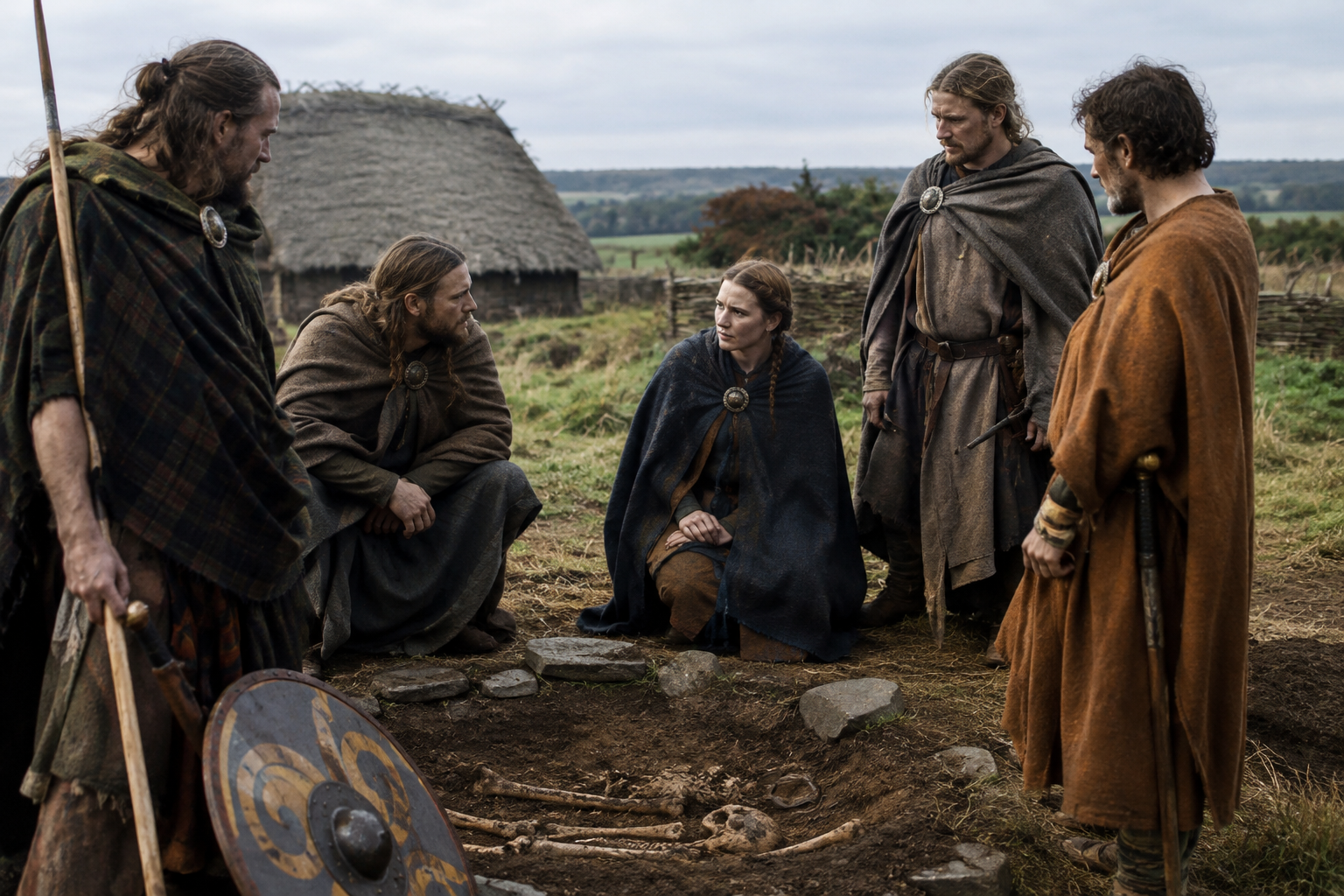
At Wetwang Slack in East Yorkshire, several men buried in the centuries just before the Roman conquest have become unexpectedly important for the history of one paternal line. Among them are I36970, I31009, and I30904, all dated to around 225 BC and associated with the Iron Age community often described as the Celtic Parisi of the Arras culture. For anyone exploring the Y-DNA haplogroup R1b1a1b1a1a2c1a2a, that cluster matters because it places this branch, or a closely associated assignment to it, in a very specific archaeological landscape: eastern Yorkshire, in the world of square barrows, chariot burials, and distinctive local burial traditions.
This is the useful thing about ancient DNA when it is handled carefully. Y-DNA traces one direct paternal line only, not the whole ancestry or identity of a person, but when several male burials from one region fall into the same narrow lineage pattern, it tells us that a particular paternal branch was not just passing through. It was part of the local human story in late prehistoric Britain.
Wetwang Slack is one of the best-known Iron Age cemetery landscapes in Britain, and it sits in a region where archaeology has long raised awkwardly interesting questions. East Yorkshire does not look exactly like everywhere else in Iron Age Britain. Its burial customs, especially the square-ditched barrows associated with the Arras culture, have often invited comparison with parts of continental Europe, while also remaining firmly local in their development.
The three Wetwang Slack individuals linked here - I36970, I31009, and I30904 - are therefore more than isolated genetic datapoints. Together they suggest continuity or recurrence of the same paternal background within one cemetery tradition. That does not mean every male in the community belonged to one lineage, nor that all were close relatives, but it does make this branch historically legible in a place where archaeology already hints at structured local identities and remembered descent.
A major ancient DNA study of Iron Age and Roman Britain, published in Nature, helped establish just how much regional patterning survived in Britain even as broader cultural worlds shifted. East Yorkshire repeatedly stands out as a place where local population history can be tracked through real burials rather than through later legend.
Wetwang Slack is not alone. Two more supplied ancient males connected with this haplogroup assignment come from nearby East Yorkshire sites: I21615 from Pocklington, dated to around 295 BC, and I28929 from Burton Fleming, dated to around 115 BC. Chronologically, that gives a spread of nearly two centuries within the same broader region.
Pocklington has become famous in recent years because the cemetery there widened the picture of what high-status and formal burial could look like in Iron Age Yorkshire. Burton Fleming, meanwhile, anchors the same paternal pattern in another local community. Taken together, Wetwang Slack, Pocklington, and Burton Fleming do not prove a single dynasty, but they do show a repeated male-line presence in the Yorkshire Wolds and surrounding landscape over generations.
That matters because the narrow haplogroup label R1b1a1b1a1a2c1a2a should not be lazily inflated into the whole history of R1b in western Europe. The parent haplogroup is widespread and ancient in many parts of Europe; this article's branch is much more specific. What these East Yorkshire burials show is not the origin of all R1b men, but the archaeological visibility of one particular paternal stream inside an Iron Age British population.
There is also a larger historical point here. For years, people discussed the "Celtic" character of Britain mostly through language, art, and classical texts. Ancient DNA has not replaced those debates, but it has changed the terms. A more recent preprint on Iron Age and Celtic-associated population history, available at bioRxiv, reflects this newer phase of research: not romantic tribes floating free of place, but real cemetery populations, dated individuals, and regional kinship structures.
The label "Celtic Parisi" appears in several of these sample descriptions, and it needs a little handling with care. In archaeology and ancient history, such names often come from later classical references matched to a region. They are useful shorthand, but they are not magic identity tags stamped on a skeleton. A man buried at Wetwang Slack around 225 BC was certainly part of an East Yorkshire Iron Age community; whether he would have recognised the same political or ethnic label used by Roman writers is a different question.
Still, the term is not empty. It points to a historically distinctive zone in eastern Britain, one that seems to have maintained recognizable customs and perhaps strong local lineages. The concentration of males associated with R1b1a1b1a1a2c1a2a in that setting gives the haplogroup a grounded context: not an abstract map spread across Europe, but a burial landscape with repeated paternal signatures.
That is exactly the sort of evidence family historians often want but do not always get. Not a vague statement that a lineage was "Celtic," but a more useful observation that men carrying this branch, or its immediate reported context, appear in late pre-Roman East Yorkshire among communities archaeologists can actually study.
The final supplied sample, I13730, comes from East Kent and is dated to around 300 BC. That is an intriguing addition because Kent was hardly a marginal backwater in the later Iron Age. It faced the Channel, was deeply entangled with continental contacts, and often shows a rather different material culture profile from Yorkshire.
So what does this Kentish occurrence mean? Sensibly handled, it means that the paternal line was not confined to a single cemetery cluster. It had a wider footprint in southern Britain before Rome. But one sample is not a migration narrative in miniature. We should resist the urge to draw a bright arrow from Yorkshire to Kent, or from Kent to Gaul, merely because the map is tempting.
What we can say is that the East Yorkshire cluster is strengthened, not weakened, by the Kent comparison. A branch that appears repeatedly in one regional population and also turns up elsewhere in Iron Age England begins to look less like an accident of preservation and more like part of the real paternal diversity of southern Britain in the centuries before conquest.
Some haplogroup articles end up being about grand geographic spread. This one is more satisfying because it is about concentration. R1b1a1b1a1a2c1a2a is linked here above all with a recognisable Iron Age milieu in England: East Yorkshire cemeteries, late pre-Roman dates, and communities archaeologists have debated for generations because of their unusual burial customs and regional identity.
That gives the branch a kind of historical texture. If your paternal line falls here, the ancient matches do not point vaguely to "the Celts" as a catch-all category. They point more specifically toward Iron Age Britain, and especially toward a region where male-line continuity may have mattered enough to leave a visible pattern in the burial record. That is not a promise of descent from any named tribe or notable family. It is something better: a defensible connection to real men buried in real landscapes, between roughly 300 BC and 100 BC, just before Britain entered the Roman world.
For this haplogroup, the strongest story is not imperial conquest or medieval pedigree, but local depth. The clearest ancient trail leads to East Yorkshire's Iron Age cemeteries, where several men associated with this paternal branch were buried across generations. That makes R1b1a1b1a1a2c1a2a one of those lineages best understood not through sweeping myth, but through the stubborn detail of place, date, and burial ground.






Comments