Haplogroup R1b1a1b1a1a2c1a1n

– 4 min read


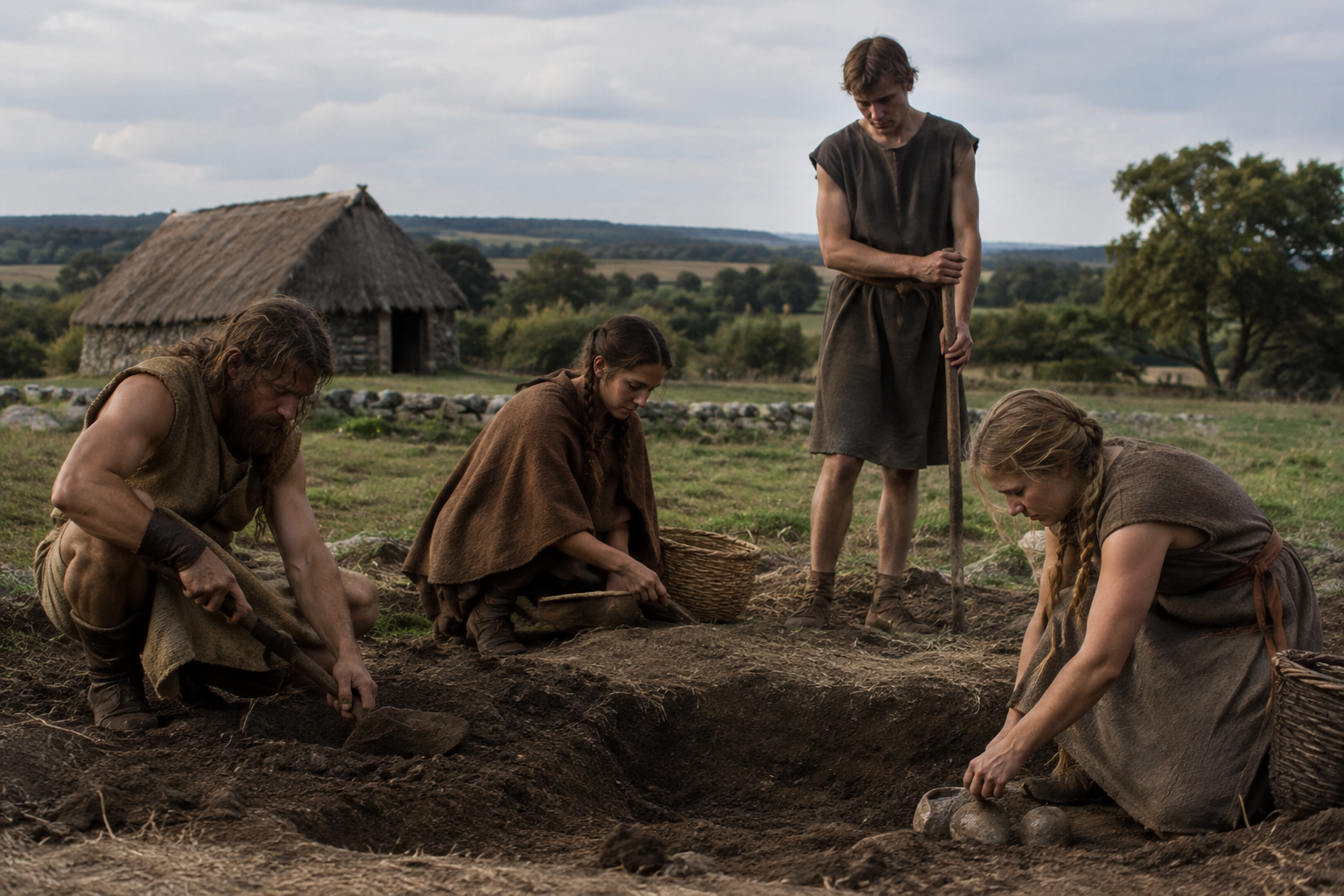
At West Heslerton in North Yorkshire, a cluster of Bronze Age men dated to around 1800 BC gives us an unusually focused glimpse of one paternal line in ancient Britain. The sample set includes KD070 and the closely associated individuals KD070_1, KD070_2, KD070_3, KD070_4, and KD070_5, all from the same broad site and period. For anyone exploring the Y-DNA haplogroup R1b1a1b1a1a2c1a1n, that concentration is the interesting fact: not a lone outlier, but a repeated appearance in one local Bronze Age landscape.
That matters because Y-DNA follows a direct paternal line only, not a person's whole ancestry, language, or identity. Even so, when the same branch appears in multiple ancient males from one region, it can hint at local continuity, a successful lineage, or a community in which closely related paternal lines were important over generations.
West Heslerton is one of those Yorkshire sites that repays attention because it sits in a region with a very long archaeological memory. By the early Bronze Age, this was not an empty frontier but a worked and inhabited countryside, shaped by farming, burial practice, and local ties that had already been developing for centuries. The men represented by KD070 and the related KD070_1 to KD070_5 samples belonged to that world.
What makes these individuals especially useful is not lavish biography, because none is securely available here, but the pattern they form together. A single Y-chromosome result can be intriguing; half a dozen related records from the same place and date become a proper historical clue. They suggest that the branch reported here was present in northern Britain well before the Iron Age, Roman period, or medieval genealogies that so often dominate public imagination.
An ancient DNA study of Britain and nearby regions, published in research on the genetic history of past populations in Britain, helped place such burials into a larger genomic framework. The broad lesson from this kind of work is that Bronze Age Britain was not genetically static: lineages spread, contracted, and sometimes became locally prominent.
The formidable-looking label R1b1a1b1a1a2c1a1n is a very narrow branch within the much wider R1b family. That wider R1b umbrella is well known in later prehistoric western Europe, especially after the population changes associated with the Bell Beaker horizon and the Bronze Age. But one must be careful here: the history of broad R1b is not automatically the history of this exact subclade.
So the safe point is a modest one, and therefore a useful one. These West Heslerton men show that this particular paternal branch, or a lineage reported under it, is associated with Bronze Age Yorkshire. That anchors the haplogroup in a real archaeological setting rather than leaving it as a purely modern testing label.
There is another important distinction. A branch turning up repeatedly at one site does not mean every man there shared it, nor that everyone in later northern England descended from these particular individuals. Archaeology works by accumulation, and here the accumulation is local and suggestive, not universal.
Public discussions of ancient DNA often gravitate to spectacular graves or named dynasties. Yet some of the best evidence for how paternal lines actually worked in prehistory comes from less glamorous site clusters. KD070 is informative precisely because it is accompanied by KD070_1, KD070_2, KD070_3, KD070_4, and KD070_5 from the same broad Bronze Age context.
That pattern may reflect a burial ground used by a community in which certain male lines were well established. It may also point to the ordinary demographic truth of prehistoric life: some paternal lines simply left more sons, more grandsons, and therefore more archaeological traces. We do not need to turn these men into chieftains to see the significance.
In Britain, repeated Y-line findings from prehistoric cemeteries and burial sites have increasingly shown that kinship could structure mortuary space and local society in ways that written history can never tell us. The result is not romance but resolution: the paternal past becomes less abstract and more human, even when names are lost.
It is worth pausing over the geography. North Yorkshire later became a place of Roman roads, Anglian settlements, Viking influence, and medieval lordship. But the West Heslerton evidence belongs to a much earlier chapter, when regional populations were already deeply rooted and yet still shaped by the great Bronze Age transformations that had remade Britain after the third millennium BC.
Those transformations were not only about metalwork. They also involved shifts in ancestry, burial custom, and social organization. A paternal branch like R1b1a1b1a1a2c1a1n, seen in this Bronze Age setting, belongs to that larger story of how incoming and locally established populations became the ancestors of later Britain.
That does not make the haplogroup "Yorkshire" in any exclusive sense, nor does it prove that later historic families in the region carried the same exact subclade. But it does show that this lineage had found a place in the fabric of ancient northern England by around 1800 BC, and that is a firmer historical statement than many sweeping claims made about haplogroups online.
Northern Britain kinship study
For a modern tester, the real value of these West Heslerton men is not that they supply a neat tribal badge. They do something better. They place your paternal line, or a very closely related one, in an excavated Bronze Age community in Britain, with sample IDs that belong to actual human remains rather than legend.
And the cluster sharpens the point. A single match can always feel accidental. Several men from the same place and period reported with the same narrow branch suggest that this was a living paternal presence in that community. It is exactly the sort of pattern archaeogenetics is good at recovering: not heroic origin myths, but the durable lines of descent that helped make ancient populations what they were.
Britain's later genetic history
The strongest insight for R1b1a1b1a1a2c1a1n is wonderfully concrete: this branch is tied here to a small cluster of men from Bronze Age West Heslerton in North Yorkshire, around 1800 BC. That does not tell the whole story of everyone who carries the haplogroup today, but it does give the lineage an archaeological home in prehistoric Britain. For anyone tracing a direct paternal line, that is often the most valuable thing ancient DNA can offer: not grandeur, but solid ground.
Comments