Haplogroup H1a1a4b

– 4 min read


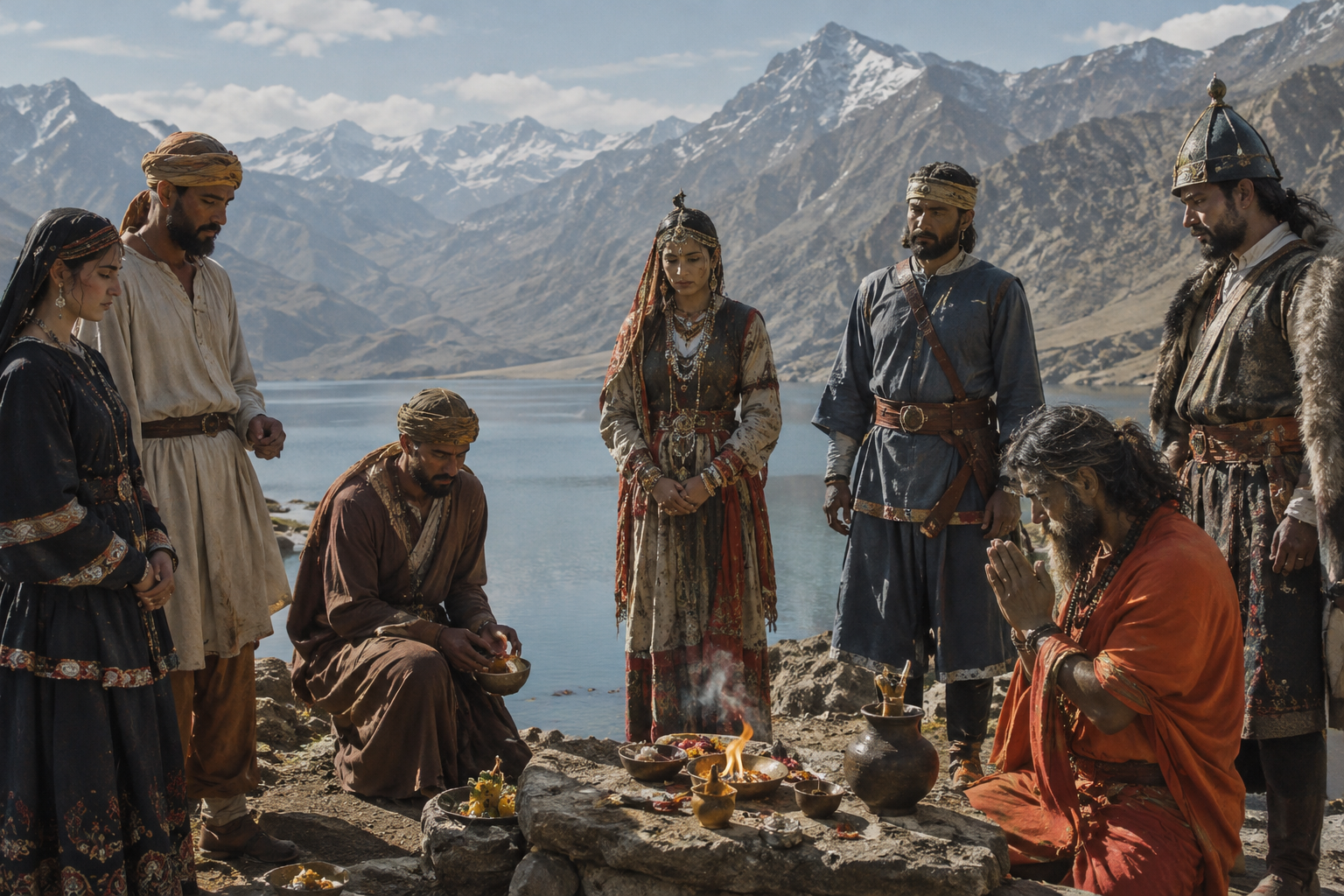
At Gonur in Bronze Age Turkmenistan, one ancient male sample stands out for anyone interested in haplogroup H1a1a4b: I10409, dated to around 2000 BC. Gonur was one of the major centers of the Oxus Civilization, also known as the Bactria-Margiana Archaeological Complex, a world of fortified settlements, irrigation, and long-distance exchange spread across the deserts and oases of Central Asia. When a paternal line associated with H1a1a4b appears there, it places this lineage not on the fringes of history, but inside one of the great Bronze Age contact zones.
That matters because H1 is an old South Asian and adjacent regional Y-chromosome lineage, while H1a1a4b is a much narrower branch within that wider family. Y-DNA follows one direct paternal line only - father to son to son - so it does not define a person's whole ancestry. But when the same branch or closely associated lineages appear repeatedly in ancient individuals from Turkmenistan, Iran, Pakistan, and later the Himalayas, they begin to sketch a very specific historical geography: the eastern Iranian world, the Indus borderlands, and the mountain corridors between them.
I10409 from Gonur is important not because one skeleton can explain a whole civilization, but because the site itself sat at a crossroads. The Oxus world linked southern Central Asia with eastern Iran, Afghanistan, and regions further toward the Indus. A genetic study of Bronze Age populations in this wider region, published in Science, helped establish just how interconnected these communities were, even while preserving distinct local histories.
For a bearer of H1a1a4b today, Gonur offers an arresting possibility: this paternal branch was present in a settled Bronze Age environment shaped by oasis agriculture and exchange, not simply by later steppe movements or medieval migrations. That does not mean every modern carrier descends from Gonur itself. It does mean that by the early 2nd millennium BC, this branch or its close paternal neighborhood had reached a major urbanized center in southern Central Asia.
An even earlier clue comes from I11459 at Shahr-e Sukhteh in Seistan, Iran, dated to around 2750 BC. Shahr-e Sukhteh - the "Burnt City" - is one of the great Bronze Age sites of the eastern Iranian plateau, tied into exchange networks reaching toward Helmand, Baluchistan, and the Indus world. If Gonur shows this paternal line in an Oxus oasis center, Shahr-e Sukhteh places it further south and earlier within another major settlement sphere.
That pairing is unusually valuable. It suggests that the ancestry associated with H1a1a4b was not confined to a single valley or one archaeological culture. Instead, the available ancient evidence points to a belt of interaction running from Seistan into southern Central Asia. The broad picture fits well with what archaeologists already know from material culture: Bronze Age communities in these regions were distinct, but regularly connected.
One must be careful here. A shared or related Y-line between Shahr-e Sukhteh and Gonur does not prove uninterrupted dynasty, ethnic identity, or a single migration event. What it does support is continuity of paternal presence across neighboring Bronze Age societies that were in contact for centuries.
By the Iron Age, the trail moves eastward into the northwest of the subcontinent. Sample I12447 from Barikot in the Swat Valley, dated to around 850 BC, and sample I12143 from Katelai, dated to around 900 BC, show the lineage's presence in a region famous for cultural layering. Swat was not an isolated mountain pocket. It was a corridor between Inner Asia and the plains, one that later fed into Achaemenid, Hellenistic, Kushan, and early historic worlds.
Research on ancient populations from the Swat Valley, including work published in Science, transformed understanding of how the region's people were shaped by multiple streams of ancestry over time. For H1a1a4b, the striking point is not that this branch explains Swat, but that it survived and circulated in a place where populations were mixing, settling, and reforming over many centuries.
The Swat and Katelai finds also help correct a common mistake in haplogroup storytelling. People often want a lineage to belong neatly either to "Iran," "India," or "Central Asia." Ancient DNA is not so tidy. These samples instead suggest a paternal line at home in the broad interaction zone between those worlds.
Kashmir and mountain corridors
The latest samples in this set come from the famous remains at Skeleton Lake, or Roopkund, in the Indian Himalayas: I3342, identified as a Hindu worshipper and dated to about AD 870, and I3407, identified as a Sindhi-Hunnic worshipper and dated to about AD 830. These labels reflect archaeological or interpretive classifications attached to the individuals, not simple ethnic facts. Still, the site is a remarkable reminder that a paternal lineage can persist through utterly different historical settings.
By the early medieval period, the world of Gonur and Shahr-e Sukhteh had been gone for millennia. In its place stood a landscape of pilgrimage, regional kingdoms, trade routes, and mobile communities crossing difficult mountain terrain. To find this haplogroup associated with individuals at Skeleton Lake is to see not a frozen Bronze Age relic, but a living paternal line still moving through South Asian history.
That long survival is perhaps the most human part of the story. A Bronze Age oasis dweller, an inhabitant of the eastern Iranian plateau, an Iron Age man from Swat, and medieval dead in a Himalayan pilgrimage setting did not belong to one people in any simple sense. Yet a direct paternal thread can still connect them across four thousand years.
On present evidence, H1a1a4b looks less like a lineage tied to one famous empire than one rooted in the older connective tissue of Asia: the eastern Iranian plateau, southern Central Asia, the northwest of the subcontinent, and the uplands beyond. Its ancient appearances cluster in exactly the kinds of places where archaeologists expect movement, exchange, and local continuity to overlap.
For someone researching this paternal haplogroup today, that is the real takeaway. H1a1a4b does not point to a single royal house or a tidy one-step migration story. Instead, it suggests a deep male-line presence in the intertwined histories of Iran, Central Asia, and South Asia - a lineage already visible in Bronze Age urban worlds and still traceable in later mountain communities many centuries afterward.






Comments