Haplogroup G2a2b2a1a1a1a

– 5 min read


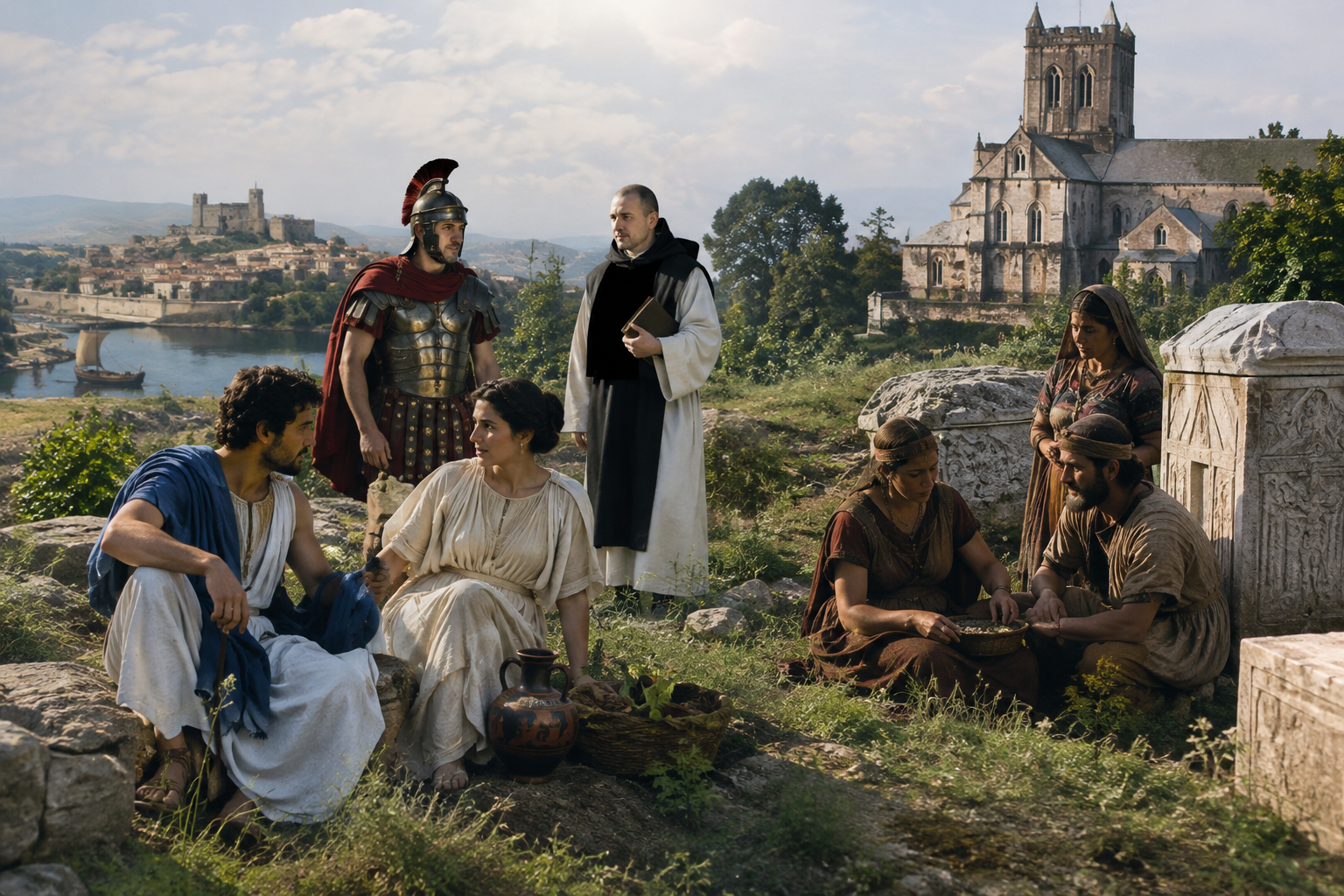
At Mursa in Roman-era Croatia, one ancient man dated to around AD 200 appears in the record as sample I26753. On its face that is a small fact: one male burial, one Y-chromosome line, one point on the map of the empire. But it becomes more interesting when the paternal lineage attached to him, G2a2b2a1a1a1a, turns up again in places that belonged to very different worlds: a Greek colony in Sicily, burials from the Lydian kingdom in western Anatolia, and a medieval monastery cemetery in London.
That spread does not mean a single family wandering intact across fifteen centuries. It means something both more modest and, in historical terms, more revealing. Y-DNA tracks one direct paternal line only, not a whole ancestry, yet even that narrow thread can show how certain male lineages persisted in old Mediterranean population networks and later reappeared in very different urban and imperial settings.
Mursa, at modern Osijek in Croatia, sat in a part of the Roman world where roads, armies, merchants, and administrators constantly moved between the Adriatic, the Danube, and the Balkans. A lineage like G2a2b2a1a1a1a appearing there in sample I26753 is therefore not surprising in the crude sense that Roman towns were mixed places. What matters is that this branch does not look, from the small set of ancient examples here, like an exclusively local Balkan curiosity.
Instead, the pattern points toward a paternal line already at home in the eastern and central Mediterranean before we meet it in Roman Pannonia. That wider context fits what ancient DNA studies have repeatedly shown about the empire: Roman-period communities were often genetically diverse, with people and lineages circulating far beyond any single province. Research on Roman-era population history has emphasized exactly this scale of movement and mixture across imperial space, including the eastern Mediterranean contribution to many Roman communities in a major ancient DNA study.
For someone carrying this haplogroup today, Mursa is useful not because it proves a Roman identity, but because it places the lineage inside a documented imperial contact zone. In other words, this branch was present in the sort of place where local, regional, and long-distance ancestries routinely met.
One of the most evocative appearances of this haplogroup is sample I20168, dated to around 550 BC and described as an ancient citizen of the Greek colony of Himera in Sicily. Himera was no mere outpost at the edge of the Greek world. It was part of the intensely connected western Mediterranean, where Greeks, indigenous Sicilians, and Phoenician-Punic populations all operated within trading, military, and political spheres that overlapped as much as they collided.
A paternal line such as G2a2b2a1a1a1a in that setting is historically plausible in several ways, and that is precisely why caution matters. It does not tell us that the man was "ethnically Greek" in some pure or modern sense. Nor does it let us declare that the haplogroup itself was uniquely Greek. What it does show is that this line belonged within the male population of a classical-era Sicilian city shaped by colonization, intermarriage, and mobility.
That makes Himera especially valuable for this article's story. It anchors the lineage in the Archaic Mediterranean, not simply in later Roman circulation. Sicily is one of those places where archaeology steadily corrects neat textbook categories; the island's ancient populations were layered, mixed, and locally specific.
The strongest cluster in the present evidence comes from western Anatolia. Three individuals from the Samantas Necropolis at Yatağan, all dated to around 615 BC, are listed with this haplogroup: I20230, I20225, and I20258. They belong to the world of the Lydian kingdom, a society famous in ancient history for its western Anatolian power, urban wealth, and position between the Aegean Greek cities and the interior of Anatolia.
Now, three men from one necropolis do not automatically equal a dynasty, a clan cemetery, or even close paternal kin. But repeated appearances of the same Y-line in one Iron Age burial ground do matter. They suggest that G2a2b2a1a1a1a was not a one-off arrival in this region. It had some local foothold in the male population of Lydian-period Anatolia.
That is important because western Anatolia was one of the great hinge-zones of first-millennium BC history. Lydians dealt with Greeks, Persians, and neighboring Anatolian peoples, and their territory sat squarely in the corridor connecting inland Asia Minor to the Aegean coast. An ancient DNA study on Mediterranean and neighboring populations has helped illuminate just how connected such zones were, and how local populations could preserve older regional ancestry while still participating in broader historical transformations through archaeogenetic research.
If there is a center of gravity in this small sample set, it is here. Not because Anatolia can be declared the origin of this exact terminal branch from these few records alone, but because the Lydian cluster gives the lineage its densest and earliest securely listed concentration in the evidence at hand.
The latest sample in this set is LG13, from the Cistercian Abbey of St Mary Graces in London, dated to about AD 1350. That is a striking shift in setting. We are no longer in Iron Age Anatolia or the classical Mediterranean, but in a major medieval city shaped by commerce, pilgrimage, disease, immigration, and ecclesiastical life.
St Mary Graces itself is a well-known London burial site, and the monastery belonged to the troubled decades around the Black Death. The important point is not to romanticize the individual, because the simple record does not license that. The point is that the same paternal branch appears in medieval England, inside one of Europe's busiest and most internationally connected cities.
London is exactly the sort of place where old continental and Mediterranean lineages could surface in later centuries without requiring any melodramatic migration tale. Merchants, clerics, artisans, soldiers, and families had been arriving in the city for generations. The presence of LG13 therefore fits a broader medieval urban pattern better than any one tidy origin story. The cemetery's archaeological setting is documented by the Museum of London's work on St Mary Graces, which places this man in a real institutional and historical landscape rather than as a floating genetic datapoint.
Medieval Mediterranean Diversity
With a branch as specific as G2a2b2a1a1a1a, one has to resist the temptation to inflate it into a civilization-sized label. The broader haplogroup G, and especially parts of G2a, has a deep association with early farming populations in western Eurasia. But that broad background should not be lazily projected onto this exact terminal lineage as though nothing changed over millennia.
What the present ancient examples support is narrower and more useful. This branch appears in first-millennium BC western Anatolia, in Archaic Sicily, in Roman Croatia, and in medieval London. That distribution makes it look like a durable Mediterranean-associated paternal line that later participated in the wider movements of classical and medieval history.
That does not make every modern bearer "Lydian," "Greek colonial," "Roman," or "medieval English." It does suggest that this paternal line was circulating in populations linked, directly or indirectly, to the eastern and central Mediterranean long before some of its descendants turned up farther afield.
The most distinctive thing about G2a2b2a1a1a1a is not sheer antiquity on its own, but continuity across very different historical settings. In the evidence here, the branch is most at home in the old Mediterranean world: especially western Anatolia and Sicily, then later within Roman and medieval urban networks. For family historians, that is a sober but intriguing clue. Your direct paternal line may preserve a thread that ran through some of the busiest contact zones of ancient and medieval Eurasia, surviving not as a grand dynasty, but as part of the ordinary persistence of men, families, and communities across changing empires.






Comments