Haplogroup J2a1a1a2b2a2b2

– 5 min read


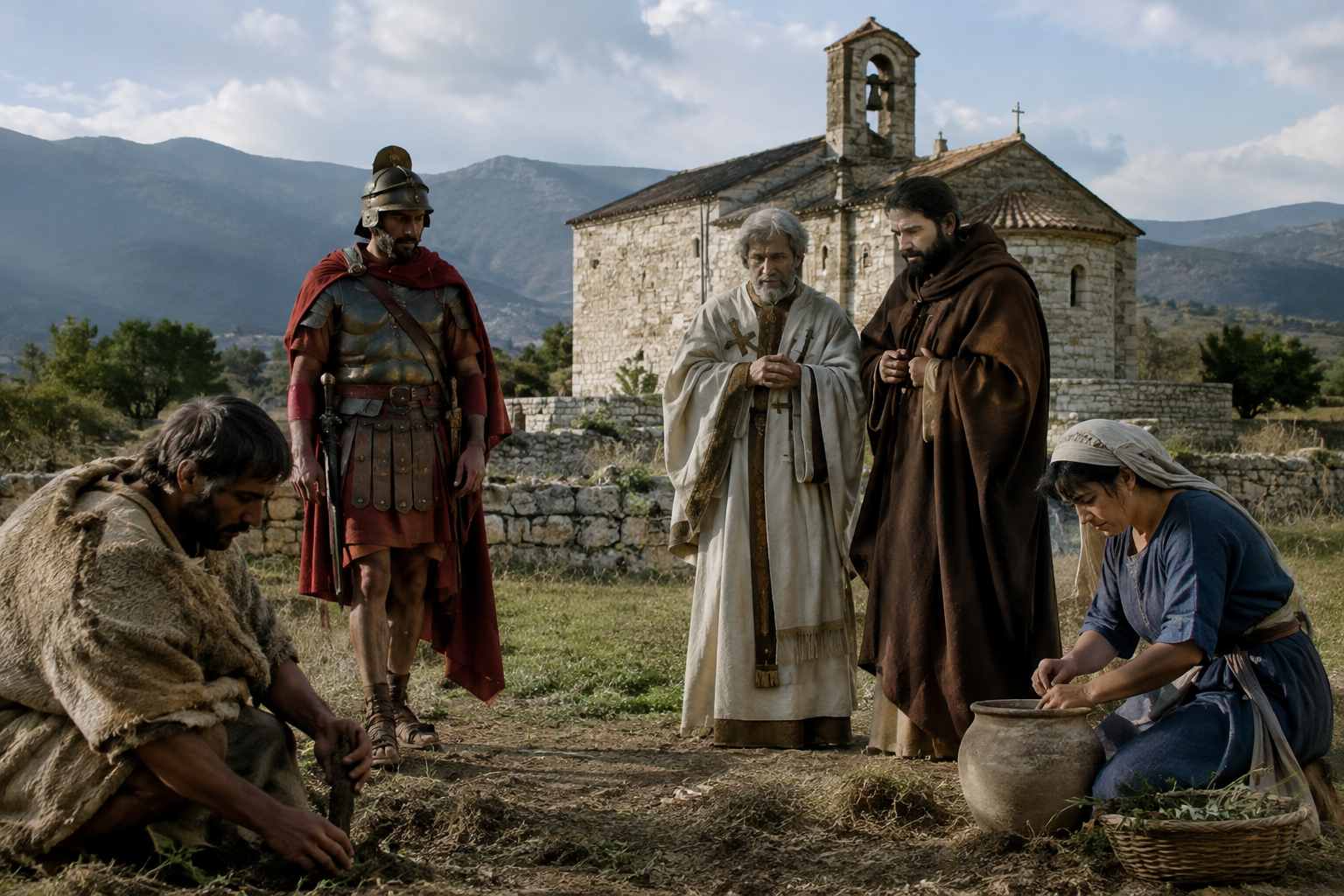
At Amiternum in Abruzzo, two men buried in the early medieval cemetery of Santa Maria in Civitate, ASM_S34 and ASM_S35, offer the clearest starting point for thinking about Y-DNA haplogroup J2a1a1a2b2a2b2. They date to around AD 800 and AD 876, in a landscape where Roman urban life had long been reshaped but not erased. That matters, because this is not a lineage appearing once, dramatically and inexplicably, on the margins. Here it turns up in the same central Italian setting across the early medieval period, suggesting continuity as much as movement.
That is an important distinction. Y-DNA follows one direct paternal line only, not the whole ancestry of a person or community. Even so, when the same paternal branch appears in several ancient individuals from Italy and nearby parts of the Roman world, it becomes a useful clue for reconstructing how male lineages persisted through changing political worlds: Neolithic settlement, Roman expansion, and the post-Roman centuries.
The two Amiternum individuals are especially valuable because they belong to a site already known for showing the long transition from Roman to early medieval Italy. Amiternum, inland in Abruzzo, was once a Roman town; by the early Middle Ages, its people were living among older structures, older roads, and older memories, but under very different social conditions. A genetic study focused on these burials has made the site one of the better windows onto continuity and change in central Italy, as discussed in research on the ancient population of Amiternum.
For haplogroup J2a1a1a2b2a2b2, the point is not that these two men founded anything identifiable, nor that they can be turned into a miniature dynasty. It is simpler and more interesting than that. Their presence suggests that a paternal line associated with the broader J2 world was still established in inland Italy centuries after the Western Roman Empire, surviving the political fragmentation that followed.
And Amiternum is not isolated in this story. The same branch is represented in earlier and later settings that make the Italian evidence look less like a local accident and more like part of a durable Mediterranean pattern.
One of the most suggestive earlier finds is I12665, dated to around 205 BC at Birgi in Sicily, during the Roman Republic era. Sicily is exactly the sort of place where one should be cautious and concrete at the same time. It was a zone of deep entanglement: indigenous communities, Greek colonies, Punic connections, and then Roman domination. A Y-line found there in the late third or early second century BC sits in a world already shaped by centuries of mobility across the central Mediterranean.
That does not let us assign this man a language, an ethnicity, or a political loyalty from his Y chromosome. But it does place the paternal branch in a region where eastern Mediterranean and local Italian histories had been interacting for a very long time. If the Amiternum burials show later continuity in central Italy, Birgi hints that related paternal ancestry was already present in a major island crossroads during the Republican period.
Sicily is also one of the best reminders that lineages do not travel by themselves. Men carrying branches within J2 moved, settled, married locally, and became part of entirely new communities. The archaeology of the island repeatedly shows mixture rather than neat ethnic compartments.
A third useful anchor is RKF243 from Rakoczifalva-Szolnok in Hungary, dated to about AD 250 in the Late Roman period. On the face of it, this looks quite different from the Italian samples. We are now in the Carpathian Basin, on the edge of the Roman world and in a region famous for population movement, military recruitment, trade, and local persistence all at once.
That is precisely why the sample matters. A paternal branch linked here with J2a1a1a2b2a2b2 appearing in Late Roman Hungary does not prove a single migration route from Italy, nor an eastern newcomer in any simple sense. What it does show is that lineages of this broader family were present in Roman-period populations well beyond the peninsula. In the empire, men moved through army service, commerce, colonization, marriage, and ordinary provincial life. A branch turning up in Hungary as well as Italy fits that historically messy reality rather well.
Roman-period ancient DNA has steadily reinforced this picture of diversity and mobility. One influential broad study of the empire and its surroundings, published in Science, helped establish just how mixed Roman-era populations could be across different provinces, though each cemetery still needs to be read in its own local context.
The oldest sample in this group, R19 from Ripa Bianca in Italy, is dated to around 5300 BC. This is a very different world again: early farming communities, long before Rome, before classical Sicily, before any medieval cemetery in Abruzzo. If the association of this sample with the article's branch is correct, it pushes the paternal story dramatically deeper into the Neolithic of the peninsula.
That would be striking, because the broader haplogroup J2 is often discussed in connection with the spread of farming and with ancient populations around the Aegean and Near East. But one must keep the scale right. The broad history of J2 cannot simply be pasted onto the narrow subclade J2a1a1a2b2a2b2. What this sample can responsibly suggest is that paternal lines within this larger family were present in Neolithic Italy very early indeed, making later Roman and medieval appearances in Italy look potentially less like fresh arrivals and more like part of a very long local history, though with all the interruptions and admixture one would expect over millennia.
Seen together, R19 and the Amiternum men create the most arresting span in the evidence: from Neolithic Italy to early medieval Italy, the same fine-grained paternal label appears in the record. That is not proof of an unbroken family tree from one excavated man to another. It is, however, a strong reminder that some paternal branches can remain in the same broad region for astonishing lengths of time while the societies around them change almost beyond recognition.
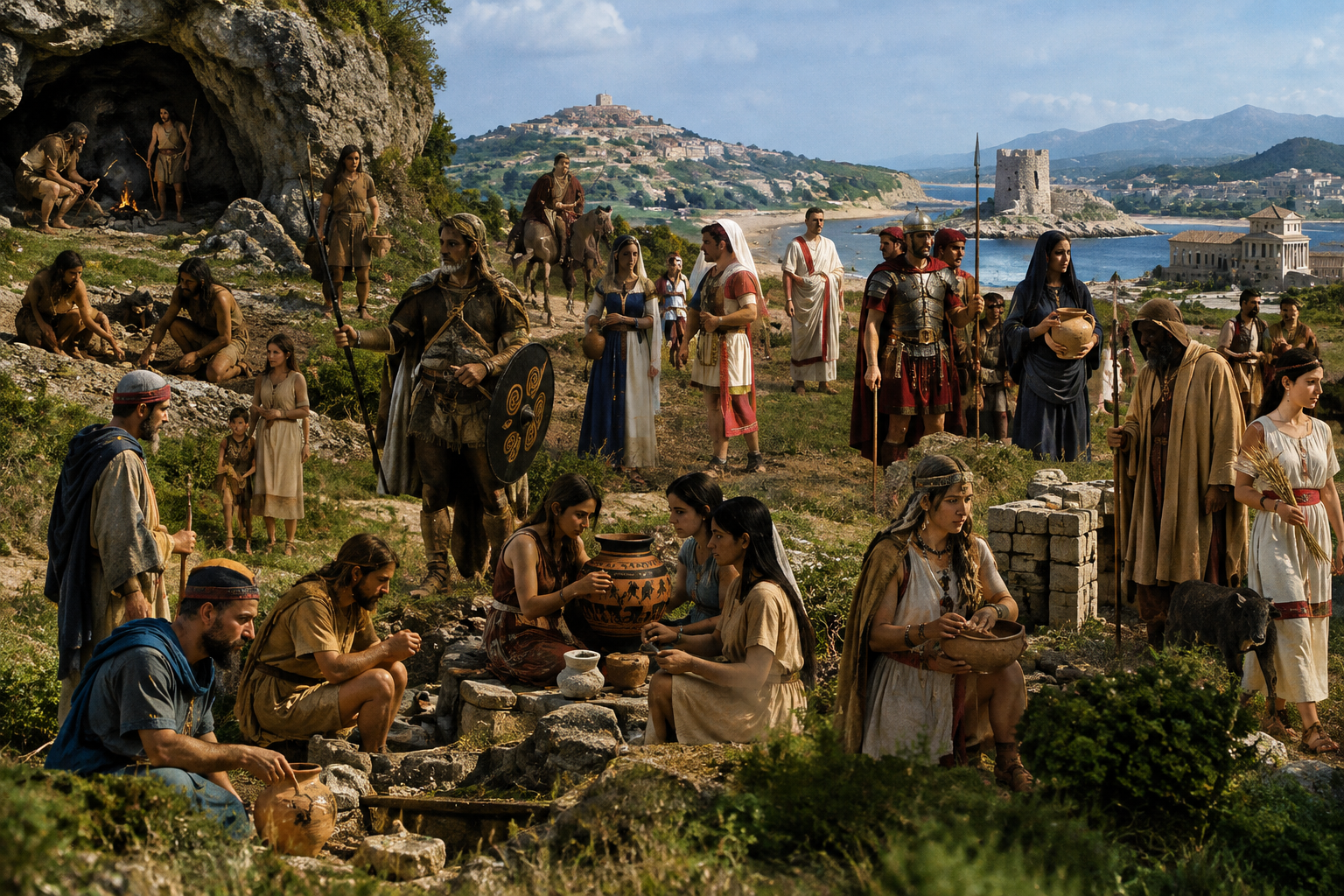
With the evidence currently in hand, J2a1a1a2b2a2b2 looks less like the badge of one famous people than like a durable Mediterranean-connected paternal thread. Its ancient appearances cluster most clearly around Italy, with a Roman-period extension into Hungary and a Republican-era presence in Sicily. That is exactly the sort of distribution one might expect from lineages shaped by early farming dispersals, later urban and maritime networks, and the integrative machinery of the Roman world.
Just as importantly, the pattern is not purely coastal and not purely elite. Amiternum is inland; Rakoczifalva-Szolnok belongs to a frontier-facing provincial world; Birgi sits in a classic island crossroads; Ripa Bianca reaches back to the first farmers. The branch therefore appears in quite different archaeological settings, which is often more informative than seeing it repeated in one narrow context.
For someone exploring J2a1a1a2b2a2b2 today, the most grounded takeaway is this: the branch is ancient in the Italian archaeological record and appears in communities shaped by some of the biggest transitions in European history. It is seen among early farmers, in a Republican-era Sicilian context, in the Roman world beyond Italy, and in early medieval Abruzzo. That does not tell you a surname, a tribe, or a single homeland story. It does suggest a paternal line with long roots in the Mediterranean world, and with a history tied to continuity as much as to movement.
Comments