Haplogroup R1b1a1a2a1a2

– 5 min read


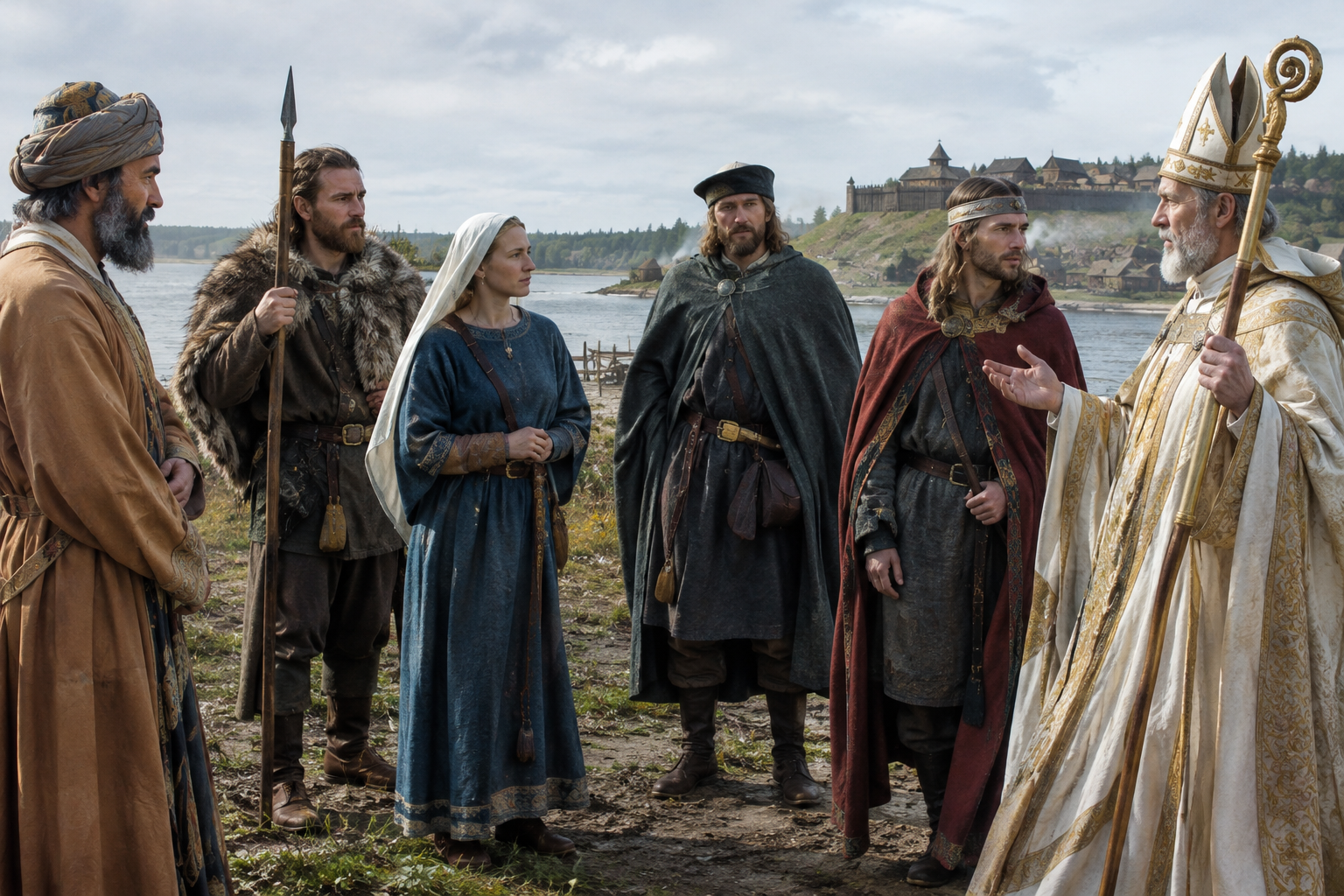
One of the clearest anchors for haplogroup R1b1a1a2a1a2 in this set of evidence is a man from medieval Sigtuna in Sweden: sample mbs092, dated to around AD 1100. Sigtuna was no obscure village. It was one of the first towns of the Swedish kingdom, a place where royal authority, Christianity, trade, and migration all met. Finding this paternal line there is interesting not because it proves some grand saga on its own, but because it places the lineage inside a very real urban world of the high Middle Ages.
That point matters. Y-DNA follows one direct paternal line only, and not a person's whole ancestry. Even so, when the same branch turns up in several medieval and post-Roman settings, from Pannonia to Sweden and as far as late medieval Uzbekistan, it begins to look less like a local curiosity and more like a lineage moving through the connected worlds of Europe and Inner Eurasia.
Sigtuna in the late Viking Age and early medieval period was exactly the sort of place where ancestry becomes historically textured. Merchants, craft workers, clergy, political elites, and newcomers all passed through or settled there. Sample mbs092 belongs to that urban setting, and another individual in the wider Sigtuna material, stl002, dated to about AD 975, is described as a Viking Age Celtic mix from Sigtuna. That label is useful because it reminds us that early Scandinavian towns were not genetically sealed worlds; they were open to movement across the North Sea and Baltic.
In that context, R1b1a1a2a1a2 is best understood not as a "Swedish" marker in any simple ethnic sense, but as part of the paternal variety present in a town shaped by exchange and conversion. Research into medieval Swedish burials has increasingly shown how town populations could include both local continuity and long-distance family histories. A project focused on kinship in medieval Swedish multiple burials helps frame this wider setting, even when one individual sample must still be treated with caution and specificity: research on genomes from medieval Swedish burials.
Sigtuna also gives us a useful warning against overconfidence. A town can contain men from very different paternal backgrounds, and one haplogroup never equals one people. But if your direct paternal line falls within R1b1a1a2a1a2, Sigtuna shows that this branch was present in a Scandinavian urban community at the moment when Viking Age networks were turning into medieval kingdoms.
A second Swedish appearance comes from mbv151 at Vasterhus, dated to about AD 1313. Vasterhus, on the island of Frösön in Jamtland, belongs to a rather different sort of setting from Sigtuna. Instead of an early royal town, this is medieval inland Scandinavia, tied to parish life, regional society, and the routines of a Christian community.
That contrast is what makes the sample valuable. The same haplogroup turning up in both Sigtuna and Vasterhus suggests that this paternal branch was not confined to one narrow coastal or mercantile niche. It appears in more than one medieval Scandinavian context, which is a stronger historical observation than any dramatic claim about a single migration event.
Archaeology often works like this. A single striking grave catches the eye, but patterns across different communities tell the deeper story. Here the pattern suggests that R1b1a1a2a1a2 could be part of the ordinary male landscape of medieval northern Europe, carried by men living very different lives under the same broad Christian order.
The sample HMU064, dated to about AD 525, comes from Scarbantia/Hegyko Barbaricum in Hungary, in the post-Roman period of Pannonia. Now this is a very different historical theatre indeed. The western Roman Empire had collapsed, old provincial structures were breaking up or being repurposed, and the Carpathian Basin was becoming a zone of intense movement, negotiation, and mixed communities.
That is why a paternal lineage like R1b1a1a2a1a2 is so interesting here. In post-Roman frontier regions, people labelled "Roman" and "barbarian" in older histories were often living in close proximity, intermarrying, shifting allegiances, and adopting new identities. A genetic study of this wider period has helped underline that complexity rather than tidying it away into neat ethnic boxes: research on post-Roman populations of the region.
HMU064 does not let us name a tribe or assign a language with certainty, and we should resist that temptation. What it does provide is a fixed point for the lineage in the former Roman borderlands of central Europe at a time when older imperial categories were dissolving. If the Swedish evidence shows the branch in medieval northern communities, HMU064 shows it earlier in a zone where late antiquity turned into the early Middle Ages.
One of the named individuals in this group is Bishop Peder Winstrup, sample LUND1n, dated to AD 1679. Here we move into the early modern world, where the line is no longer represented only by anonymous burials but by a historical figure with a documented life. Winstrup was bishop of Lund, a leading churchman in a region shaped by the long contest between Denmark and Sweden.
His presence is a neat reminder that Y-DNA lineages do not belong only to prehistoric migrations or warrior-age romance. They continue quietly through literate, bureaucratic, confessional Europe as well. A paternal line that also appears in medieval towns and post-Roman borderlands is, by the seventeenth century, found in an educated ecclesiastical elite. That does not make the lineage noble or exceptional; it makes it historically continuous.
And continuity, in history, is often the most surprising thing of all. Kingdoms change, languages shift, churches reform, but paternal lines can thread straight through those upheavals, attaching themselves to utterly different kinds of lives.
The easternmost sample here is TGA012b, from Tell Garden Lungi Tepa in Uzbekistan, dated to about AD 1500. Even with limited contextual detail, the location is enough to widen the frame. This is a Silk Road world, or rather the late afterlife of many Silk Road worlds: oasis towns, imperial competition, Islamic scholarship, trade corridors, and long histories of mixture across Central Asia.
R1b lineages as a broad family have deep and varied histories across western Eurasia, but one must be careful not to dump all of that history wholesale onto the narrower branch R1b1a1a2a1a2. What TGA012b shows, more modestly and more usefully, is that this exact article haplogroup is represented not only in European medieval contexts but also in late medieval Central Asia. That makes this branch geographically wide in the surviving evidence, even if the route by which any one family reached Uzbekistan remains unknown.
It is tempting to turn such a spread into a single tidy migration story. Better not. Central Asia, like Scandinavia and Pannonia, was a meeting ground. The more responsible conclusion is that this paternal line could travel within very different political and cultural systems, and that its carriers were part of the ordinary human traffic linking Europe and Asia.
For R1b1a1a2a1a2, the striking feature is not one legendary founder or one royal house, but its appearance in several historically dense settings: post-Roman Hungary, Viking Age and medieval Sweden, early modern Lund, and late medieval Uzbekistan. Taken together, these samples suggest a paternal line at home in the mobile, mixed, and often urban worlds that connected Europe with the wider Eurasian continent. If this is your branch, the safest historical reading is not a single ethnic label, but a lineage that repeatedly surfaces where frontiers, trade, faith, and political change met.






Comments