Haplogroup Q1a2a1c

– 4 min read


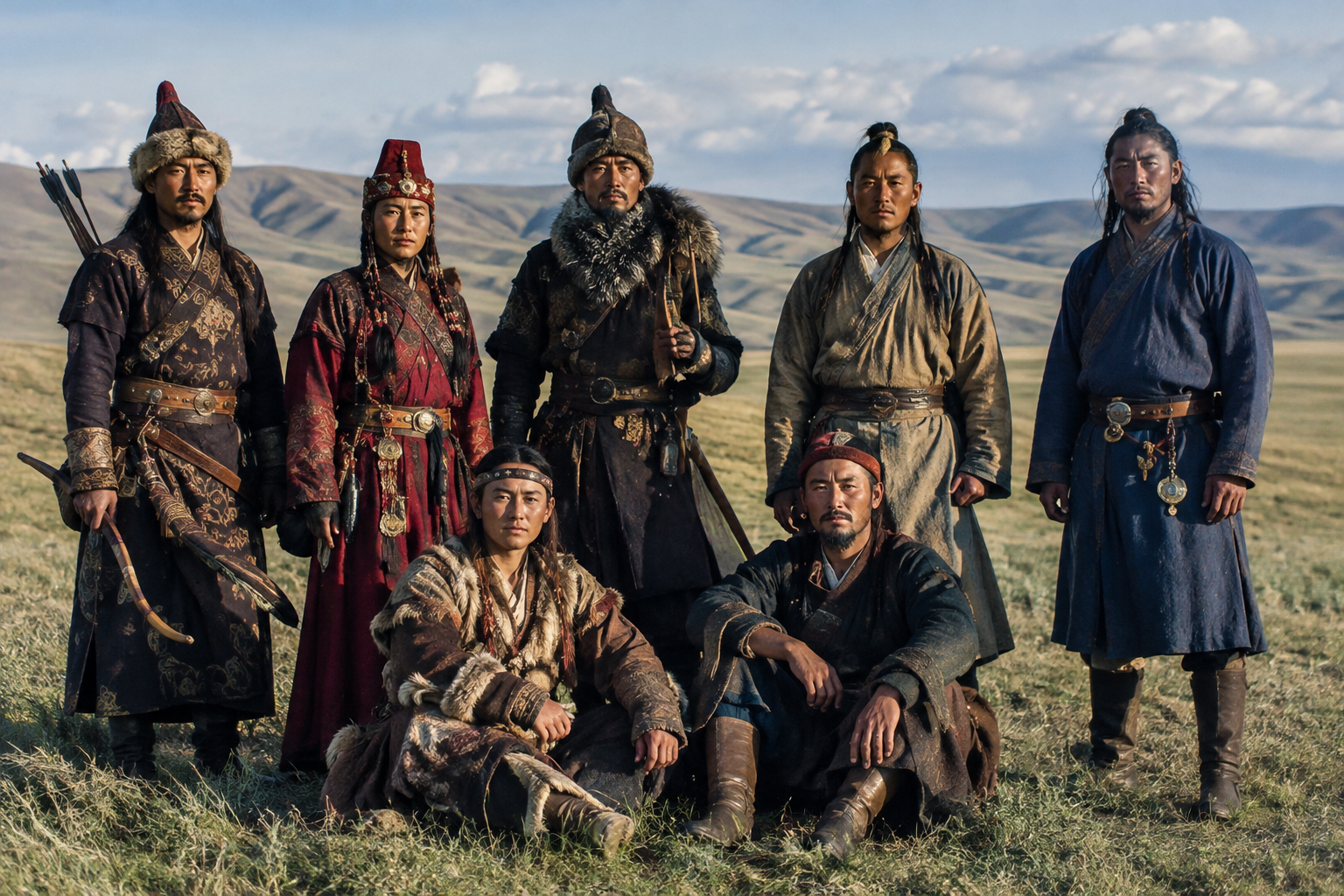
At Berel in the Kazakh Altai, a cluster of burials spans a remarkable stretch of steppe history. Among the ancient men associated here with Y-DNA haplogroup Q1a2a1c are BRE002, dated to around 270 BC and identified with the Saka-Scythian world of the Pazyryk necropolis, BRE005 from about 50 BC at the same broader setting, and BRE013 from around AD 300, described as Xianbei Hun from Berel. That is an arresting pattern: one paternal branch appearing in the same wider region across very different political and cultural moments.
It is worth being precise about what that means. Y-DNA traces one direct paternal line only, not a person's whole ancestry or identity. Even so, when the same branch turns up repeatedly in the Altai and neighboring Mongolia from the Late Bronze Age into the Xiongnu and post-Xiongnu eras, it becomes historically interesting. Q1a2a1c, in this small set of ancient results, looks less like a single dramatic migration and more like a durable eastern steppe lineage moving through changing confederations, burial traditions, and imperial horizons.
Berel is famous because the Altai is one of those places where archaeology refuses to stay tidy. The same mountain-steppe zone can preserve traces of elite Iron Age burial traditions, later nomadic groups, and the shifting frontier between Inner Asian powers. In this case, the sample labels themselves already tell an important story: BRE002 and BRE005 are linked to the Saka-Scythian Pazyryk milieu, while BRE013 belongs to a much later horizon described as Xianbei Hun.
That does not make all three men members of one family, still less of a single ruling house. But it does suggest that the paternal line represented by Q1a2a1c had real staying power in the eastern steppe. Archaeologically, that matters because Berel sits in a zone where historians once liked to imagine clean ethnic succession: Scythians, then Xiongnu, then Huns, then others. Ancient DNA tends to spoil that tidy parade. The region was often a place of overlap, absorption, and continuity as much as replacement.
An ancient DNA study of Iron Age and later steppe populations in this region helped clarify just how mixed, mobile, and locally persistent these communities could be, especially in the Altai and adjoining степpe worlds; one of the key research papers associated with these burials is here. For Q1a2a1c, Berel gives us a grounded historical setting rather than a mythical origin story: real men, in a real cemetery landscape, separated by centuries but tied to the same broad corridor of movement.
If Berel shows endurance, Arbulag Soum in Mongolia pushes the story earlier. Three Late Bronze Age individuals from around 1060 BC, ARS008, ARS016, and ARS001, are associated with this haplogroup in the material supplied here. That is significant because it places Q1a2a1c in eastern steppe contexts well before the classic historical names, before the Xiongnu, before the Huns of late antique imagination, and before most written sources have anything useful to say.
This earlier appearance matters for another reason. It warns us not to reduce every eastern steppe lineage to the better-known imperial confederations of the first millennium BC and AD. By the Late Bronze Age, Mongolia already contained societies with mixed economic strategies, long-distance contacts, and complex local developments. A paternal lineage present there at this date belongs to that deeper prehistoric background, not merely to later headline empires.
That is often the awkward but valuable lesson of archaeogenetics. The labels familiar from classical texts or Chinese chronicles can dominate how we think, yet lineages themselves may have been rooted in local populations centuries earlier. For someone carrying Q1a2a1c today, Arbulag Soum suggests that this paternal branch belonged to the older demographic fabric of Inner Asia, not simply to one brief conquering episode.
The sample BTO001, dated to around AD 50 and described as Late Xiongnu Period from Burkhan Tolgoi, adds a crucial middle chapter. Here the haplogroup appears in a context tied to the great imperial formation that reshaped the eastern steppe and loomed so large in Chinese historical writing. Again, one must be careful: a single Y-chromosome result does not define the Xiongnu as a whole. But one result can still show that Q1a2a1c participated in that world.
And the Xiongnu world was not simple. It joined local steppe populations, incoming groups, political allies, dependents, and conquered communities into a large and uneven confederation. A paternal lineage seen earlier in Bronze Age Mongolia and later at Berel fits rather well with that broader archaeological picture. Rather than a sudden appearance, we may be looking at one thread running through several reorganizations of steppe society.
Research connected with ancient Mongolia and surrounding regions has repeatedly shown that political confederations there were genetically diverse, with continuity in some lines and fresh mixture in others. Another associated research link, preserved here exactly as provided, is this supplementary research material. Even without pressing it too hard for details not stated in the sample list, its relevance lies in the wider effort to map how populations of the Mongolian steppe changed over time.
There is a temptation, whenever a lineage appears in Scythian, Xiongnu, or Hun-associated settings, to turn it into a badge of ethnicity. Archaeology is rarely so obedient. The men represented by BRE002, BRE005, BRE013, ARS008, ARS016, ARS001, and BTO001 belonged to communities shaped by burial customs, alliances, local traditions, and broad ancestry profiles that cannot be reduced to one paternal marker.
Still, the pattern is meaningful. In this evidence set, Q1a2a1c appears repeatedly in the Altai-Mongolia zone across more than a millennium, from the Late Bronze Age through Iron Age Saka contexts and into the Xiongnu and later Xianbei-Hun horizon. That gives the branch a very particular historical flavor: eastern steppe, long-lived, and embedded in societies that were mobile but not rootless.
It also helps correct a popular misconception about the steppe as a place of endless total replacement. Sometimes there was replacement; sometimes there was mixture; and sometimes old lines plainly persisted through new political names. A lineage can survive the fall of confederations much more easily than a history textbook suggests.
For a modern tester belonging to Q1a2a1c, the strongest responsible conclusion is not a claim to one famous tribe, but a connection to the deeper human landscape of Inner Asia. The ancient evidence tied to this branch places it among men living in Mongolia and the Altai from the Late Bronze Age to late antiquity, in settings linked to Saka-Scythian, Xiongnu, and Xianbei-Hun worlds. That is a substantial historical range: not a romantic legend, but a durable paternal footprint across the eastern steppe.






Comments