Haplogroup R1b1a1b1b1

– 5 min read


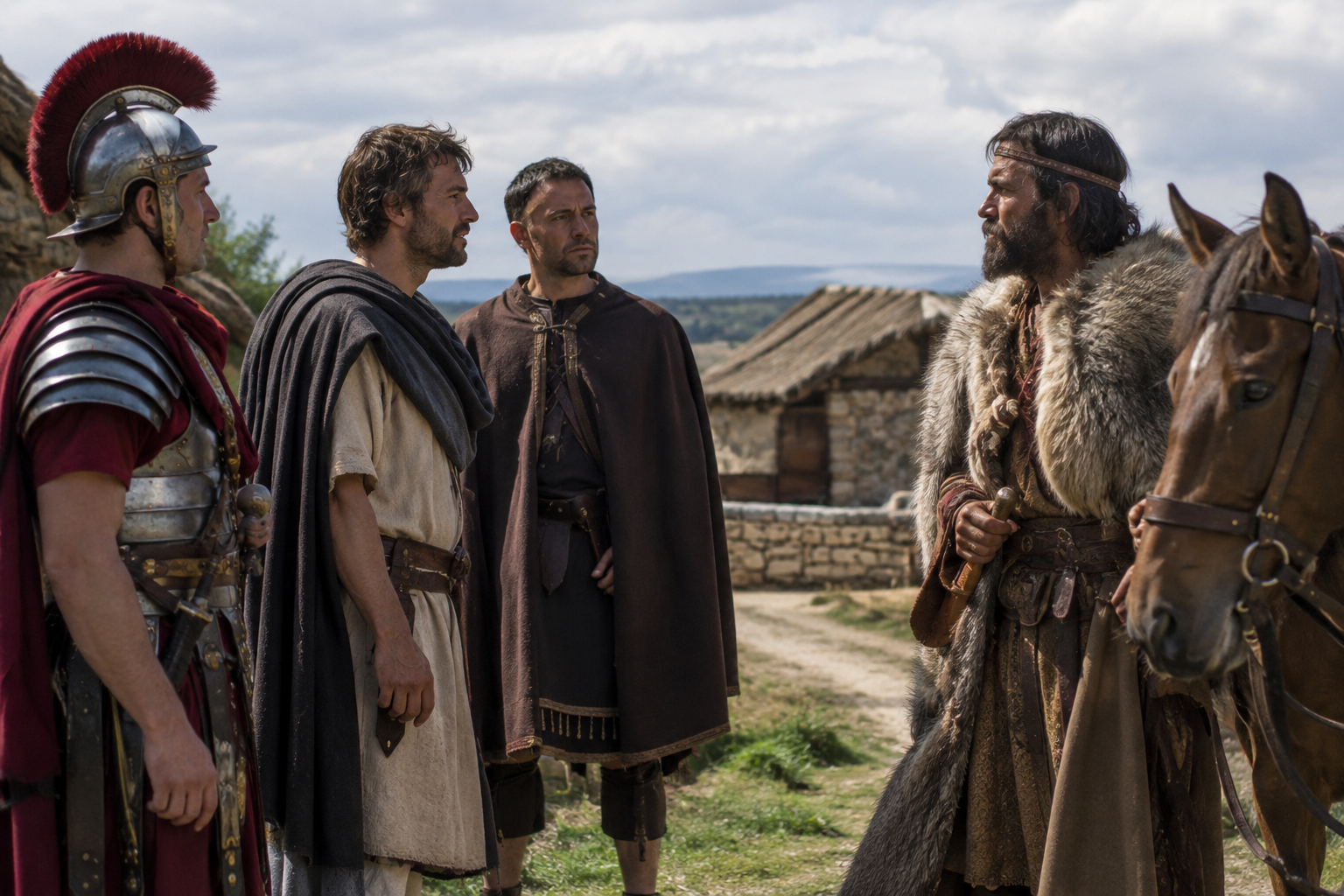
At Offord Cluny in Roman Britain, a small cluster of men dated to about AD 177 has become unexpectedly important for the history of Y-DNA haplogroup R1b1a1b1b1. The individuals labelled C10271a, C10271f, C10271, and C10271h were identified as "outsiders" in the archaeological-genetic study of the cemetery: men who did not simply fit a neat picture of local continuity, but instead pointed to movement into Britain during the imperial period.
That is the first useful thing to say about this lineage here. Not that it "belongs" to one people forever, and not that a single branch defines a whole identity, but that this paternal line appears in a setting where Roman Britain was plainly connected to much wider worlds. Y-DNA follows one direct male line only, yet even that narrow thread can sometimes illuminate the larger traffic of empire, migration, and military service.
Offord Cluny, in Cambridgeshire, belongs to that fascinating Romano-British landscape where burials can look local while genomes tell a more complicated story. The individuals associated here with R1b1a1b1b1 are not presented as an ancient ruling house or as founders of a province. What makes them interesting is more modest, and more historically valuable: several men from one site, around the late 2nd century AD, whose ancestry did not match a simple village-bound model of Roman Britain.
In practical terms, that means the paternal branch turns up in a community shaped by movement. The four linked IDs - C10271a, C10271f, C10271, and C10271h - should be treated as specific archaeological individuals, not as proof of one family dynasty. But taken together, they show that this branch was present among men caught up in the human circulation of the Roman world.
A broader ancient DNA study of Britain in the Roman and early medieval periods helped sharpen exactly this sort of picture, showing that mobility into Britain could be substantial and regionally varied rather than exceptional or anecdotal. That larger context matters when reading Offord Cluny: these are not romantic wanderers invented after the fact, but part of a documented pattern of imperial-era population mixture and relocation seen in research on Roman and early medieval Britain.
The label R1b1a1b1b1 places these men within the very large R1b family of paternal lineages, one of the best-known Y-chromosome groupings in western Eurasia. But it is important not to smuggle in more certainty than the evidence allows. A broad parental lineage may have a deep prehistoric history, while a narrower branch can surface in very different historical settings centuries or millennia later.
So the sensible reading is not that Offord Cluny "proves" one origin point for everyone carrying this haplogroup today. Rather, it gives us securely dated evidence that a branch reported as R1b1a1b1b1 was present in imperial Britain among men interpreted as non-local to that burial community. That is already a substantial historical clue, because it ties the lineage to the cosmopolitan machinery of Rome.
For family historians, this matters more than one might think. A haplogroup entry is not a flag pinned to a map forever; it is a record of where one paternal line has been observed. In this case, one observation point is an imperial frontier province that was anything but isolated.
It is still easy to imagine Roman Britain as a place with a local Celtic population, a layer of Roman administration, and not much else. Archaeology has long made that view look thin, and genetics has made it thinner still. Soldiers, traders, craftspeople, enslaved people, officials, and families moved across the empire, and burial grounds in Britain increasingly reveal those movements in human terms.
The Offord Cluny men are valuable because they turn that broad statement into named evidence. C10271a, C10271f, C10271, and C10271h are reminders that paternal lines now found in many later European populations also moved through provincial Roman settings in antiquity. One should not leap from that to ethnicity, language, or legal status, but one can say with confidence that this lineage sat within a world of mobility, recruitment, and resettlement.
This is why Roman-period Y-DNA evidence is so arresting. It catches lineages in motion. Instead of imagining straight-line descent from some timeless homeland, we see men living in a connected imperial zone where ancestry, upbringing, and place of burial did not always coincide.
The other striking appearance of this haplogroup comes from a very different world: sample scy304, dated around 290 BC in southern Moldova and classified as Scythian. This is chronologically earlier than the Offord Cluny cluster and geographically far to the east of Roman Britain. It does not create a neat single-route story, but it does show that the branch, or a reported association with it, appears in an Iron Age steppe context as well.
That is historically important because Scythian-period populations were themselves products of mobility, exchange, and mixture across the northern Black Sea zone and adjacent степpe worlds. Southern Moldova sat in a region where forest-steppe, river corridors, and wider Eurasian contacts overlapped. A paternal lineage found there cannot be reduced to one tribe from one classical text.
An ancient DNA study of Iron Age nomads across the steppe has helped establish just how mixed and regionally varied Scythian-associated populations could be. In that light, scy304 is best read not as a mascot for an entire people, but as one datapoint showing that the paternal history behind R1b1a1b1b1 touched the western steppe as well as the Roman provinces farther west. For the wider scientific backdrop, see research on Iron Age steppe populations.
The temptation, always, is to draw a bold arrow from Scythian Moldova to Roman Britain and declare the problem solved. History is rarely so obliging. The safer and better conclusion is that R1b1a1b1b1 appears in two settings where movement mattered enormously: the Iron Age western steppe and the Roman imperial province of Britain.
That overlap does not mean the men at Offord Cluny were "Scythians", nor that scy304 was part of some direct ancestral chain leading to Cambridgeshire four centuries later. But both settings belong to larger Eurasian systems of contact. The Black Sea zone fed people, goods, and military traditions into the Mediterranean world; the Roman Empire then redistributed people on a remarkable scale. A paternal lineage present in both regions fits that larger historical fact rather well.
It also helps explain why haplogroups should be read historically, not mythically. They persist through movement, intermarriage, service, resettlement, and ordinary family continuity. Their significance lies not in assigning fixed ethnic labels, but in anchoring human stories to real places and dates.
For someone researching haplogroup R1b1a1b1b1 today, the most distinctive lesson is that its ancient record here is tied to mobility rather than isolation. One appearance comes from an Iron Age Scythian context in southern Moldova; another from several men in Roman Britain identified as outsiders around AD 177. That is a small dataset, but a meaningful one. It places this paternal line in exactly the kinds of connected historical landscapes where populations mixed, moved, and re-formed across generations.






Comments