Haplogroup C2b1a1b1

– 5 min read


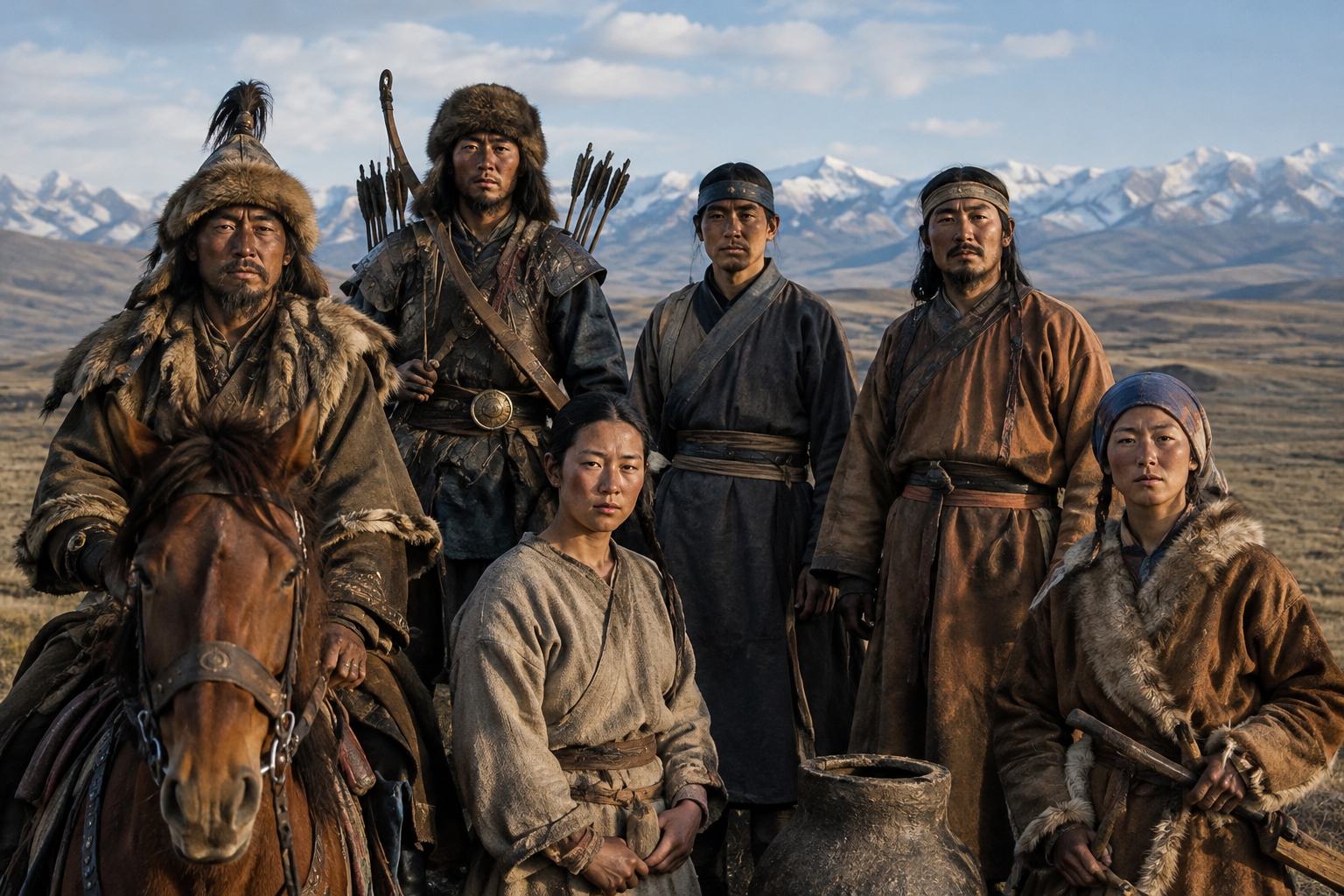
At Longtoushan in northern China, one ancient male identified as 91KLM2 carries us a very long way back. He belongs to the Upper Xiajiadian horizon, dated here to around 2700 BC, and he is the earliest sample in this set linked with Y-DNA haplogroup C2b1a1b1. That matters because it places this paternal line, or at least a lineage reported as associated with it, not first in the age of empires, but deep in the Bronze Age worlds that connected northern China to the eastern steppe.
From there, the trail does something archaeologists love and historians must handle carefully: it reappears in very different settings. The same haplogroup is represented among Xianbei-period males in Inner Mongolia, among individuals labelled Turk at Zaan-Khoshuu in the mid-1st millennium AD, and among late medieval Mongol-era burials in Mongolia. Y-DNA tracks one direct paternal line only, not a person's whole ancestry, but even so, C2b1a1b1 here looks less like a local curiosity and more like a line with staying power across centuries of political change on the eastern steppe.
The Longtoushan sample 91KLM2 is the earliest anchor for this article, and that gives C2b1a1b1 an unusually deep archaeological setting. Upper Xiajiadian communities belonged to the northern frontier zone between the agricultural worlds of the Central Plains and the mobile pastoral worlds of the steppe. This was not an empty border. It was a contact belt where technologies, subsistence strategies, and people moved in complicated ways.
That context is crucial. A paternal lineage turning up in this region so early does not mean a single uninterrupted tribe or dynasty can be drawn from prehistory to the Middle Ages. What it does suggest is that some paternal lines later prominent in the eastern steppe had roots in populations living along this long interaction zone. For readers interested in the broader genomic background to northern China and nearby frontier regions, MyTrueAncestry has also covered 6,000 years of genomic history in the Middle Yellow River.
A related ancient DNA study of the Mongolian and neighboring steppe populations, published in Nature Communications, helped establish just how dynamic this wider region was across time. The larger lesson fits 91KLM2 rather well: eastern steppe history is not a simple tale of one people replacing another, but a long sequence of mixtures, continuities, and reassembled communities.
By around AD 150, this paternal branch appears again at Mogushan in Inner Mongolia, in two Xianbei-associated individuals: MGS-M6 and MGS-M7L. Here the setting has changed dramatically. We are no longer in Bronze Age frontier society, but in the era after the Xiongnu, when new confederations and regional powers were taking shape across the steppe and its margins.
The Xianbei are often described as though they were a single, fixed people, but archaeology and genetics both push against that neatness. Confederations on the steppe were usually politically assembled, not biologically uniform. So the significance of MGS-M6 and MGS-M7L is not that they prove "the Xianbei haplogroup," which would be far too blunt a claim, but that they show this paternal line present within one important Inner Mongolian community of the 2nd century AD.
Two males at one site also raise a sensible historical possibility: some local continuity or repeated male-line representation within that burial population. That still does not prove a ruling house, a close family relationship, or a wider ethnic monopoly. But it does tell us that C2b1a1b1 was not a one-off appearance. In this cemetery context, it had some local depth.
The next appearance comes at Zaan-Khoshuu, with two individuals labelled Turk, ZAA002 and ZAA004, dated to about AD 650. This is precisely the sort of evidence that makes steppe history both fascinating and awkward for anyone hoping for clean ethnic boxes. The political world had changed again, and yet a related paternal line persisted into a Turkic-period context.
That does not mean a Bronze Age man from Longtoushan can be turned into a "Turk" by retroactive imagination, nor that every Turkic-speaking population shared one paternal origin. It means something subtler and more historically interesting: the male line associated here with C2b1a1b1 was still present in eastern steppe populations as political labels, alliances, and languages shifted.
This is one of the recurring patterns in archaeogenetics. Political names change faster than chromosomes do. A man buried in a Turk-period site may carry a paternal lineage already old in the region, just as later imperial populations often inherited male lines far older than the states they served. For a wider look at mixed populations and frontier complexity, the post on Khazar frontier graves and Saltovo-Mayaki diversity offers a useful comparison from another Eurasian zone.
The latest samples in this cluster bring us into late medieval Mongolia: ARG003 from a Mongol warrior burial at Argali Mountain, dated around AD 1300, and KHN001 from Khalgan Khoshuu, dated around AD 1400. These are the finds most readers will immediately notice, because the Mongol world is historically vivid and comparatively well known. Yet their real value lies in how they complete the longer pattern rather than overshadow it.
Seen in isolation, a medieval Mongolian burial with this haplogroup might invite easy but shallow conclusions. Seen alongside Longtoushan, Mogushan, and Zaan-Khoshuu, it becomes part of a much richer story: this paternal line appears again and again across regions that would later feed into the populations of the eastern steppe and Mongol-era Mongolia.
ARG003 is especially evocative because of the "Mongol warrior" label, but we should resist the temptation to turn that into a cinematic certainty about ancestry, rank, or clan. What the evidence securely gives us is place, period, and paternal lineage association. That is enough to say something important. By the 13th and 14th centuries, C2b1a1b1 was still part of the male-line landscape of Mongolia, long after earlier Xianbei and Turk-period horizons had passed.
A preprint on ancient eastern steppe populations and related supplementary material can be found at bioRxiv. Even without leaning on unverified specifics, the broader research tradition is clear: Mongolia's medieval populations emerged from deep regional histories rather than appearing from nowhere in the age of Chinggis Khan.
So what kind of haplogroup is C2b1a1b1 in this evidence set? Not a marker of one empire, one ethnicity, or one famous conqueror. It looks more like a durable eastern steppe paternal lineage, appearing first in a Bronze Age northern Chinese frontier context, then in Xianbei-period Inner Mongolia, then in a Turk-period site, and finally in late medieval Mongolian burials.
That sequence is interesting because it shows continuity across enormous historical upheavals. States rose and fell; ethnonyms changed; burial traditions and political allegiances shifted. Yet one paternal line, or a closely related branch reported under this label, remained present across that long arc. Readers interested in the oldest male-line framework behind such patterns may also enjoy the overview of ancient Y chromosomes in East Asia.
For someone exploring C2b1a1b1 today, the strongest responsible takeaway is not a promise of descent from a named dynasty, but a connection to a very old male-line history in the eastern steppe world. The samples here place that history in northern China and Mongolia from the Bronze Age to the late medieval period. In other words, this is a lineage with deep archaeological time, tied to one of Eurasia's great zones of movement, exchange, and empire-building.






Comments