Haplogroup N1a1a1a1a1a

– 5 min read


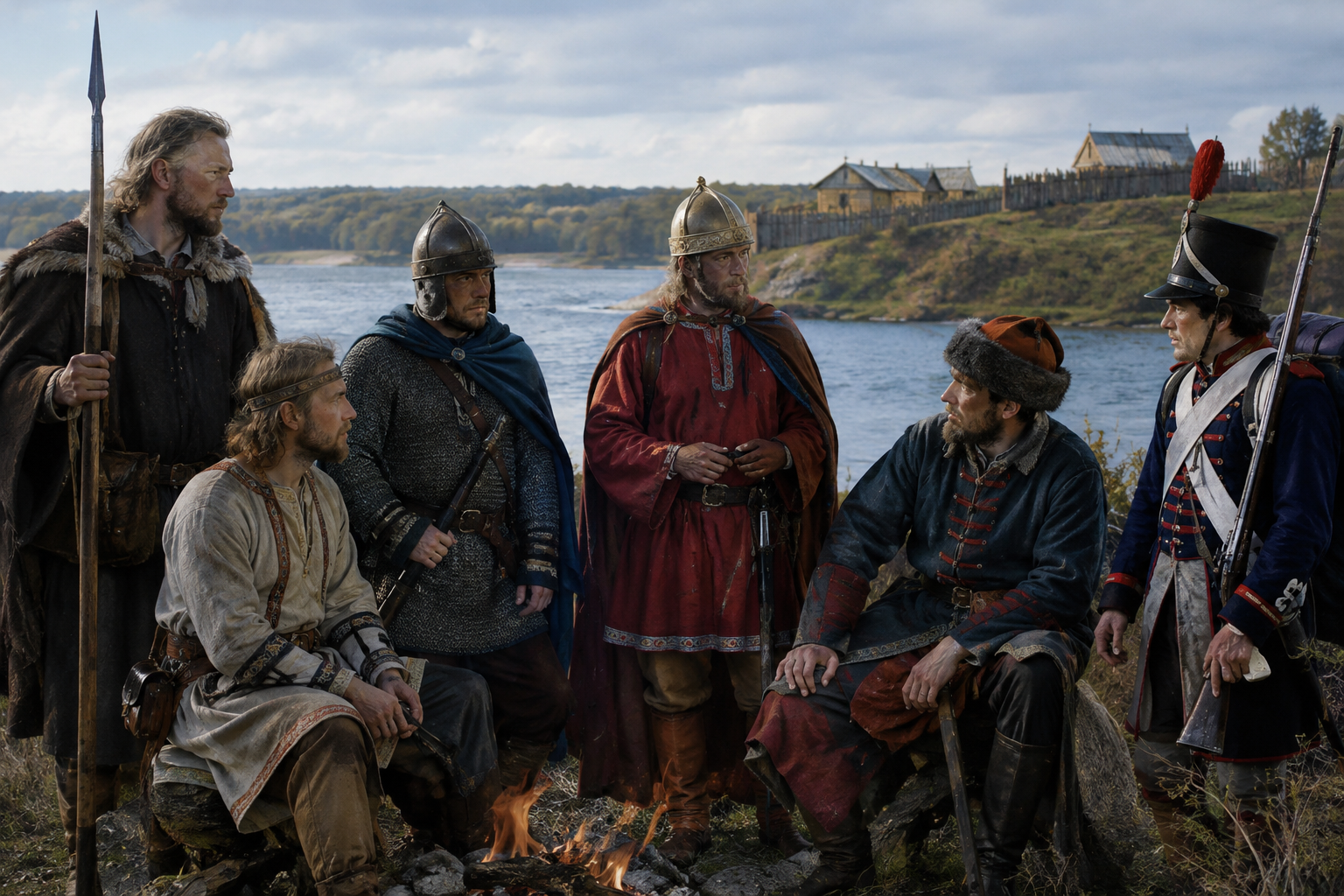
At Janakkala in Kanta-Hame, an early medieval burial dated to around AD 1190 produced an individual labelled JAN001. That find matters because it places the Y-DNA haplogroup N1a1a1a1a1a in a firmly northern setting at the close of Finland's medieval transition, when local communities were tied into both Baltic and wider Scandinavian worlds. It is exactly the sort of evidence that makes a paternal lineage feel less abstract: not just a code on a tree, but a man buried in a real landscape of forests, lakes, church expansion, trade, and regional change.
N1a1a1a1a1a is a very specific branch within the broader Y-haplogroup N family, a lineage long associated in general terms with northern Eurasia and especially with many Uralic-speaking and Finnic populations. But the narrower label matters. A subclade is not the whole parent haplogroup, and one should not simply pour every grand story ever told about haplogroup N into this single branch. What the ancient evidence here actually shows is more precise and more interesting: men associated with this branch, or with very closely related reporting around it, appearing in medieval Finland, the Baltic region, early medieval Poland, Viking-Age western Russia, and even in a much later Napoleonic mass grave.
JAN001 is the clearest place to begin because the archaeological setting is specific and the historical moment is important. Late 12th-century Finland was not an isolated fringe. It was a contact zone linking inland communities, Baltic traffic, Swedish expansion, and older eastern connections. A paternal lineage found here belongs to that entangled world rather than to any simple national origin story.
Research on early medieval Finland has increasingly shown that the region cannot be reduced to a single homogeneous population block. Ancient DNA has revealed local continuity in some areas, mobility in others, and meaningful links across the Gulf of Finland and around the Baltic basin. In that context, N1a1a1a1a1a in Janakkala looks less like an outlier than part of a northern network of paternal lines that moved with people, households, and communities over centuries.
An ancient DNA study on this Finnish material and related populations has helped sharpen that picture, showing how medieval Finland sat within larger demographic shifts rather than outside them. See the regional research here: https://link.springer.com/article/10.1186/s13059-026-04277-7.
If Janakkala gives us a northern medieval anchor, two other samples suggest that related paternal lines were also present around the Baltic's southern and eastern shores. One is PCA0522 from Pruszcz Gdansk in Pomerania, dated around AD 200 and identified here as an Early Goth context connected with the Wielbark cultural horizon. The other is CGG017690 from Berciunai in Lithuania, dated around AD 566 and associated with Iron Age Baltic tribes.
Now, this is where one must be careful. A grave in a Gothic-period cemetery does not make a Y-lineage "Gothic" in some pure ethnic sense, any more than a Lithuanian Iron Age burial makes the same branch exclusively Baltic. Archaeology and genetics rarely line up so tidily. What these finds do show is that a paternal line connected with N1a1a1a1a1a was present in societies around the Baltic during centuries when identities, alliances, and material cultures were constantly shifting.
That is historically revealing. The Baltic was not merely a boundary between peoples; it was a corridor. Coastal communities, river routes, and exchange zones encouraged the movement of objects, styles, and sometimes men themselves. A lineage appearing on both northern and southern shores fits that world rather well.
For a broader look at how ancient DNA has complicated older ideas about Gothic communities, this related discussion is useful:
Goths as a Multi-Ethnic Community
Another important sample is VK224 from Gnezdovo in Russia, dated around AD 950. Gnezdovo is one of those sites that historians and archaeologists return to again and again, because it sat on the great riverine routes linking the Baltic to the lands of the Rus' and beyond. It was a place where Scandinavian, Slavic, Finnic, and steppe-connected worlds overlapped.
That makes VK224 especially interesting for this haplogroup. A paternal lineage of this kind turning up at Gnezdovo does not prove a single migration tale, but it does place the branch within one of early medieval eastern Europe's most dynamic contact zones. If your direct paternal line falls under N1a1a1a1a1a, that may speak not of one tribe marching in one direction, but of participation in the northern exchange systems that tied together forest, river, and sea.
The point is worth lingering on. Viking-Age eastern Europe was not simply "Scandinavian colonists abroad." It was a mixed social world. Men bearing similar Y-lines could have spoken different languages, served different rulers, or married into different local groups while still belonging to the same distant paternal branch.
The sample PCA0417, described as a Medieval Poland Piast Dynasty lad and dated around AD 950, adds a different sort of angle. Here the interest is not just geography but political formation. Tenth-century Poland was the age in which the Piast realm was taking shape, consolidating authority across a landscape of regional groups, fortified centres, and competing loyalties.
One should not overstate this. A single individual connected with a Piast-period or Piast-dynastic context is not proof that N1a1a1a1a1a was the defining lineage of the dynasty as a whole. Dynastic, regional, and personal histories are more complicated than that. Yet PCA0417 does show that this paternal branch, or a very close reported association to it, was present within the social world of early state formation in medieval Poland.
That is a valuable reminder that haplogroups do not belong only to remote prehistory. They were also part of historically documented societies - Christianising courts, emerging kingdoms, and communities already entering the written record. For readers interested in that wider setting, this related article offers a direct link to the subject:
The latest sample in this group is YYY089B from a mass grave associated with soldiers of Napoleon's Grande Armee, dated to AD 1812 and tied here to the Vilnius campaign. At first glance this seems far removed from Janakkala, Gnezdovo, or Piast Poland. In fact, it is precisely the opposite: it shows how an old northern-eastern European paternal line could still be present in the age of imperial armies and modern states.
The Napoleonic campaigns pulled together men from many backgrounds, and the catastrophic retreat from Russia left behind one of the most studied military disaster assemblages in European archaeology. A lineage like N1a1a1a1a1a appearing in that setting reminds us that paternal branches survive not through neat historical periods, but through ordinary generations of fathers and sons who eventually find themselves caught up in very different events.
Ancient DNA research on populations connected with the eastern Baltic and surrounding regions has repeatedly shown how deep local lineages could persist through enormous cultural change. A wider genomic study relevant to this northern and eastern European setting can be found here: https://www.nature.com/articles/s41586-022-05247-2.
The most distinctive thing about N1a1a1a1a1a, on the evidence here, is not royal glamour or a single heroic migration. It is its repeated appearance across the northern and eastern Baltic world: Finland, Pomerania, Lithuania, Viking-Age Russia, Piast-era Poland, and then much later in a Napoleonic military grave. That pattern suggests a paternal line at home in the connected societies of the Baltic and forest zone, carried through centuries of trade, mobility, political change, and local continuity.
If this is your Y-DNA haplogroup, the responsible historical takeaway is a good one: your direct paternal line may belong to a branch with a visible ancient footprint in the northern arc of Europe, especially in Finnic and Baltic-connected settings. That does not define your whole ancestry, but it does place one line of descent inside a very real historical landscape.
Comments