Clan MacDougall
– 3 min read


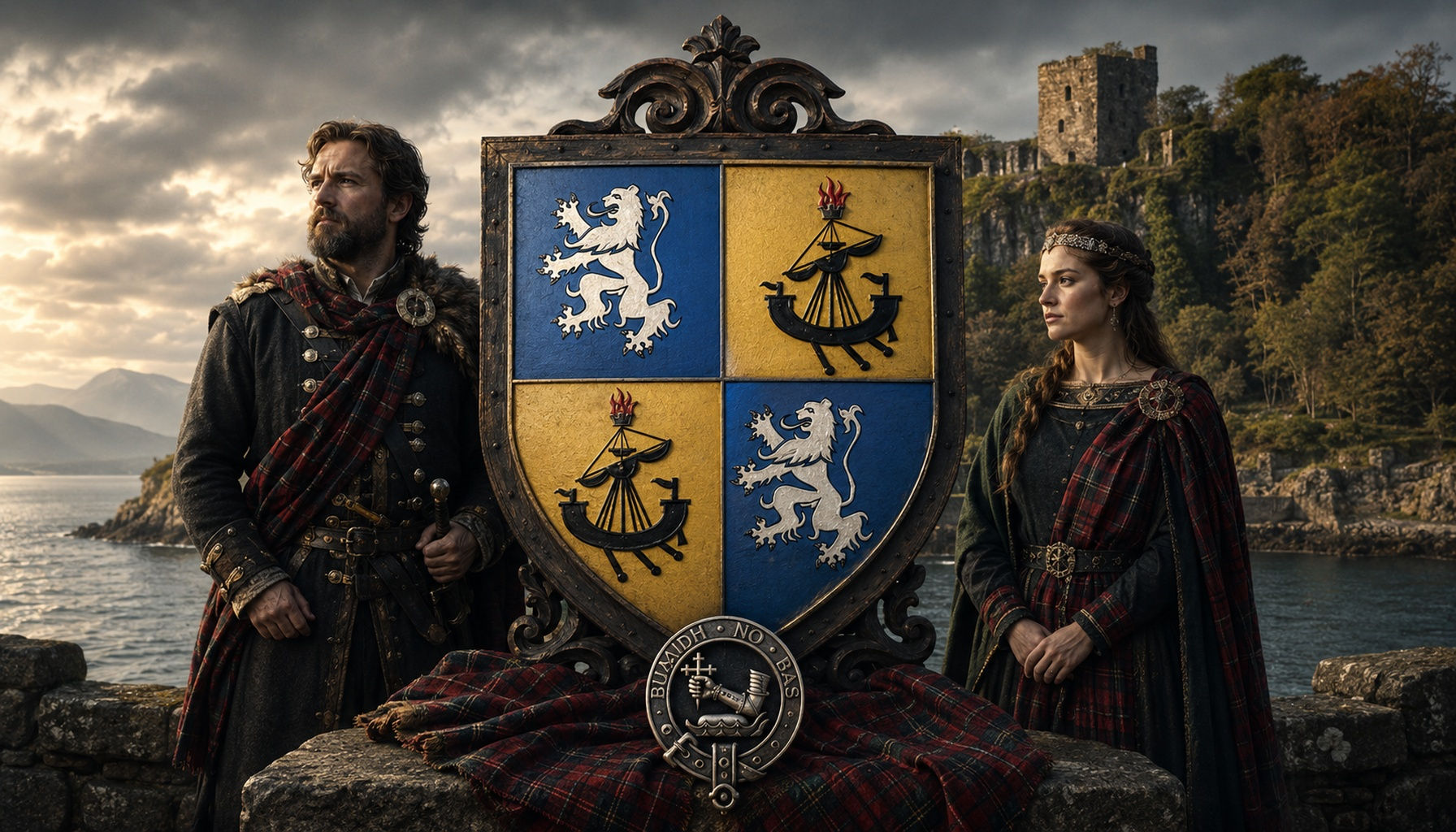
Clan MacDougall was one of the great lordly kindreds of western Highland Scotland, rooted above all in Argyll, Lorn, and the long sea roads of the western seaboard. This was not a clan shaped only by glens and cattle, but by ships, harbours, island channels, stone strongholds, and the old Gaelic political world of the west. In that setting, kinship was power, and the MacDougalls emerged as a notable noble clan whose prestige rested on descent, armed followings, territorial authority, and the ability to command both coast and castle. In haplogroup tagging, the primary family haplogroup linked here is R1a1a1b1a3a1a1a.
The family background is richer than the usual shorthand of tartan and badge. The MacDougalls developed out of the medieval Gaelic lordship tradition tied to the descendants of Somerled and the Norse-Gaelic maritime zone of the Hebrides and western mainland. Their surname means "son of Dougal," and that Dougal was Dugall mac Somairle, son of Somerled, the formidable 12th-century ruler whose descendants shaped much of the politics of the western Highlands and Isles. The MacDougalls became especially associated with Lorn, where coastal command mattered enormously: whoever held the sea lanes, the anchorages, and the castles could influence trade, warfare, alliance, and royal politics. Named figures from the clan include Dugall mac Somairle himself as dynastic founder, Ewen MacDougall of Argyll, a major 13th-century lord, and Alexander of Argyll, who belonged to the turbulent era of the Wars of Scottish Independence, when loyalties and survival in the west were rarely simple.
Read more about Clan MacDonald
Dunollie Castle is the great location anchor for Clan MacDougall, and it could hardly be more dramatic. Set on a rocky knoll overlooking Oban Bay on the west coast of Scotland, Dunollie guarded the approaches by sea and stood at the heart of MacDougall authority in Lorn. The site is very old, with occupation long before the later medieval stone ruin now visible, and tradition places it as a principal seat of the chiefs of Clan MacDougall. The surviving castle remains largely date from the 15th century, though the place itself has much deeper roots in the early medieval kingdom of Dalaradia and later in the Norse-Gaelic and Scottish worlds that followed. It is one of those western strongholds that makes immediate historical sense when you see it: this was a lookout, a statement of rank, and a practical centre of lordship all at once. Yes, it can still be visited today, with the castle ruins and the wider Dunollie heritage area near Oban offering a direct encounter with the landscape that shaped the clan.
From a DNA perspective, the MacDougall haplogroup tag here is R1a1a1b1a3a1a1a, and there are related or linked ancient DNA samples carrying the same broader paternal line across a wide sweep of medieval and post-Iron Age Europe and the North Atlantic world. These include Medieval Vasterhus Sweden (mbv281), Historic St. Mary City Chapel Field Cemetery Maryland (I15285), Viking Age Halogaland Holm (CGG107030), Medieval Hungary Carolingian Empire Zalavar Varsziget (AHS18), Anglo-Saxon Sedgeford England Norfolk (SED006), Post Viking Era Denmark St Clemen Zealand Denmark (KPN002), Early Medieval Polhill Kent England (POH006), Viking Age Skara Varnhem Sweden (VK35), Medieval Age Faroe Islands Sandoy Church (VK244), Iron Age Islandbridge Dublin Ireland (VK546), Vendel Age Saaremaa Salme II-U (VK551), and a Viking Gaelic Mix individual from Iceland (GTE-A1). These do not prove direct descent from Clan MacDougall, of course, but they do show how this paternal lineage appears in populations tied to the same larger northern European and maritime historical worlds that also touched Scotland's western seaboard.
If Clan MacDougall is part of your story, the interesting question is not just whether a surname appears in a tree, but whether your deeper ancestry connects to the same western Highland world of sea lordship, fortress power, and long-lived kin identity. Upload your DNA to MyTrueAncestry and see whether you match Clan MacDougall or any of the related ancient DNA samples linked to haplogroup R1a1a1b1a3a1a1a.
Comments