Integer Partitions Reveal Super-Archaic Gene Flow in Human Ancestry
– 5 min read


Long before farming or cities, there were meetings between different kinds of people—preserved not in words, but in human ancestry. Modern humans did not emerge from a neat, isolated line. Their story includes contact with a deeply ancient population so old that no genome has yet been recovered from its bones.
This unknown group is often called a "ghost" population, yet ghost is too pale a word. These people were real: they walked landscapes, hunted, raised children, and shaped stone. They may have been related to Homo erectus, stretching the story back more than a million years, into a time when the human family tree was far bushier than any textbook suggests.
Africa was no single cradle occupied by one population, but a patchwork of river valleys, grasslands, forests, and highlands. Groups split, moved, survived drought, and sometimes met again—some as close cousins, others as astonishingly distant relatives. That possibility transforms the human story from a lone triumphal line into a crowded, messy prehistory where ancient people contributed rather than simply vanished. Some fraction of their ancestry entered the lineage that became all living humans today.
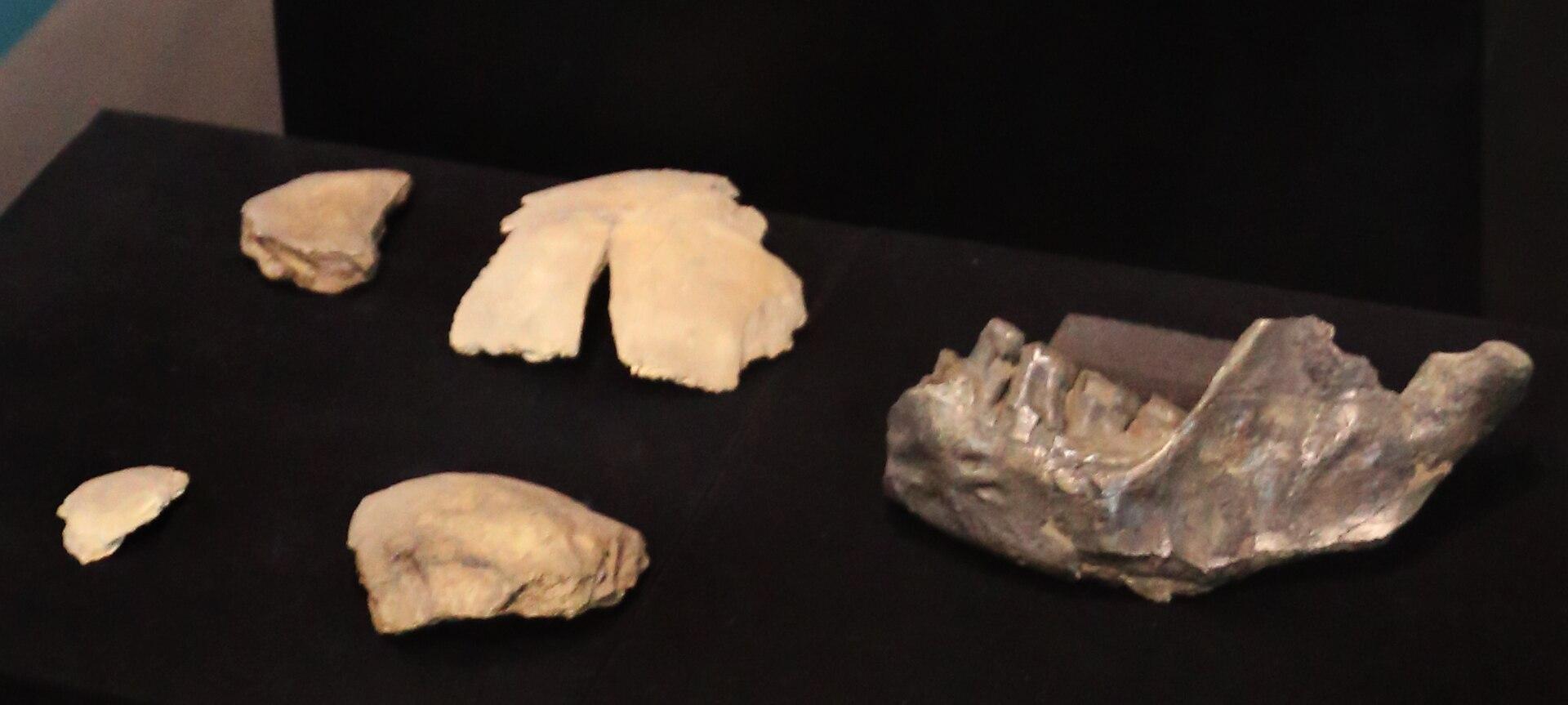
Archaeology turns abstraction into reality. Sites like Olorgesailie in Kenya preserve worlds of stone tools and long-term adaptation. Ethiopia's Bodo and Herto remains hint at varied populations across enormous spans of time. At Jebel Irhoud in Morocco, ancient bones push the roots of our species far back while confirming that early humans did not all look alike or belong to one unified population. The Kabwe skull from Zambia and the Florisbad skull from South Africa further reveal how much anatomical diversity once existed across the continent.
The central idea is beautifully simple. Trace five ancestral lines backward and they eventually merge into shared ancestors. The shape of those mergers—balanced or lopsided—reveals whether the past held a single well-mixed population or a more divided world.
If everyone descended from one large, freely mixing population, tree shapes should follow predictable patterns. But if some ancestry came from a deeply separated group, branches fall into odd arrangements: too many lopsided trees, one branch holding four descendants opposite a solitary outlier. That repeated imbalance across the genome becomes evidence of ancient contact—the genetic equivalent of finding the same unusual burial arrangement again and again across a landscape.
What makes this approach powerful is that it requires no sample from the vanished group itself. The traces survive in living people's inherited family trees. A single population's genome contains enough signal to detect the skewed branching patterns caused by deep ancestral mixing—crucial for African prehistory, where ancient DNA survives poorly in warm climates.
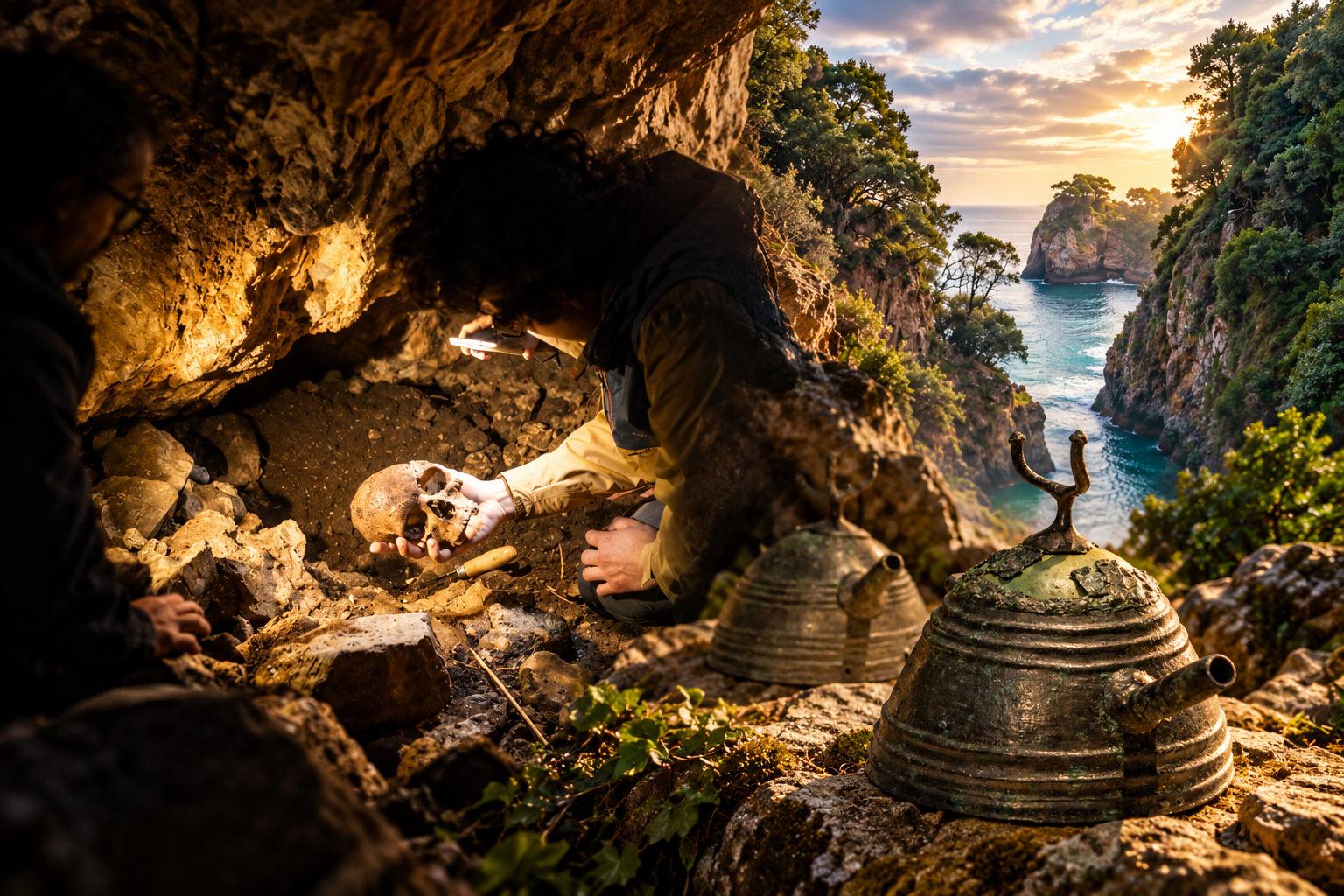
Archaeology offers a useful parallel. Excavators routinely reconstruct vanished events from incomplete evidence: the position of bones, placement of beads, type of pottery, trace of a hearth. Here the same instinct applies—look carefully at the pattern of relationships, and lost people begin to emerge from the shape of the human family tree.
Once contact with a deeply ancient population is established, the next question becomes historical: was there one dramatic episode, or drawn-out interaction across thousands of years? The evidence points strongly toward the latter—repeated exchange as populations overlapped in neighbouring regions, with ancestry from the older group trickling slowly into the ancestors of modern humans.
Africa's shifting climates made this plausible. Wet periods opened corridors; dry periods isolated populations. Lake expansions created routes; shrinking forests pushed groups into shared territory. The result need not have been mass migration but many small contacts over very long time—a human frontier stretching across generations beyond counting.
A bottleneck also appears in the main ancestral population, followed by recovery. A reduced group may have survived in refuges during climate stress, later expanding and mixing with older local populations. Survival did not mean purity. It meant entanglement.
The most vivid parallel is "Denny" from Denisova Cave—a girl with a Neanderthal mother and Denisovan father, proof that two distinct populations met intimately. Africa has not yet produced an equivalent ancient genome from such deep time, but the ancestry signal implies similar people once lived there. Their intimate acts—partnership, children, shared traditions—repeated across thousands of years, created exactly the quiet genetic legacy now being detected.
The most exciting part may be what has not yet been found. The hidden lineage has been detected through inheritance patterns, but its bones and camps remain uncertain—setting up one of archaeology's great future hunts.
Burials are especially evocative because they give individuality. If the hidden lineage is ever tied to skeletal remains, archaeologists will ask where these people lived, what they ate, what tools they made, whether they used pigments, and whether they cared for their dead. Even without rich grave goods, ordinary objects speak volumes: worn stone points, cracked marrow bones, hearth charcoal, shell from distant shores.
Future discoveries will likely combine many methods. Protein analysis from teeth is improving where DNA fails. Sediments can preserve molecular traces. Isotope work reveals diet and movement. The hidden ancestry may not belong to one single fossil type but to a wider web of structured African populations—older and more separate than the main lineage leading to modern humans, yet still part of the continental story.
Every African Middle Pleistocene site becomes a possible stage in this drama. The Bodo individual is no longer merely an anatomical specimen but a possible witness to deep population structure. The Kabwe skull becomes part of a puzzle about African diversity. The Jebel Irhoud people confirm that early humans were spread and varied across a continent where interaction with older lineages was entirely plausible.
The most important future discoveries may not be spectacular—a new date for an old fossil, a tooth from an overlooked layer, a sediment sample yielding molecular clues. Yet from such modest pieces a whole people may emerge. Deep in Africa's past, ancient humans met others separated for immense stretches of time. Their encounters left descendants who eventually became part of all living humans. The lost people are gone, but not entirely. Their afterlife remains in bones, stones, landscapes, and in the shape of the family tree carried by every person alive today.
 View ORCID Profile
Comments