Thomas Jefferson’s DNA and the Sally Hemings Paternity Question
– 4 min read


Monticello sits on a Virginia hilltop as one of America's most revealing historical landscapes. Beneath its elegant architecture lies a harder truth: this was a plantation sustained by enslaved labor, where ideals of liberty lived side by side with human bondage. More than six hundred enslaved people worked Jefferson's properties over his lifetime—not a footnote, but a central fact.
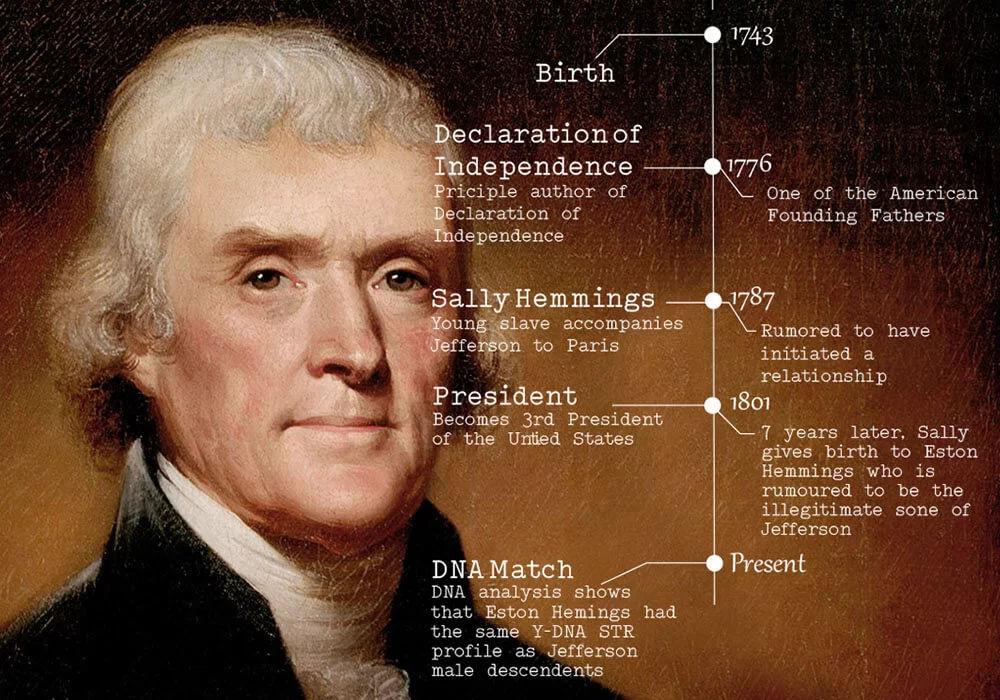
Sally Hemings has become one of the best-known women in early American history, not through written documents but through family memory, historical research, and genetic evidence. Her descendants' claim that Jefferson fathered her children stirred fierce argument for two centuries, touching painful questions about race, slavery, power, and American freedom. Archaeology at Monticello transformed this understanding, uncovering workshops, dwellings, tools, and fragments of daily life along Mulberry Row that anchor the story in physical reality.
This history is intimate—bedrooms, childbirth, whispered family knowledge, and graves. It is a story where descendants carried memories long after official narratives dismissed them, and where Sally Hemings emerges not as shadowy rumor but as an individual at the center of America's most significant historical reckoning.
The breakthrough came not from graveyards but from museum boxes. Locks of hair, once treasured as mourning relics, became the key to unlocking one of history's most debated questions. The most compelling samples came from Monticello collections and the Smithsonian—rootless hairs, clipped after Jefferson's death on 4 July 1826 by Nicholas Trist, his grandson-in-law.
The detective work was layered. First, researchers confirmed biological sex. Then they matched maternal ancestry against a living descendant of Jefferson's sister through an unbroken female line. The hair matched. Then paternal markers were compared against the known Jefferson male line. Again, a match. Different packets of supposed Jefferson hair were compared against each other and proven consistent with one individual.
Though old hair contains damaged, fragmented DNA, enough genetic information survived to build a picture of Jefferson's genome. These modest human remnants—saved in grief, surviving through careful curation and chance—became historical witnesses of extraordinary power, demonstrating that intimate museum objects can preserve identity and reconnect family lines across two centuries.
The investigation depended on living people willing to step forward. Descendants from Jefferson's acknowledged family line and from Sally Hemings's sons Madison and Eston participated—families who inherited stories, loyalties, wounds, and hopes across roughly five generations.
Madison Hemings gave a public nineteenth-century account identifying Jefferson as his father. Eston Hemings's male-line descendant had already carried the Jefferson Y chromosome signature. These were not shadowy figures but named individuals whose descendants remained traceable. For years, family testimony was dismissed, yet oral tradition—especially under slavery, where records were created by owners rather than the enslaved—preserves truths official archives refuse to record.
The painful social dimension is clear: descendants through Jefferson's marriage enjoyed public acceptance while Hemings descendants faced exclusion from family institutions. The investigation exposed not merely a genetic puzzle but the long afterlife of racial boundaries, transforming a national controversy into a family reckoning finally being faced.
The science here is wonderfully archaeological—reconstructing a whole from fragments. Jefferson's hair provided only patchy, damaged DNA while living descendants offered rich, complete profiles. The solution was identifying inherited DNA segments shared through common ancestry. Close relatives share many long segments; distant ones share fewer, shorter ones. Researchers scanned descendants' genomes and asked, site by site, whether observed patterns were more likely through true Jefferson descent or mere coincidence.
Crucially, this went far beyond earlier Y chromosome testing. The paternal marker alone resembles a family signet ring—it identifies the family but not the individual. The genome-wide approach added fingerprints across the entire inherited landscape, providing far finer resolution. Hemings descendants through both Madison and Eston showed Jefferson-linked DNA segments, with variation between individuals exactly as inheritance randomness predicts.
The method carries implications beyond this case. Museums hold countless hair keepsakes from the eighteenth and nineteenth centuries. This work demonstrates these intimate objects can preserve biological identity and reconnect family lines—an extraordinary expansion of the historian's toolkit, though one that requires historical records, family trees, and careful interpretation to function.
The sharpest question was never whether a Jefferson fathered Sally Hemings's children, but which Jefferson man. Thomas Jefferson himself? His brother Randolph? A nephew? Brothers share substantial inherited material, so earlier Y chromosome evidence left genuine ambiguity that defenders exploited for generations.
The new approach asked how much of Thomas Jefferson's DNA should survive in Hemings descendants under each proposed father scenario. Thousands of simulated family histories modeled inheritance's randomness. When tested against uncontested family lines first, the model behaved correctly—establishing trust in the measuring stick before tackling the disputed branch.
The results were decisive. Madison Hemings's line showed extremely strong evidence favoring Thomas Jefferson over Randolph or his sons. Eston's line also favored Thomas Jefferson, with slightly more room for Randolph but still tilting clearly toward Thomas himself. Even when allowing that Madison and Eston might have had different fathers, the evidence made it overwhelmingly likely that Thomas Jefferson fathered at least one, and strongly supported him as father of both.
This collapses a familiar historical escape route. The ambiguity of "some male relative" once allowed responsibility to dissolve into fog. The new evidence narrows that sharply. It restores the story to the specific man who wrote of equality while enslaving people, and returns to Sally Hemings, Madison, Eston, and their descendants a place not on the margins of the American story, but close to its center.
Comments