Haplogroup E1a1a2d

– 4 min read


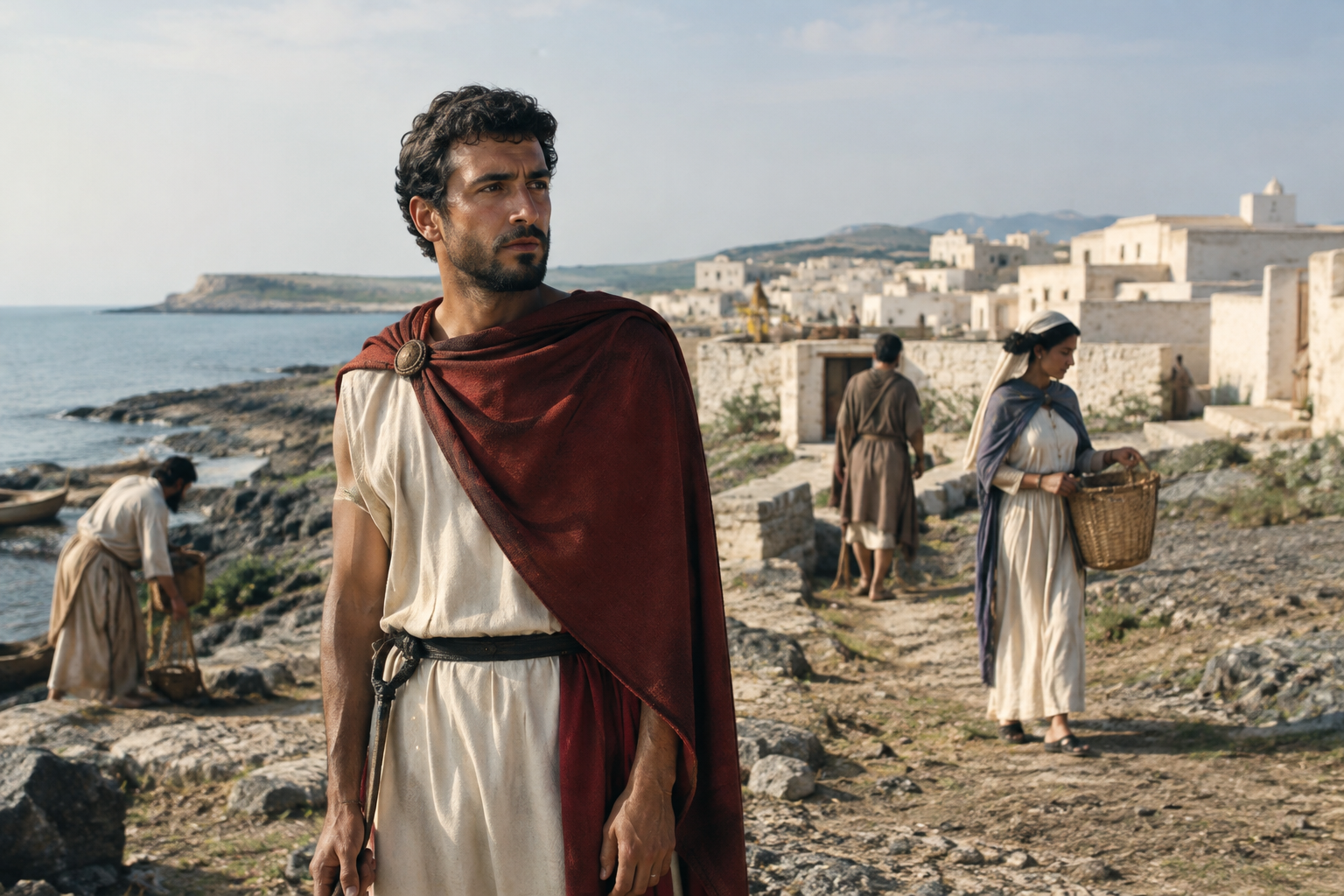
At Kerkouane on Tunisia's Cap Bon peninsula, archaeologists are working in one of the rare Punic cities never rebuilt over by the Romans. That matters because the site preserves a distinctly Carthaginian world in unusually sharp outline. Among the ancient individuals studied there is sample I24206, dated to around 484 BC and described as a Proto Numidian Punic Era Tunisia Kerkouane individual, associated here with the Y-DNA haplogroup E1a1a2d.
That is a very specific paternal line, and one ancient man does not stand for all of Punic Tunisia. But he is still fascinating, because Kerkouane sits exactly where several histories met: Phoenician expansion from the Levant, older North African populations, and the political rise of Carthage across the central Mediterranean. A Y-chromosome result like E1a1a2d tracks only one direct male line, not a person's whole ancestry, yet in this setting even a single lineage can illuminate how deeply local and how thoroughly connected Punic North Africa could be.
Kerkouane was a coastal town in the Carthaginian orbit, flourishing in the centuries before Rome destroyed Carthage. Unlike Carthage itself, it was not buried under a later Roman city on the same scale, so its streets and neighborhoods have long attracted archaeologists interested in everyday Punic life rather than only imperial aftermath. Sample I24206 belongs to that broader Punic landscape, but the label "Proto Numidian" is a useful reminder that ancient North Africa cannot be reduced to a simple colonist-versus-native story.
The word "Numidian" evokes the indigenous peoples of the Maghreb known from classical sources, while "Punic" points to the Phoenician-founded and Carthaginian-shaped cultural world of the western Mediterranean. Those are not interchangeable categories, and neither is the same thing as a haplogroup. What makes I24206 interesting is precisely that the burial comes from a Punic-era North African setting where local ancestry, regional identities, and Mediterranean connections may all have overlapped in one life.
A broader ancient DNA study of Punic and neighboring populations has helped bring that complexity into focus, showing that Punic communities were not genetically uniform colonies transplanted wholesale from the Levant, but places of mixture and local continuity as well as seaborne movement. The relevant research can be found here: https://www.nature.com/articles/s41586-025-08913-3.
The haplogroup in this article, E1a1a2d, belongs to the wider Y-DNA family E, a major African paternal lineage with deep roots on the continent. That wider background matters, but it should not be lazily projected onto this precise branch as though every subclade had the same history. In practice, what we can responsibly say from the evidence here is narrower: a man linked with E1a1a2d appears in Punic-era Tunisia, in a context where African local ancestry and Mediterranean cultural exchange were both historically plausible.
That makes E1a1a2d especially interesting for members whose paternal line points toward North Africa, because it places this branch, or a reported association with it, in the archaeological world of pre-Roman Tunisia. Yet one sample cannot define the entire time-depth or spread of the branch. It is a fixed point, not the whole map.
There is a temptation, whenever Carthage enters the story, to imagine every important line arriving by ship from the eastern Mediterranean. Ancient DNA has steadily complicated that picture. In North Africa, cultural Punic identity could exist alongside substantial local biological continuity, and local men could be fully part of Punic society without needing to be recent Levantine migrants in the paternal line.
That is where the description attached to I24206 becomes valuable. A "Proto Numidian" classification suggests an interpretive link to indigenous North African population history, even while the burial belongs to a Punic-era context. In other words, the sample sits in the overlap between Carthaginian history and deeper Maghrebi roots. For readers exploring E1a1a2d, that overlap may be more historically meaningful than any simplistic claim of a single-origin "ethnic" marker.
Kerkouane was no isolated village at the edge of history. It belonged to a maritime sphere linking Tunisia with Sicily, Sardinia, Iberia, and beyond. Goods, styles, cult practices, and people moved through this network, and any ancient port or coastal settlement in that world is likely to have held a mixed population in one sense or another.
But mixed does not mean anonymous. Ancient DNA is useful precisely because it gives us individual anchors inside those broad processes. I24206 shows that a paternal lineage associated with E1a1a2d was present in this Punic-era setting, in the centuries when Carthage was one of the dominant powers of the western Mediterranean. That is not proof of a dynasty, a tribe, or a migration route all by itself. It is something more disciplined and, in its way, more revealing: a documented male line situated in a real place at a historically charged moment.
This broader Mediterranean perspective also fits with work on later Iberian and island populations, where North African and eastern Mediterranean movements repeatedly appear in the genetic record rather than arriving as a one-off event. Punic and post-Punic worlds alike were shaped by contact, settlement, and incorporation.
For someone researching E1a1a2d today, the real value of this evidence lies in context. Sample I24206 does not tell you that every bearer of this haplogroup is "Punic," still less that a modern family descends from a named historical people in any neat textbook fashion. What it does suggest is that this paternal branch, or a closely reported association with it, was present in northern Tunisia in the fifth century BC, within a society shaped by both indigenous North African foundations and Carthaginian political culture.
That is quite a powerful combination. It places E1a1a2d not on the margins of written history, but in one of the central crossroads of the ancient Mediterranean, where local African ancestry and long-distance exchange met face to face.
The most distinctive thing about E1a1a2d here is not grandeur but placement. In sample I24206 from Punic-era Kerkouane, this paternal line appears in a North African coastal community that was simultaneously local, urban, and Mediterranean. For modern testers, that is the useful historical clue: E1a1a2d can be set, at least in one documented ancient case, within the human landscape of pre-Roman Tunisia, where the history of the Maghreb and the history of Carthage were already thoroughly intertwined.

Comments