Haplogroup N1a1a1a1a1a2b1a

– 5 min read


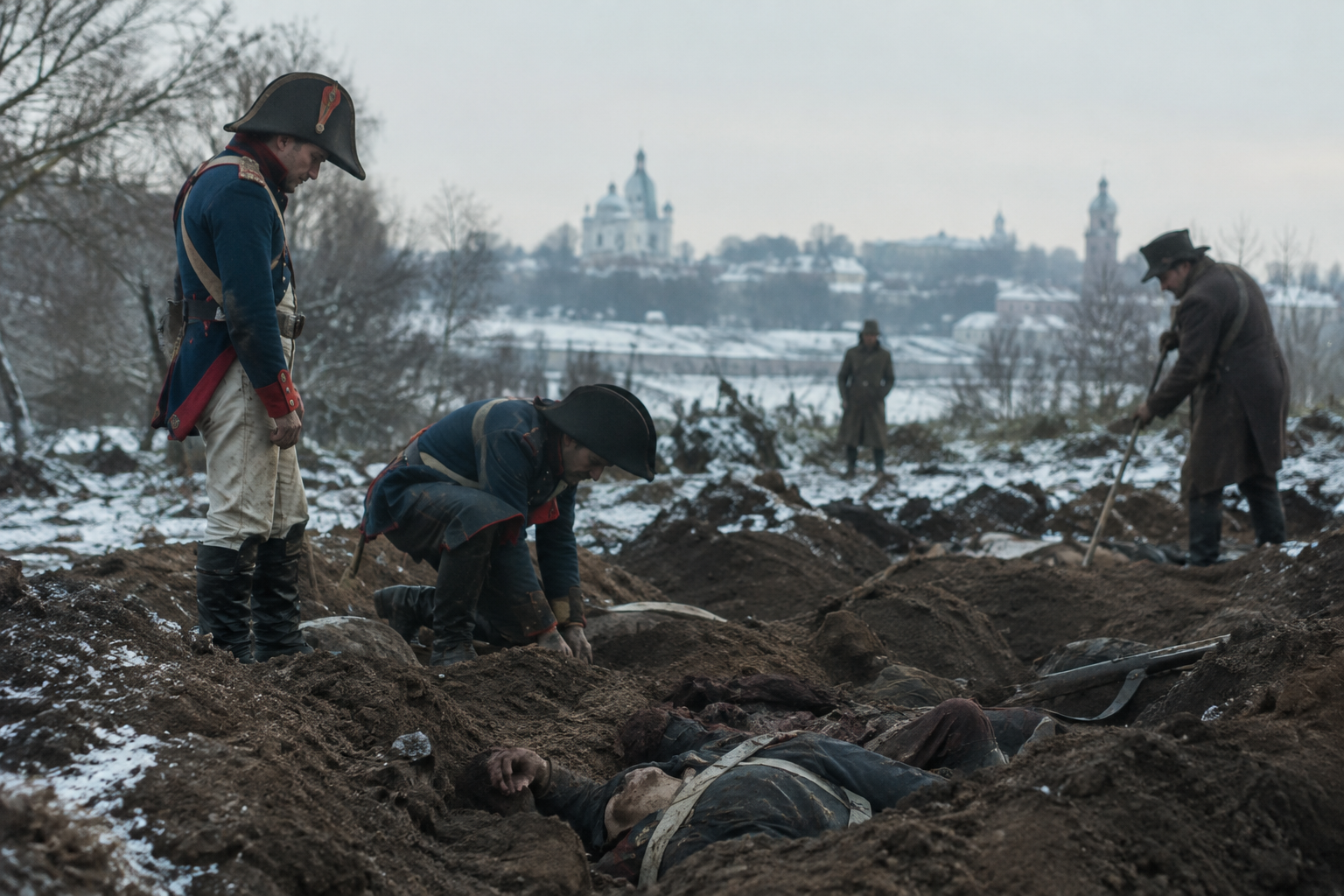
In the winter catastrophe of Napoleon's 1812 campaign, one man from the Grande Armée ended up in a mass grave at Vilnius, identified in the ancient DNA record as YYY097B. That is already a vivid historical setting: retreat, disease, exposure, and the collapse of one of Europe's largest armies. But for Y-DNA, the striking detail is narrower and more personal. This individual has been associated with the paternal haplogroup N1a1a1a1a1a2b1a, a very specific branch inside the wider haplogroup N family.
That matters because a mass grave from 1812 is not some dim prehistoric horizon where all identities blur into broad population labels. It is a sharply historical context, with documents, military routes, and a known disaster. Here, a highly specific paternal line turns up not in legend or genealogy, but in the remains of a real man caught in one of the best-known military collapses in European history.
The Vilnius burials linked to Napoleon's retreat have become important precisely because they show history at human scale. These are not abstract "troops on the move"; they are bodies recovered from the aftermath of hunger, cold, infection, and logistical failure. Research on the remains of the Grande Armée has also fed into wider work on epidemic disease during the campaign, as discussed in MyTrueAncestry's piece on Napoleon's 1812 retreat and the pathogens found among the dead.
For YYY097B, the haplogroup assignment is useful not because it tells us his regiment or language, but because it gives one durable thread of paternal ancestry. Y-DNA follows the direct male line only: father to son, over many generations. It does not describe the whole ancestry of this soldier, still less his nationality, but it can place his paternal line within much longer population histories across northern Eurasia and the Baltic world.
That wider setting is especially relevant for haplogroup N lineages. In Europe, branches of N are often discussed in connection with northeastern Europe, the eastern Baltic, Finland, and populations shaped by long histories around the forest zone of northern Eurasia. One should be careful here: the exact subclade N1a1a1a1a1a2b1a is not the same thing as the whole of haplogroup N, and the presence of this one soldier does not prove a single place of origin. But it does place one strand of the Grande Armée's human mixture into a paternal tradition more characteristic of Europe's northeast than of Napoleonic mythology.
It is tempting to think that ancient DNA is most revealing when it reaches deep prehistory. Yet burials like Vilnius show something equally valuable: how genetics can sharpen the picture of very recent, very messy historical events. Armies are famous for movement, recruitment, coercion, and mixed origins. A soldier buried in Lithuania in 1812 may have begun life far away, and his paternal lineage may point to connections invisible in ordinary military history.
That is one reason a single sample like YYY097B deserves attention. Napoleonic armies gathered men from across imperial France and from allied, annexed, or subordinate territories. A Y-DNA lineage associated with N1a1a1a1a1a2b1a fits neatly into that broader truth: the Grande Armée was not ethnically or regionally simple. The dead at Vilnius were not a uniform block of "Frenchmen" in any biological sense, and archaeology keeps reminding us that empires moved very mixed human populations.
A recent research lead connected with this material can be found at https://www.biorxiv.org/content/10.1101/2025.07.12.664512v1. Even without leaning on unverified details, the significance is plain enough: the scientific study of such remains helps bridge battlefield history, burial archaeology, and the long continuity of paternal descent.
To understand why this branch stands out, it helps to look beyond 1812. Haplogroup N, in its broader sense, has a long history across northern Eurasia and later became especially important in parts of northeastern Europe. Different sub-branches today are found at notable frequencies among some Finnic, Baltic, and other northern or eastern European populations. That does not mean every branch has the same story, nor that every man carrying a downstream N lineage came from the same historical people.
Still, when a subclade like N1a1a1a1a1a2b1a appears in a soldier from Vilnius, it invites us to think in regional rather than purely national terms. Lithuania sat at a crossroads of armies, trade, dynasties, and languages. By the early 19th century it was also entangled in the political aftermath of the Polish-Lithuanian Commonwealth and the expanding Russian Empire. A paternal lineage with northeastern European associations turning up in this setting is not surprising; what is useful is that DNA lets us see it directly in an individual man rather than inferring it from maps and chronicles.
For readers interested in the deeper regional background, MyTrueAncestry's discussion of early medieval Finland is useful because it shows how genetics in the Baltic and Finnic world often reveals mobility, mixture, and shifting paternal patterns rather than tidy ethnic boxes.
There is another reason not to oversimplify this haplogroup. The Baltic region has rarely been a sealed container. Over the last two millennia it has seen contacts among Baltic-speaking groups, Finnic speakers, Scandinavians, Slavs, Germans, steppe-linked movements, and imperial armies. A Y-line can persist through all of that while the rest of a person's ancestry, language, and identity change repeatedly.
That is why a paternal lineage in a Napoleonic burial should be read historically, not romantically. N1a1a1a1a1a2b1a does not turn YYY097B into a representative of one tribe, nation, or language family. What it does show is continuity of one male line across generations substantial enough to survive into the age of muskets, mass conscription, and imperial collapse.
Seen this way, the sample belongs to a larger archaeological theme: the persistence of older regional ancestry patterns inside supposedly modern institutions. Armies often look standardised on paper. In graves, they are anything but. The Vilnius dead preserve traces of the same population complexity that ancient DNA has been uncovering in medieval cemeteries, frontier zones, and mobile communities across Europe.
A comparable regional perspective appears in MyTrueAncestry's article on Viking-Age multiple burials from Semigallia, Latvia, where the archaeology of the eastern Baltic again shows that local histories were made by movement, violence, and mixture rather than isolation.
If your paternal line belongs to N1a1a1a1a1a2b1a, the clearest lesson from the present evidence is not a grand dynastic claim but a regional one. This branch sits within a wider paternal family with strong northern and northeastern Eurasian significance, and at least one documented ancient individual associated with it was part of the shattered Grande Armée buried at Vilnius in 1812. That places the lineage within a world of Baltic crossroads, imperial mobilities, and long-lasting male-line continuity.
In other words, this is a haplogroup that speaks less of a single heroic founder than of endurance through centuries of upheaval. One man's Y-chromosome survived the collapse of Napoleon's invasion and now helps illuminate how older northeastern European paternal lines remained present in the very modern disasters of recorded history.
Comments