The Uggla Family
– 2 min read


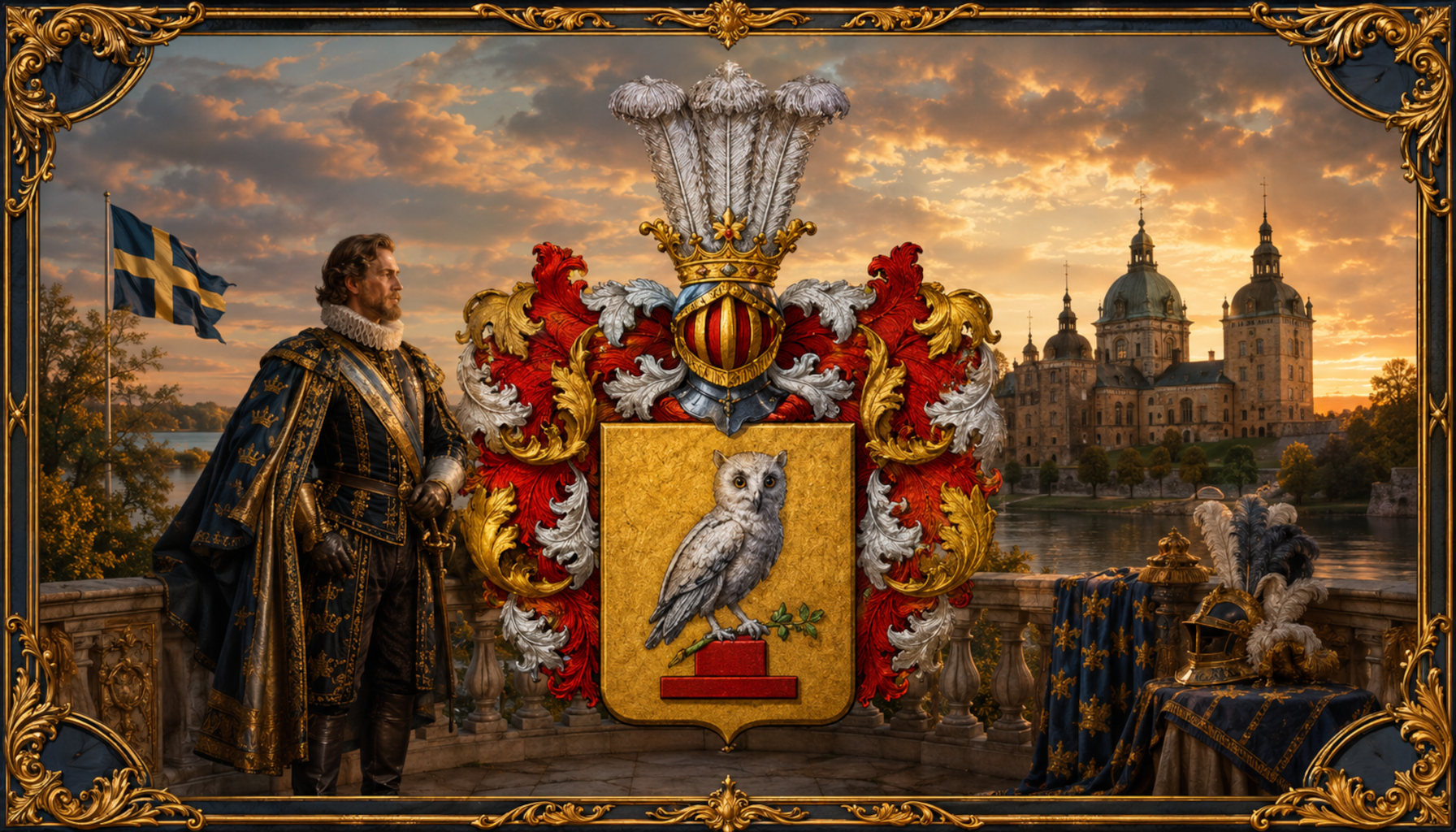
The Uggla family was one of the old noble houses of Sweden, formally introduced at Riddarhuset in 1625 as noble family no. 100. In origin, it is generally regarded as a deeply rooted Swedish family, with its late medieval heartland in Vastergotland rather than in Norway or Holstein, despite older claims that tried to place it elsewhere. In genetic tagging terms, the primary family haplogroup linked here is R1b1a1b1a1a1c2b2a1b1a1a2b2a, a lineage that sits comfortably within the wider north European story of movement, continuity, and elite family formation.
The earliest clearly known member is Claes Hansson of Bosgarden, who died in 1529 and appears as a squire in the early 1500s. From there the family broadens into view: not a single glittering court line, but a sprawling noble kin-group with roots in landed society, legal office, and military service. In the early 1600s the Ugglas split into several branches linked with Paarp, Claestorp, Finland, Averstad, Krokstad, and Saleby. That branching matters, because it helps explain why Uggla became one of the larger noble families in Sweden, with members serving as district judges, cavalry officers, commanders, governors, naval officers, and estate holders, while also becoming part of the connected world of the Finnish House of Nobility. Their heraldry is wonderfully memorable too: an owl, already visible in 16th-century seals, later often shown holding a twig in its claw, a device that became the best-known version of the family arms.
Read more about the Bure Family
If you want the real anchor of the Uggla story, look to Vastergotland in western Sweden. This was not some vague ancestral backdrop but a historic region dense with parish networks, noble estates, law districts, and old fralse society, the sort of place where medieval and early modern power was built field by field and marriage by marriage. Bosgarden, associated with Claes Hansson, belongs to that world: a local landed environment where the lesser nobility acted as soldiers, jurors, judges, and intermediaries between crown and countryside. Vastergotland still preserves much of this landscape in churches, manors, roads, and settlement patterns, and it remains a very visitable part of Sweden today. Even when specific medieval buildings have changed or vanished, the region itself still offers the nearest thing to walking through the Ugglas' historical stage set.
Explore the Silfverskiold Family
From an ancient-DNA angle, the haplogroup tag R1b1a1b1a1a1c2b2a1b1a1a2b2a connects the Uggla story to a wider web of related northern and central European male-line samples rather than to any proven direct ancestor. Among the linked examples are Thuringii Tribe Germany Deersheim Saxony-Anhalt sample DRH010, Viking Age Denmark Sjaelland Kyndby sample CGG107519, Viking Age Trelleborg Kingdom of Denmark sample CGG106832, Carolingian Drantum Lower Saxony Germany sample DRU012, and Post Viking Age Hedeby Schleswig Rathausmarkt Southern Jutland sample SWG013. What that gives us is not a neat family tree but a historical atmosphere: lineages moving through the same broad Scandinavian and north German world of the Migration Period, Viking Age, and medieval centuries, exactly the larger setting in which a house like Uggla emerged and flourished.
Read more about the Tavast Family
The Uggla family is a fine example of how noble history is rarely just about titles. It is about regions, symbols, office, service, and the slow accumulation of status across generations. If you have Swedish or Finnish roots, or simply want to see whether your DNA connects with the Uggla family or with related ancient DNA samples from Viking and medieval northern Europe, you can explore those links for yourself by uploading your DNA to MyTrueAncestry.
Comments