The Bure Family

– 3 min read


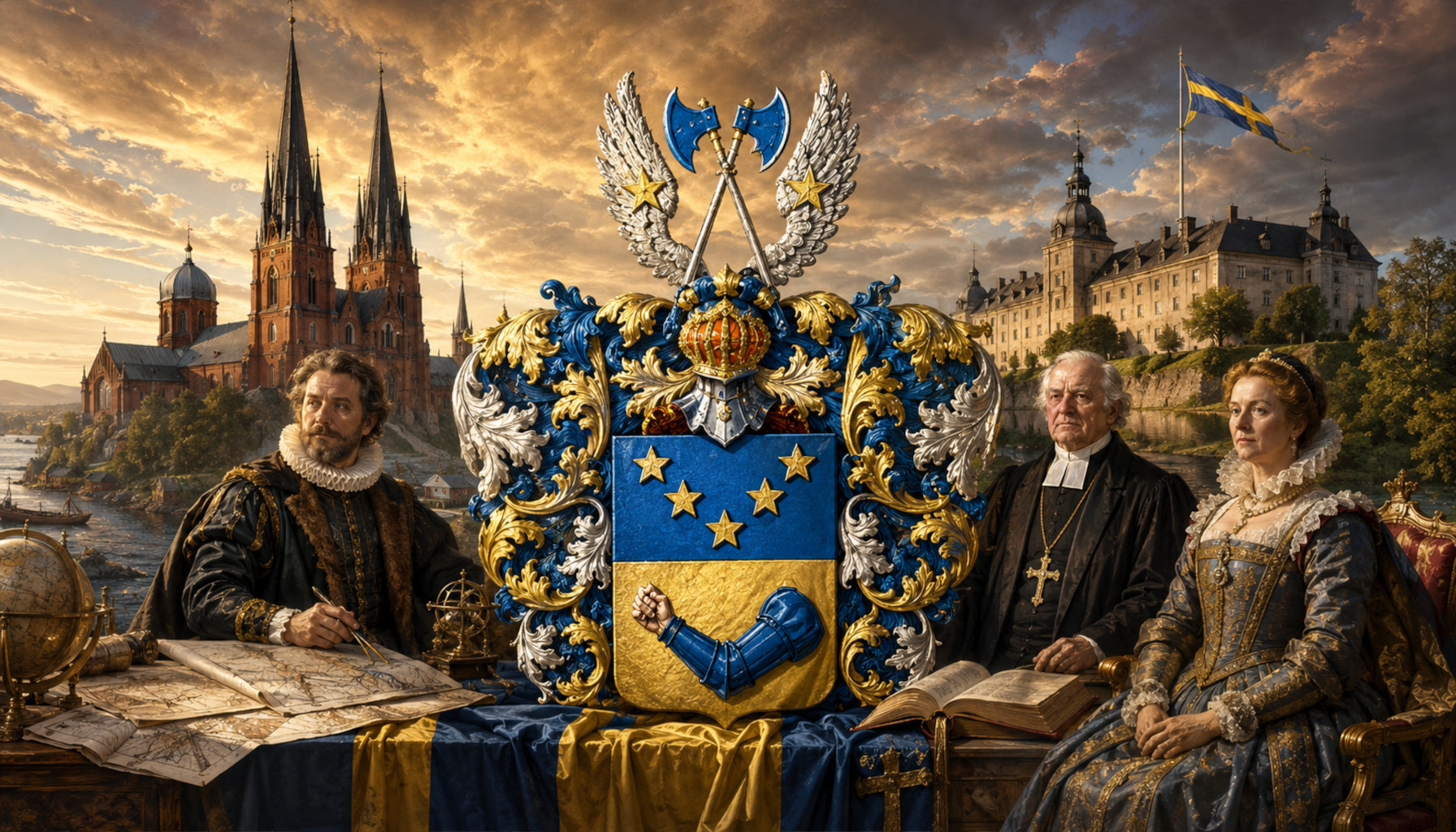
The Bure family was a Swedish noble family entered at the Riddarhuset as noble family no. 126, with its primary linked haplogroup identified here as G2a2b2a1a1b1a1a2a1b2a1. But the really interesting thing is that Bure was never just a narrow noble house. It grew out of the wider Bure lineage of northern Sweden, a remarkable clerical and learned family network tied to Halsingland, Angermanland, Vasterbotten, Uppsala, and the expanding institutions of church and state in the age of the Reformation and early Swedish empire.
The family's rise belongs to that great 16th- and 17th-century moment when Sweden was being intellectually built as much as militarily built. Branches were ennobled on 24 June 1621 and 10 May 1624, and the family was introduced in 1627. One branch died out in 1655 and the later in 1829, while sharing common origin with the noble and baronial Burenskold families. Among the named figures were Laurentius Svenonis, born in 1507, priest at Uppsala Cathedral and later the first Lutheran parish priest in Sabra pastorate; Andreas Engelbertsson Bureus, born in 1571, the great royal official, mathematician, diplomat, and cartographer; and Olof Bure (1578-1655), one of the better-known members of this northern learned kin group. The family also produced bishops, professors, antiquarians, court preachers, and royal servants such as Jacobus Johannis Zebrazynthius, Johannes Bure, and Lars Bure, while women including Margareta Hansdotter Sabrazynthia, Anna Buraea, and Christina Buraea helped bind the lineage into wider clerical, academic, and noble society.
Read more about the Bure family
The location anchor for the Bure family is the far north of Sweden, especially around Sabra parsonage and the old ecclesiastical landscapes of Vasterbotten, with intellectual roads leading south to Uppsala. This matters because the Bure story is not the tale of an ancient castle family planted ready-made in aristocratic soil. It begins in parish life, in the church's local authority, in literacy, land knowledge, and regional memory. Northern Sweden in the 1500s and 1600s was a frontier of administration as much as geography, where the Crown, church reform, taxation, education, and mapping all had to be made real on the ground. The Bures were extraordinarily good at that sort of work. If your location source refers to sites such as Sabra church, parsonage country, or associated regional heritage places, these are part of a landscape that can still, in reasonable terms, be visited today: not as a preserved family stage set, but as living historic ground where the family's world first took shape.
From an ancient-DNA point of view, the haplogroup link G2a2b2a1a1b1a1a2a1b2a1 connects the Bure family to a broad and intriguing spread of earlier Eurasian individuals, without implying direct descent from any specific one. Related or linked samples include elite Celtic burials from Germany such as Magdalenenberg Villingen-Schweningen (MBG017), Eberdingen-Hochdorf Biegel (HOC002 and HOC002b), and Ludwigsburg Roemerhuegel (LWB003 and LWB003b); Iron Age and Gallic-period individuals from France including Sequani-linked Parancot (CGG023712), Les Moidons (CGG023724), and Tumulus de La Forat de Chatillon (CGG023644); a Late Antique Roman individual from Arrabona in Pannonia, Hungary (GYS041); Wielbark-associated samples from Kowalewko in Poland and Pommerania (PCA0015, PCA0063, PCA0062); a Hallstatt-period individual from Stradonice in Bohemia (I16327); an Iron Age sample from Zamardi, Hungary (I25516); a Viking Age individual from Trelleborg in the Kingdom of Denmark (CGG106833); and a post-Roman Britain sample from Randwick Long Barrow (CGG020724). What this gives you is not a neat single line, but a deep time backdrop showing how a paternal lineage associated with an early modern Swedish learned family can also be found across Celtic, Roman frontier, Gothic, and Viking Age contexts.
Explore ancient DNA and Celtic origins
If you think your own family history may touch the Bure lineage, northern Sweden, or these deeper G2a-linked ancient connections, this is exactly the sort of case where DNA, documents, and landscape start talking to one another. Upload your DNA to MyTrueAncestry and see whether you match the Bure family or any of the related ancient DNA samples mentioned here.
Comments