The Stierna Family

– 3 min read


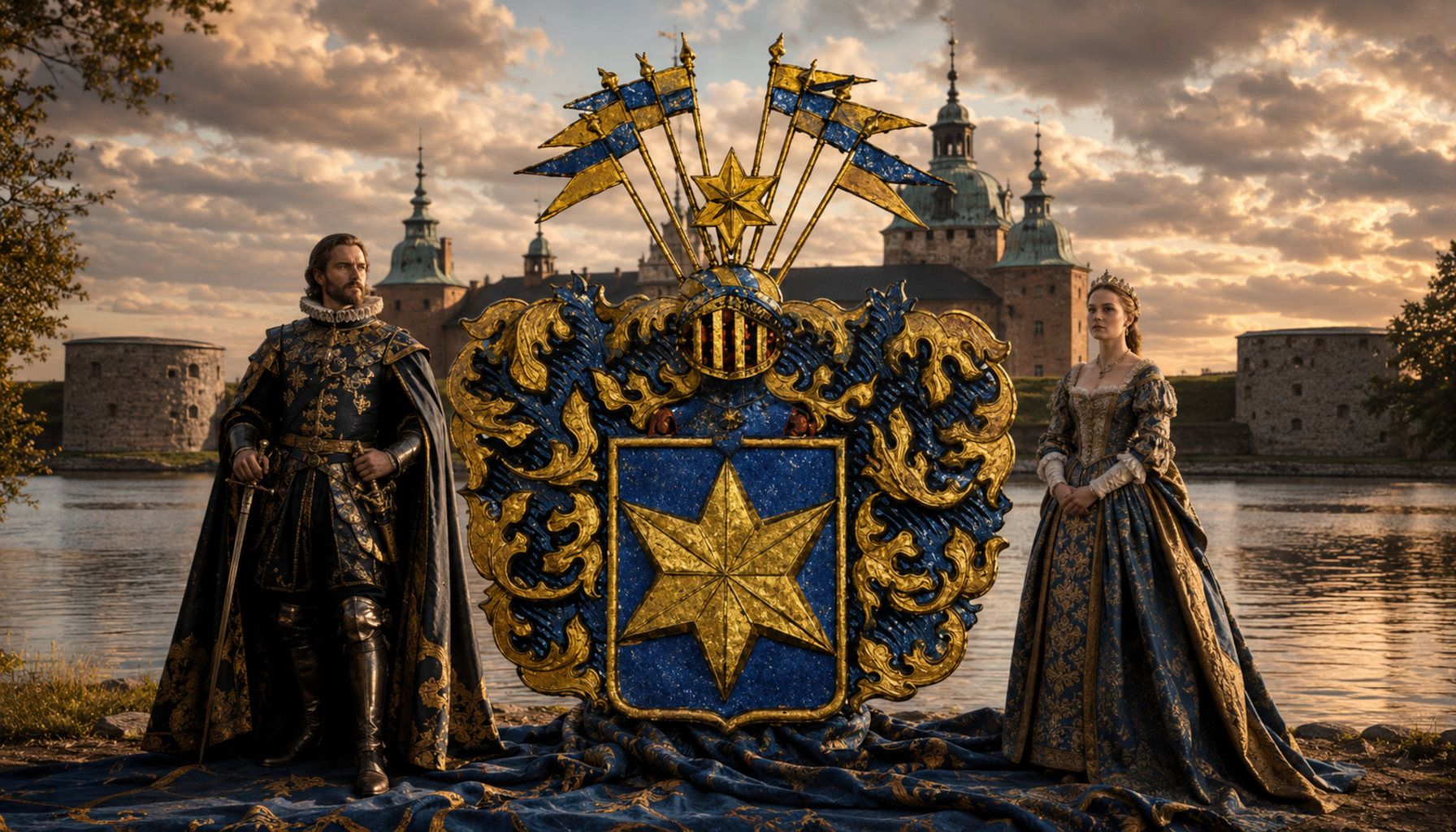
The Stierna family was one of the older noble houses of Sweden, introduced at Riddarhuset in 1625 as noble family no. 77, though its roots reached much further back into the medieval fralse of Smaland. This was a family of local power, law, land, and crown service, centered above all in Jonkoping County and linked especially to the district world around Saby in Backaby parish. Their heraldic sign was the star, already associated with early figures such as Nils Gregersson, who served as district judge in Vastra harad in the early 1400s. The primary Y-DNA haplogroup linked with the family is R1a1a1b1a2b3a1d5a1b, a lineage with a long record across central, eastern, and northern Europe.
What makes the Stierna family interesting is that they sit right on the fault line between medieval Sweden and the new royal state of the Vasas. In the earlier period, they look very much like an old provincial noble lineage: landholding, judging, representing local authority, and building status through office and marriage. Later, in the 1500s and early 1600s, they appear in a rougher and more ambitious world of castles, military commands, royal administration, and the political upheavals of Gustav Vasa, Sigismund, and Duke Karl. Among the named figures of the family we find Olof Olofsson Stjarna (1430-1498), part of that older noble stratum of Smaland, as well as Mans Pedersson Stierna, an important royal servant who held offices in Allbo, Ostbo, Uppsala, and Kronoberg, and Goran Mansson Stierna, who served as commander, colonel, governor, and administrator in the turbulent early Vasa state. The male line died out in 1749, but the family remains a vivid example of how old provincial nobility helped shape Sweden before and during the rise of the early modern kingdom.
The family's deepest anchor lies in Smaland, especially around Saby in Backaby parish in what is now Jonkoping County. This was not some grand metropolitan center, but that is precisely the point. Families like the Stierna grew out of the local landscape of farms, parish ties, district courts, and regional power networks. Saby and the surrounding district belonged to the inland world of Smaland, where noble status was often bound tightly to landed control and service as lagman, haradshovding, military officer, or royal official. In that setting, the Stierna family became one of those enduring local lineages whose influence stretched from the courtroom to the estate and from the parish to the castle. The area around Backaby and Saby can still be visited today, and for anyone interested in Swedish noble origins it offers something more valuable than a palace facade: the actual provincial setting that produced families such as the Stierna, rooted in the old heartland of Smaland.
The Stierna family's primary haplogroup, R1a1a1b1a2b3a1d5a1b, belongs to a wider paternal network seen in a range of ancient and medieval samples across Europe. These are not proof of direct descent from the Stierna family, but they are useful related or linked reference points for the deeper history of the lineage. Among them are Avar Elite Hungary Rakoczifalva samples RKC052 and RKC051, Bronze Age Hungary Balaton Region Somogyvar-Vinkovci sample S9, Piast Dynasty and Santok area samples PCA0404, PCA0520, PCA0381, PCA0382, and PCA0198, Western Slav settler samples from medieval Sachsen-Anhalt including NDW036, NDW017, NDW025, NDW038, NDW043, SDN028, and SDN029, Duchy of Sandomierz Lublin Region samples PDH011 and PDH012, Early Medieval Croatia samples VEM035 and VEM049, Dark Ages Hungary Gothic-associated sample SEI-5, Bronze Age Romania sample I6185, and Iron Age Ingria sample VII15. Taken together, these linked finds place the haplogroup in a broad historical zone that overlaps with Slavic, Baltic, steppe-influenced, and northern European worlds, which is exactly the sort of long, tangled background one might expect behind an old Smaland noble house.
If you have Swedish, Smalandic, or noble family traditions in your background, DNA can add a fascinating extra layer to the paper trail. Upload your results to MyTrueAncestry to explore ancient and medieval matches, haplogroup context, and the deeper population history connected to lineages like R1a1a1b1a2b3a1d5a1b.
Comments