The Tavast Family

– 3 min read


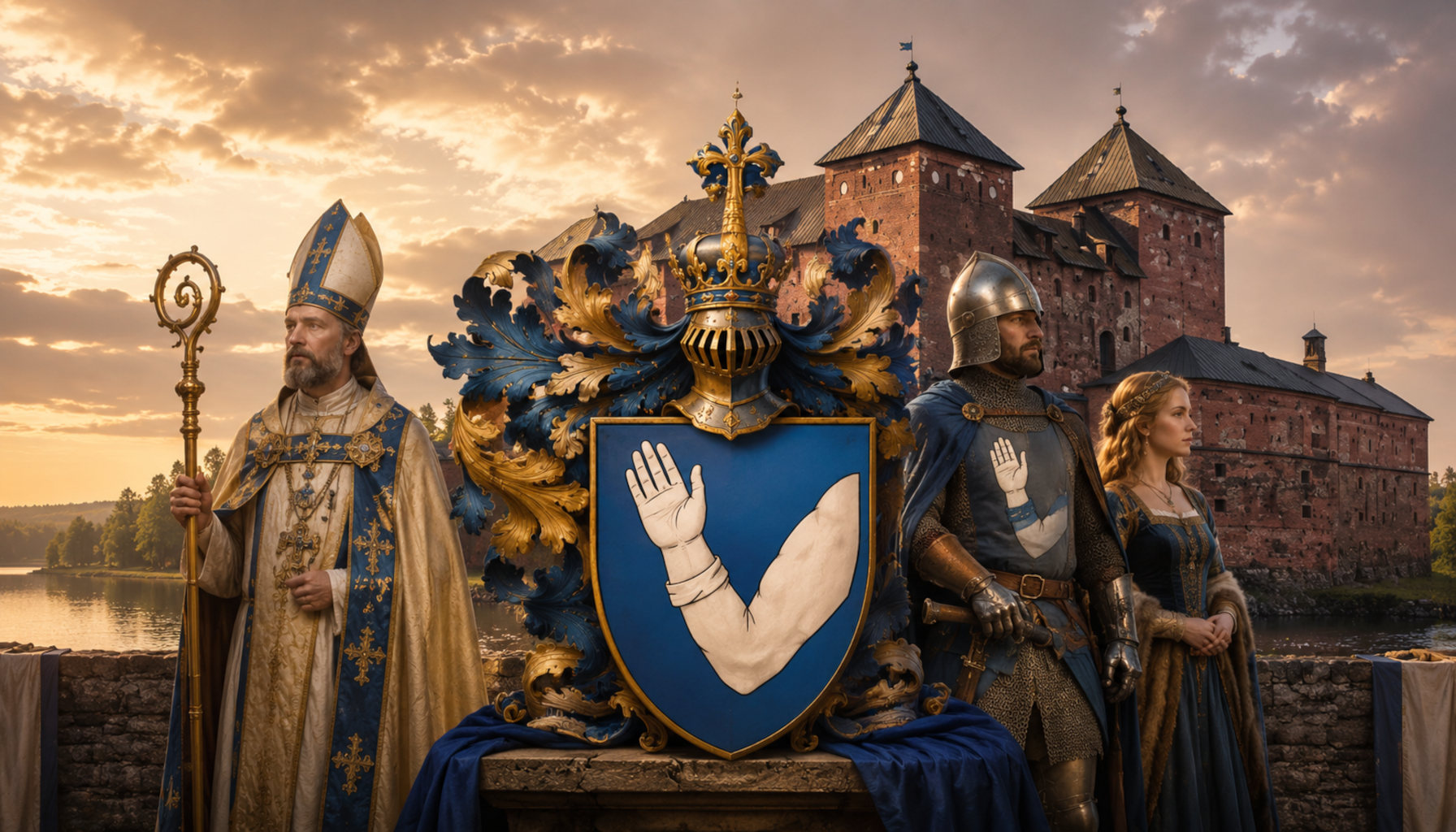
The Tavast family was one of medieval Finland's best-known noble lineages, closely associated with Tavastia and remembered for its role in the political, legal, and ecclesiastical life of the late medieval Swedish realm. Emerging from the medieval fralse, the tax-exempt noble class that formed the backbone of local lordship and royal service, the family appears clearly in the records when Olof Tavast sealed as a nobleman in 1386, while his son Nils received a formal letter of nobility in 1407. Their primary haplogroup in this heritage context is N1a1a1a1a1a1a1b2a2a1, a lineage strongly linked with northern and northeastern Europe and deeply relevant to the wider population history of Finland and the Baltic world.
The family's roots lay in Tavastian landholding and in that important medieval frontier zone where inland Finland, royal administration, and church power met. During the 1400s, the Tavasts reached their height. Magnus Olofsson Tavast became bishop of Turku and was one of the most influential churchmen in medieval Finland, expanding ecclesiastical influence through donations, prebends, and strategic landholding across Finland and Aland. Nils Tavast served as district judge in Tavastia, and Olof Nilsson Tavast rose still higher as knight, district judge, and commander of Hame Castle, placing the family at the center of governance, justice, and defense. The family held lands in Tavastia, Finland Proper, Nyland, Satakunta, and Aland, and married into other notable Finnish and Swedish noble houses. In the broader sweep of history, the Tavasts stand as a classic example of a medieval Finnish noble family: provincial in origin, but fully woven into the institutions of church, crown, and castle. A later named figure connected to this wider noble world is Jakob Kaas, who died in 1529.
No place captures the Tavast family's historical setting better than Hame Castle in Tavastia. Built in the late 13th century, probably as part of the Swedish crown's effort to consolidate control over inland Finland, the castle became one of the great administrative and military centers of medieval Finland. Positioned by the water routes and surrounded by the Tavastian landscape that gave the family its name, it served not merely as a fortress but as a working seat of government, taxation, justice, and regional power. Olof Nilsson Tavast's role as commander tied the family directly to this stronghold and to the everyday mechanics of rule in medieval Finland. The castle, with its red brick architecture and long layered history, remains one of Finland's most important medieval monuments, and yes, it can still be visited today, making it a rare and vivid place where the world of the Tavasts can still be felt in stone.
The haplogroup linked here with the Tavast family, N1a1a1a1a1a1a1b2a2a1, belongs to a wider northern and eastern European genetic story rather than serving as proof of direct descent from any one ancient individual. Related or linked ancient DNA samples help sketch that broader background. Among them are Pre-Vendel Age Oland Sandby Borg, Sweden samples snb014, snb019a, and snb019; Early Medieval Croatia Velim-Velistak samples VEM032 and VEM003; Vendel Age Saaremaa Salme II-D sample VK550; and Late Bronze Age Estonia sample VII4. These finds show that related branches of this paternal line were present across the Baltic and parts of eastern and central Europe over long periods of time. For a family like Tavast, rooted in medieval Finland yet connected to the wider Swedish realm and Baltic world, that is a fascinating reminder that noble history sits atop a much deeper human past.
If the story of the Tavast family, Hame Castle, and haplogroup N1a1a1a1a1a1a1b2a2a1 makes you curious about your own deeper origins, you can upload your DNA to MyTrueAncestry and explore how your results may connect with ancient populations, medieval lineages, and the wider history of northern Europe.




Comments