The Tavast Family

– 3 min read


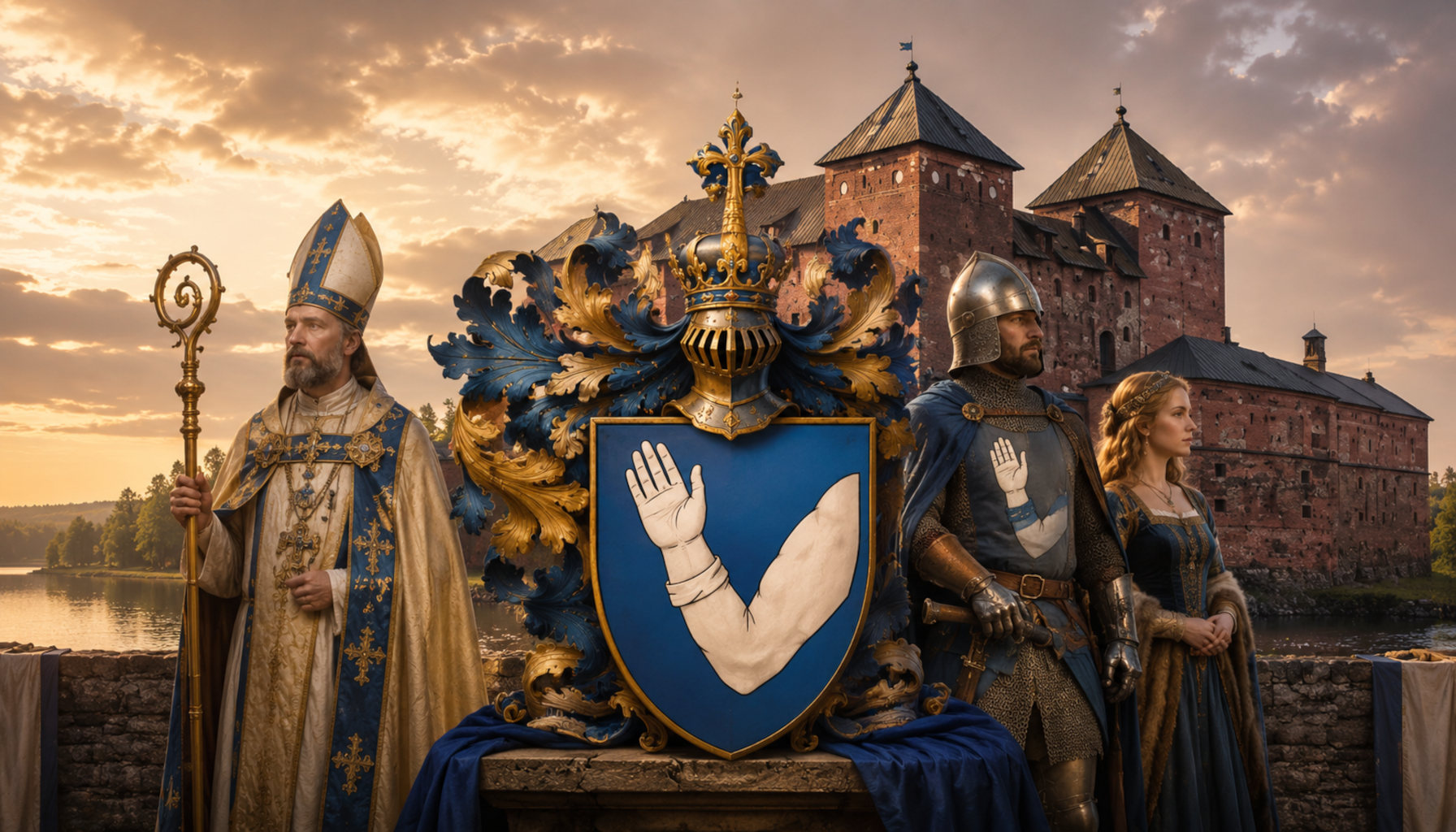
The Tavast family was one of medieval Finland's classic noble lineages: a family rooted in Tavastia, active in the Swedish realm, and remembered for bishops, judges, knights, and castle command. Their name is closely tied to the old inland province of Tavastia, a region of forests, lakes, farms, and frontier politics, where local landholding mattered enormously. In haplogroup tagging, the family is linked here with N1a1a1a1a1a1a1b2a2a1 as the primary family haplogroup, a lineage with deep northern Eurasian and Finnic associations.
Historically, the Tavasts emerge clearly among the medieval fralse, the tax-exempt noble class. Olof Tavast is recorded sealing as a nobleman in 1386, and his son Nils received a formal letter of nobility in 1407, which tells us a good deal about the moment: this was a family not merely local, but increasingly recognized within the wider legal and political order of the kingdom. Their great century was the 1400s. Magnus Olofsson Tavast rose to become bishop of Turku, one of the most powerful churchmen in medieval Finland, extending influence through donations, prebends, and strategic landholding across Finland and Aland. Nils Tavast served as district judge in Tavastia, while Olof Nilsson Tavast became a knight, district judge, and commander of Hame Castle, placing the family squarely at the intersection of law, war, and government. Through landed wealth in Tavastia, Finland Proper, Nyland, Satakunta, and Aland, and through marriages into notable Finnish and Swedish noble houses, the family became one of those indispensable late medieval networks from which power in Finland was actually made. A later named figure associated with this wider noble world is Jakob Kaas (?-1529), a reminder that the social and political circles around such families remained interconnected well into the transition from the medieval to the early modern age.
Read more about Medieval Finland
To understand the Tavasts, one must pause at Hame Castle, because this was not just a building in the background: it was one of the great anchors of power in medieval Finland. Hame Castle, in present-day Hameenlinna, began as a medieval brick and stone fortress and became an important administrative, military, and political center of the Swedish crown in inland Finland. Built near water routes and at a strategic point in Tavastia, it helped project royal authority into a region that was both valuable and contested. Over the centuries it developed from an early fortified site into a substantial castle complex, with thick walls, defensive works, and later additions reflecting changing military needs. For a family like the Tavasts, command of Hame Castle meant more than prestige: it meant access to the machinery of rule itself, including justice, defense, taxation, and oversight of a key province. The castle still stands today and can indeed be visited, which is one of the pleasures of Finnish medieval history: the landscape has not entirely let go of its past.
From an ancient-DNA point of view, the Tavast family's tagged haplogroup N1a1a1a1a1a1a1b2a2a1 sits in an intriguing web of northern and eastern European connections. Related or linked samples include Pre-Vendel Age Oland Sandby Borg Sweden individuals snb014, snb019a, and snb019; Vendel Age Saaremaa Salme II-D sample VK550; Late Bronze Age Estonia sample VII4; and Early Medieval Croatia Velim-Velistak samples VEM032 and VEM003. These are not claims of direct descent from the Tavast family, and it is important not to pretend otherwise. What they do offer is a wider genetic backdrop: the sort of long-range paternal pattern that appears across parts of the Baltic, Scandinavia, and into eastern Europe over many centuries. In other words, if the Tavasts belong to the world of medieval Tavastia, their linked haplogroup belongs to a much older and broader human story of movement, settlement, and regional continuity around the Baltic and beyond.
Read more about the Aminoff Family
If the Tavast family appears in your own family story, or if you are simply curious about medieval Finnish nobility, castles, and the deeper genetic landscape behind them, this is exactly where DNA history becomes so compelling. Upload your DNA to MyTrueAncestry and see whether you match the Tavast family context or any of the related ancient DNA samples linked with haplogroup N1a1a1a1a1a1a1b2a2a1.




Comments