Clan Fleming
– 2 min read


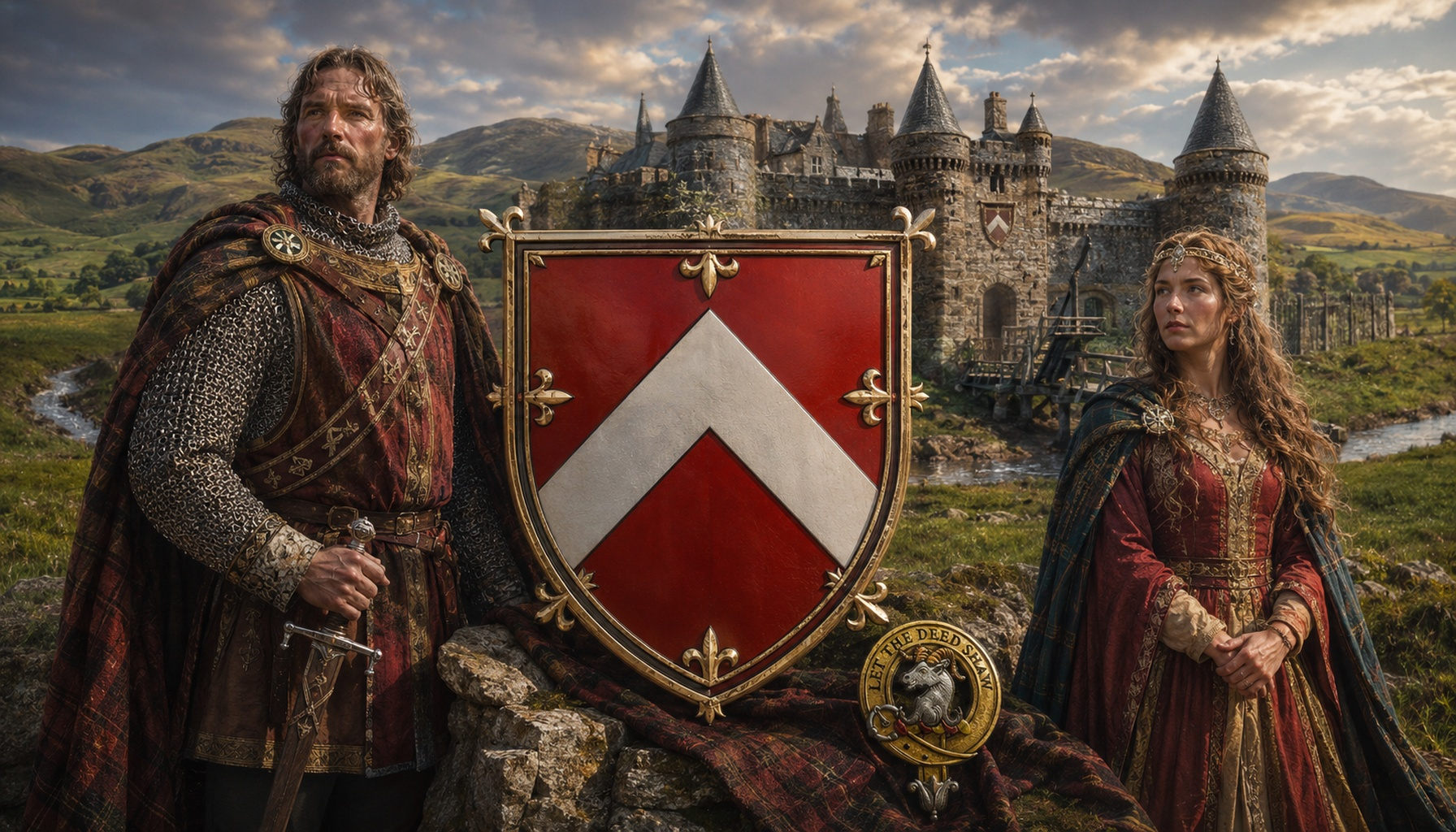
Clan Fleming was one of those Scottish noble families whose very name tells a story. The surname points back to Flanders, and that matters, because medieval Scotland did not grow in isolation. It drew in capable families from across the North Sea world, especially in the 12th and 13th centuries, when kings rewarded service with land, office, and opportunity. The Flemings fit that pattern beautifully: continental in origin, then thoroughly Scottish in allegiance, estate life, politics, and memory. Their primary linked haplogroup here is R1b1a1b1a1a2c1a5c1b1a, a paternal line tag that sits comfortably within a wider northwestern European story.
Once established in Scotland, the Flemings became part of the fabric of noble life through royal service, landholding, military duty, marriage alliances, heraldry, and public office. This is the real interest of the family: not merely that they came from elsewhere, but that they became unmistakably Scottish without losing the memory of where they had come from. Sir Malcolm Fleming, noted in 1363, stands in the medieval line of the family’s prominence; Robert Fleming, born in 1581, reflects the later continuity of the name in public life; and Alexander Fleming, born in 1881 and famous worldwide for the discovery of penicillin, shows how an old noble surname could echo far beyond its feudal beginnings.
If you want a place that anchors Fleming history to the ground itself, Boghall Castle in South Lanarkshire is the one to look at. Near Biggar, it is associated with the Flemings and later developed as a fortified tower house, with parts of the structure dating mainly to the 16th century, though the site has earlier medieval roots. It is the sort of place that reminds us that noble history was not abstract. It was built in stone, defended by walls, and tied to local authority, estate management, and kinship. Boghall was not simply a residence but part of a working territorial world in which lineage, status, and survival were all bound together. The castle survives as a ruin, and yes, it can still be visited from the outside as a historic site, which makes it one of those rare places where the surname, the landscape, and the long memory of a family still meet face to face.
The haplogroup tag R1b1a1b1a1a2c1a5c1b1a does not prove direct descent from any named ancient person, and it should not be used that way. What it can do is place Clan Fleming within a broader web of related paternal lines seen across ancient and early medieval Europe. Related or linked samples include Anglo-Saxon Kingdom of Northumbria, Yorkshire, Britain, Fox Holes Cave, Clapdale, Ingleborough Hill (I16392); Germanic Weklice, Poland (R10626); Iron Age Hill Fort Fin Cop, Derbyshire, England (I20628); Celtic Briton Stanton Harcourt, Oxfordshire (I21272 and I21277); Viking Age Skara, Varnhem, Sweden (VK405); and Bronze Age Covesea Cave, Scotland (I3132). What is striking here is the spread: Britain, Poland, Sweden, and Scotland, across Celtic, Iron Age, Germanic, Anglo-Saxon, and Viking Age settings. That is exactly the sort of long, entangled northwestern European background one might expect behind a medieval family whose story begins in Flanders and flowers in Scotland.
If you carry the Fleming surname, have roots in Lanarkshire, or simply suspect a family story that crosses from continental Europe into medieval Scotland, this is the moment to test it against both history and ancient DNA. Upload your DNA to MyTrueAncestry and see whether you match Clan Fleming or any of the related ancient samples linked to haplogroup R1b1a1b1a1a2c1a5c1b1a.
Comments