The House de Lugny

– 3 min read


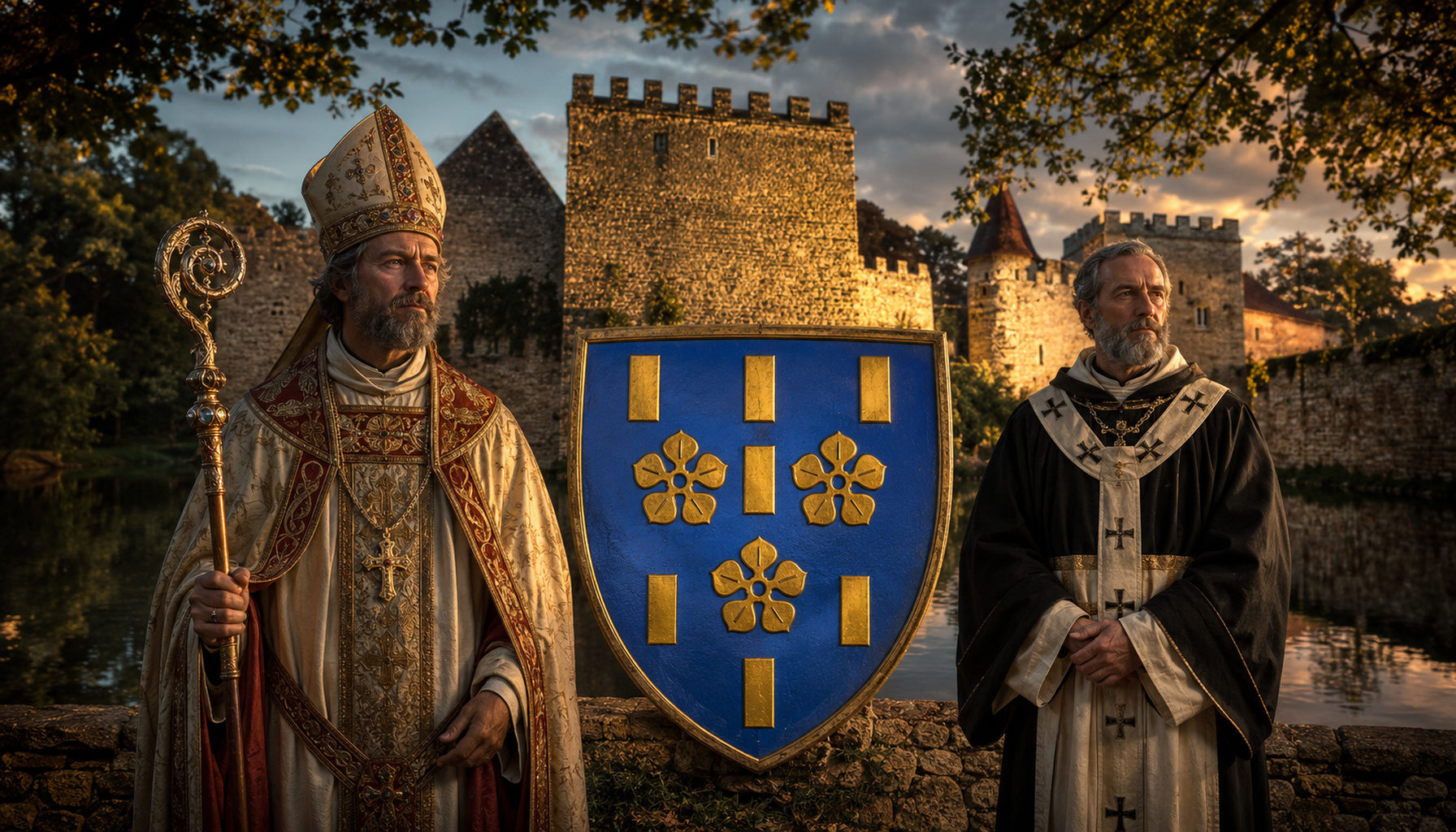
The House de Lugny was a French noble family of Burgundy, rooted in the historic territory around Lugny in the Maconnais, and remembered above all as a landed provincial house whose identity was tied to estate, jurisdiction, and heraldic continuity. In haplogroup terms, the primary family association here is tagged to R1b1a1b1a1a2a1b1a1, a branch within the broad R1b line so often found in western European paternal histories. That does not by itself tell the whole story, of course. Noble houses are never just genes in a neat box. They are places, marriages, loyalties, offices, lawsuits, inheritances, and the stubborn survival of a name across centuries.
What makes the Lugny family interesting is precisely how representative they are of the French provincial noble pattern. They emerged from a territorial setting in Burgundy where authority was local before it was grand: seigneurial rights, landholding, military or administrative service, and the careful preservation of family arms. Such houses built power not simply by battlefield glory but by endurance, alliance, and memory. Claude de Lugny, recorded in 1549, belongs to that later historical visibility when names step more clearly into the archive, but the family tradition itself reflects a much older world in which lineage and landscape were inseparable.
Read more about the House of Sully
The great location anchor for the family is the Chateau de Lugny in the commune of Lugny, in Saone-et-Loire, Burgundy. The site embodies that old aristocratic truth that a family was not merely from a place but, in a sense, was the place. The chateau stands on ground long connected with local lordship and later rebuilding, and the present structure reflects centuries of change rather than a single frozen medieval moment. It has served different purposes over time, as many French chateaux did, adapting to altered politics, altered fortunes, and altered ideas of what noble residence should look like. That is part of its fascination: it is not a fairy-tale survival untouched by history, but a layered Burgundian seat whose stones belong to the long afterlife of seigneurial France. The chateau and its grounds remain a real landmark of Lugny, and the site is still visitable in the sense that the building survives and can be seen, even if practical access may vary depending on local arrangements and current use.
Explore more on the House de Lugny
From the ancient DNA angle, the Lugny haplogroup tag R1b1a1b1a1a2a1b1a1 links the family to a much wider paternal story spread across time and geography rather than to any proven one-to-one ancestor. Related or linked samples assigned within this branch include Historic St. Mary City Chapel Field Cemetery, Maryland individuals I15304, I15319, and I35265; Bronze Age Pre-Celtiberian Spain Murcia Almoloya Pliego ALM041; Medieval Denmark Tjrbjerg or Tjoreby area sample CGG100678; a soldier of Napoleon's Grande Armee from the Vilnius mass grave, YYY084B; the Carthaginian Punic western Sicily sample I24674 from Marsala; Carolingian-era Groningen GRO024; Iron Age Suddern Farm in Hampshire I20982; Gallic Chemin de Coupetz in Marne I21399; Viking Age VK403 from Skara Varnhem, VK87 from Hesselbjergmarken, and VK166 from the St. Brice massacre at Oxford; and Sicily Early Bronze Age sample I3123 from Buffa II. None of these individuals should be presented as direct ancestors of the House de Lugny without documentary proof. But together they show how this paternal line appears in contexts stretching from Bronze Age Iberia to Iron Age Gaul, Viking Scandinavia, Carolingian northwest Europe, Napoleonic warfare, and colonial-era Maryland. That is the real excitement of archaeogenetics: not a fantasy pedigree, but a web of related deep history.
Explore ancient DNA and Celtic origins
If you think your own family story may touch Burgundian nobility, French regional lineages, or the wider R1b1a1b1a1a2a1b1a1 world, you can upload your DNA to MyTrueAncestry and see whether you match the House de Lugny profile or any of these related ancient DNA samples. It is a marvellous way of testing whether the history in the archive and the history in the genome might speak to one another.
Comments