The Aminoff Family
– 3 min read


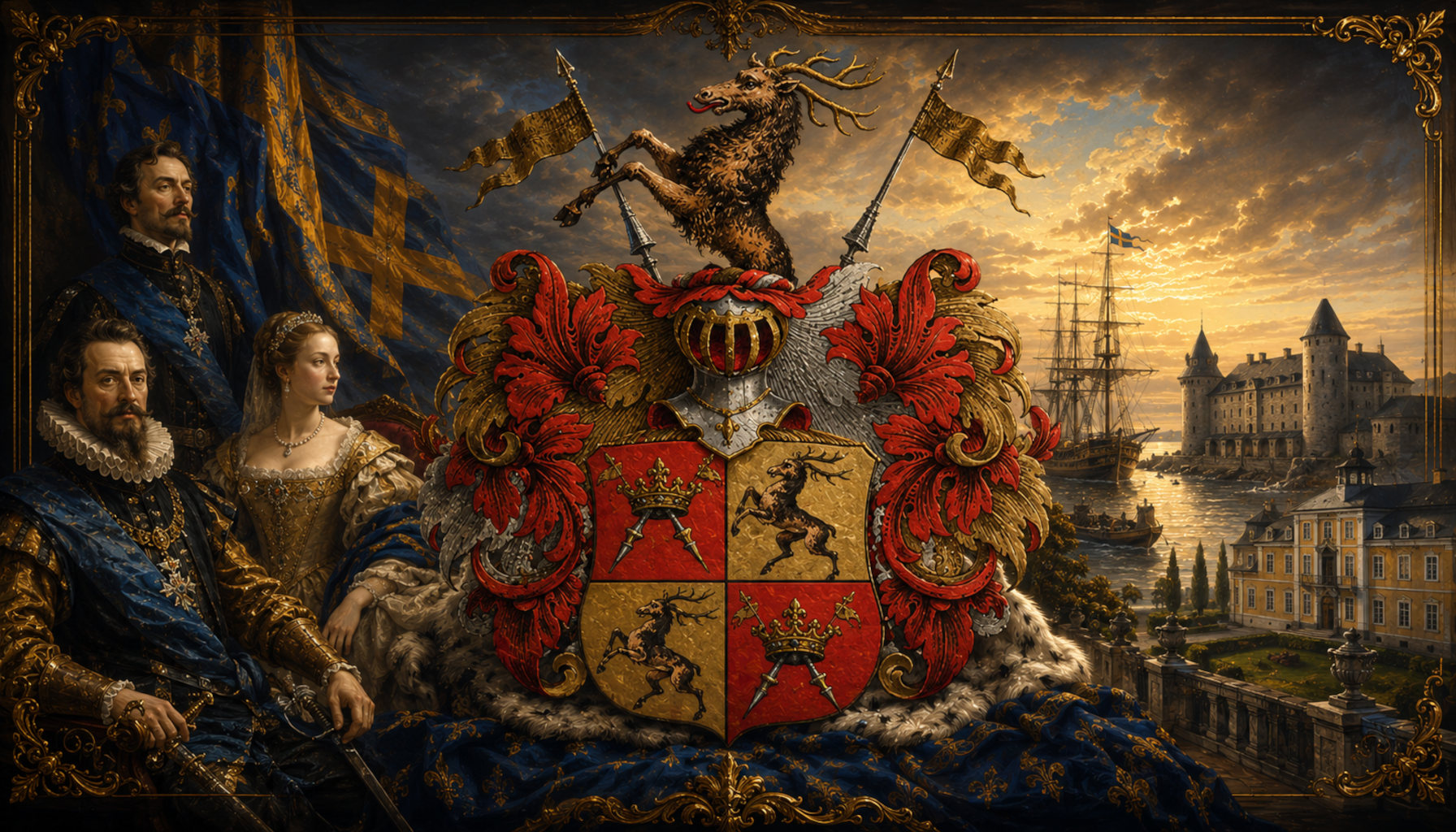
The Aminoff family was a Swedish and Finnish noble family with deep roots in the eastern Baltic frontier, introduced at the Swedish House of Nobility, Riddarhuset, as noble family no. 456 in 1650, and later entered at the Finnish House of Nobility in 1818. Traditionally, the family traced its older origin to Russian boyar nobility tied to Novgorod, Moscow, and Tver, which already tells you a great deal: this was not a family born in a quiet provincial manor, but one shaped by the tense, militarized borderlands between Swedish and Russian power. Their primary family haplogroup is linked here as G2a2b1a1b1a2, a lineage that adds another layer to the story of movement, service, and long memory across northern and eastern Europe.
The Swedish noble line begins most clearly with Feodor Aminoff (1565-1628), a boyar and commander associated with the fortress of Ivangorod. In the wars between Sweden and Russia, he defended that key stronghold and later entered Swedish service together with his sons and followers, remembered in Swedish tradition as the so called Swedish Cossacks. Naturalized as a Swedish nobleman in 1618, Feodor received confirmation of estates in Ingermanland and nearby frontier territories. His descendants then did what frontier noble families so often did: they turned military service into dynastic identity. Across generations they appear as colonels, cavalry officers, commanders, governors, and military men in places such as Ingermanland, Narva, Ivangorod, Nöteborg, Finland, and the eastern Baltic. Through marriage as well as office, the family became woven into a larger noble network linking Russian, Swedish, Finnish, and Baltic lines including Kalitin, Apolloff, Pereswetoff-Morath, Fock, Cronman, and Gripenstierna.
The best place to understand the Aminoffs is Ivangorod, the fortress town on the Narva River facing the great castle of Narva on the opposite bank. This is one of those extraordinary border landscapes where history becomes almost embarrassingly visible: two fortresses, two political worlds, one river between them. Ivangorod was founded in the late 15th century under Ivan III of Moscow as a strategic outpost guarding the western edge of Russian power. By the late 16th and early 17th centuries, when Feodor Aminoff was active, this was a zone of siege, negotiation, shifting loyalties, and military adaptation. That makes it an ideal location anchor for the family, because the Aminoffs were very much a product of this frontier world rather than of a single settled national story. Ivangorod fortress still stands and can be visited, reasonably enough, as one of the most striking surviving monuments of this long Swedish-Russian-Finnish-Baltic border history.
The Aminoff family's tagged haplogroup, G2a2b1a1b1a2, also appears in a scattering of ancient DNA samples across a surprisingly wide historical map. These are not evidence of direct descent from the family, of course, but they are useful linked points for understanding the deeper time depth of the lineage. Related or linked samples include Migration Period Hungary Rakoczifalva RKF258 and Rakoczifalva Szolnok RKF255, Neolithic Anatolia Arslantepe ART014, Bronze Age eastern Anatolia Van I19612, Medieval Russia Shekshovo SHE003, Medieval era southeast Anatolia Gaziantep I14647, Ikiztepe on the Black Sea coast of Anatolia IKI037, a Byzantine Roman warrior labeled NS3b, and even Greco-Bactrian Tajikistan sample I12293. What that spread suggests is not one tidy family line marching through time, but a much older paternal branch moving through the worlds of early farmers, Bronze Age societies, Black Sea networks, Byzantine military culture, medieval Rus, and the migration era crossroads of eastern Europe. In other words, the Aminoff haplogroup sits inside a lineage with a very long archaeological backstory.
Explore the DNA journey from Anatolia
If you are fascinated by families like the Aminoffs, where noble identity, border warfare, and deep ancestry all meet, this is exactly the kind of story DNA can help you explore. Upload your DNA to MyTrueAncestry to see whether you match the Aminoff family profile or any related ancient DNA samples connected to G2a2b1a1b1a2 across medieval Russia, Anatolia, and the wider frontier world.






Comments