Spanish House of Bourbon
– 3 min read


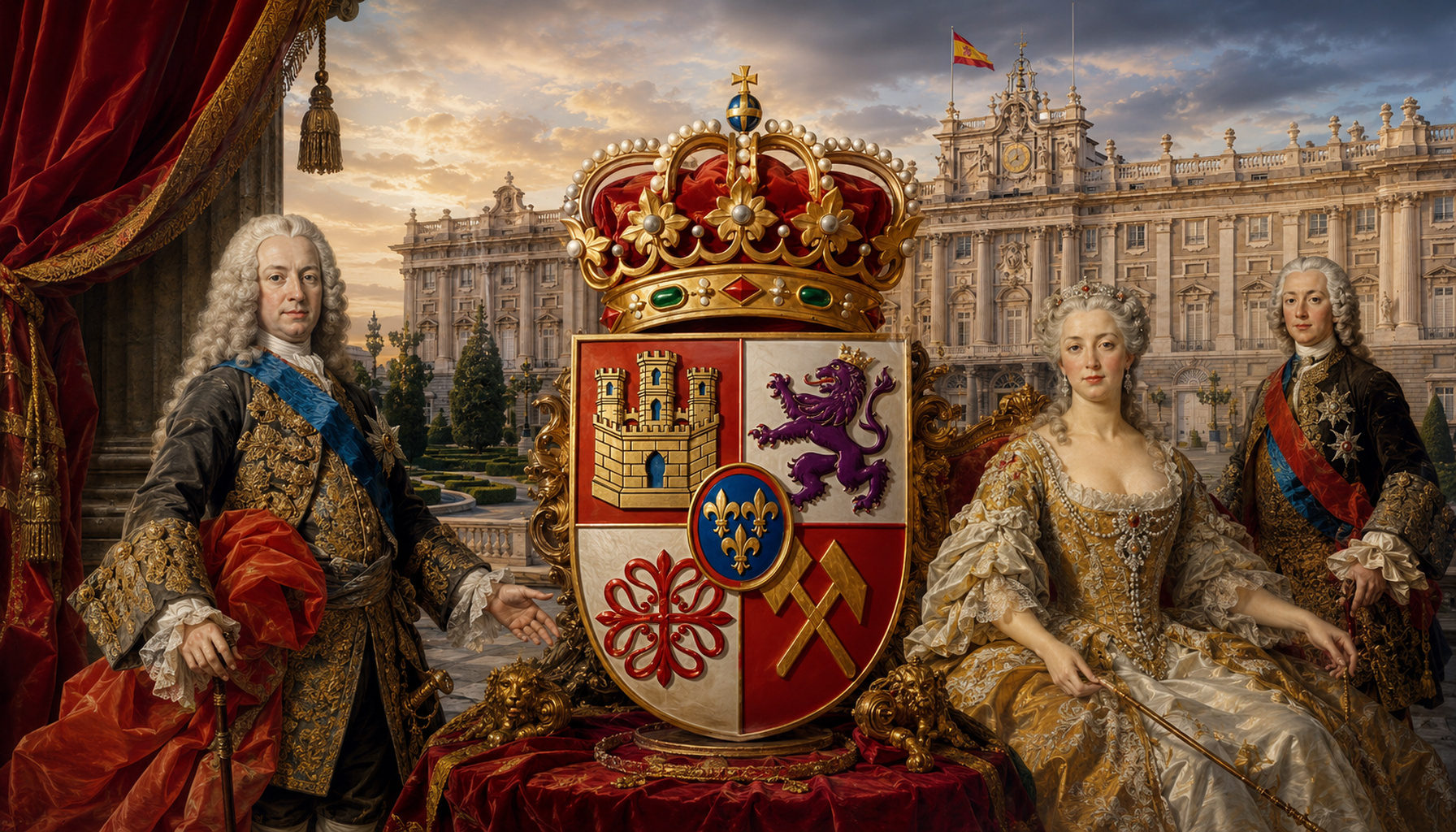
The Spanish House of Bourbon was, and remains, one of Europe's great royal dynasties: a ruling family that came into Spain from the wider Bourbon world of France and the Capetian tradition, then became thoroughly woven into Spanish history from the early eighteenth century onward. Its primary linked Y-DNA haplogroup here is R1b1a1b1a1a2b3, a lineage often found across western Europe and especially resonant in Iberian, French, and broader Atlantic-facing historical populations. In political terms, the dynasty entered Spain through the Bourbon succession crisis after the death of the last Habsburg king of Spain, and from that moment the Bourbons became central to monarchy, reform, diplomacy, and the stubborn business of dynastic survival.
What makes the Spanish Bourbons so interesting is that they were never just a family sitting on a throne. They were part of that intricate European machine in which marriages were treaties, births were state events, and inheritance could redraw the map. Philip V of Spain (1683-1746), the first Bourbon king of Spain, marked the beginning of the line in Madrid after the War of the Spanish Succession. Charles III of Spain (1716-1788) became one of the dynasty's most celebrated rulers, remembered for reform, administration, and the reshaping of royal government. In the modern age, Juan Carlos I of Spain (1938-) carried Bourbon identity into the contemporary constitutional monarchy, showing how a dynasty can survive revolutions, exile, restorations, and regime change while still acting as a national symbol.
Explore the Royal House of Capet
The great location anchor for the Spanish House of Bourbon is the Royal Palace of Madrid, which is less a private home than a statement in stone about monarchy, ceremony, and power. Built on the site of the old Alcazar of Madrid after that earlier palace was destroyed by fire in 1734, the present palace was developed under the early Bourbon kings and became the formal royal residence of the Spanish monarchy. It is vast, monumental, and unmistakably dynastic, with grand state rooms, ceremonial spaces, royal armoury collections, art, frescoes, and interiors designed to impress ambassadors as much as subjects. Although the Spanish royal family does not ordinarily live there today, the palace remains one of the chief symbolic centers of the crown and is used for state ceremonies and official occasions. Just as importantly for visitors, it is open to the public and can still be visited, making it one of the most tangible places to encounter Bourbon Spain not as an abstract family tree, but as architecture, ritual, and political theatre made visible.
Explore the Royal House of Savoy
From a DNA-history perspective, the Spanish House of Bourbon is tagged here with haplogroup R1b1a1b1a1a2b3, and that matters because this is a well-attested western European paternal line with deep archaeological echoes. That does not mean we can claim direct descent from ancient samples to the dynasty without specific evidence; rather, these are related or linked finds that help sketch the older population landscape in which such a lineage circulated. Particularly relevant are medieval and earlier Iberian examples such as Medieval Northern Spain Las Gobas (ldo066, ldo037, ldo046, ldo048, ldo040) and Dark Ages Northern Spain Las Gobas (ldo062), along with Bronze Age and later Iberian-linked samples including Bronze Age Spain Murcia Almoloya Pliego (ALM040, ALM047, ALM057, ALM069, ALM078, ALM080), Bronze Age Spain Molinos del Papel Murcia Caravaca (MDP003), Bronze Age Spain Madre Mercedarias Iglesias Murcia Lorca (MMI004), Bronze Age Valdescusa Northern Spain (VAD004), and Late Iron Age Cantabrian Spain PMB (I19990). Beyond Iberia, the same broader haplogroup appears in linked samples from France, Britain, Central Europe, and even royal or elite contexts such as Hungarian Royal House of Aba Samuel Aba Benedictine Monastary (HUASper55B) and Elite Celtic Burial Germany Asperg-Grafenbuehl (APG001, APG003). In other words, the lineage sits comfortably within the long male-line history of western and central Europe, which suits a dynasty born in the Franco-Iberian world and sustained by centuries of European royal alliance.
Read about Roman Iberia and DNA
If the Spanish House of Bourbon sparks your curiosity, the next step is wonderfully simple: upload your DNA to MyTrueAncestry and see whether you match the family's linked haplogroup R1b1a1b1a1a2b3 or any of the related ancient Iberian and European samples. It is a lovely way to move from textbook monarchy to your own place in the long human story.
Comments