The Silfverlaas Family
– 3 min read


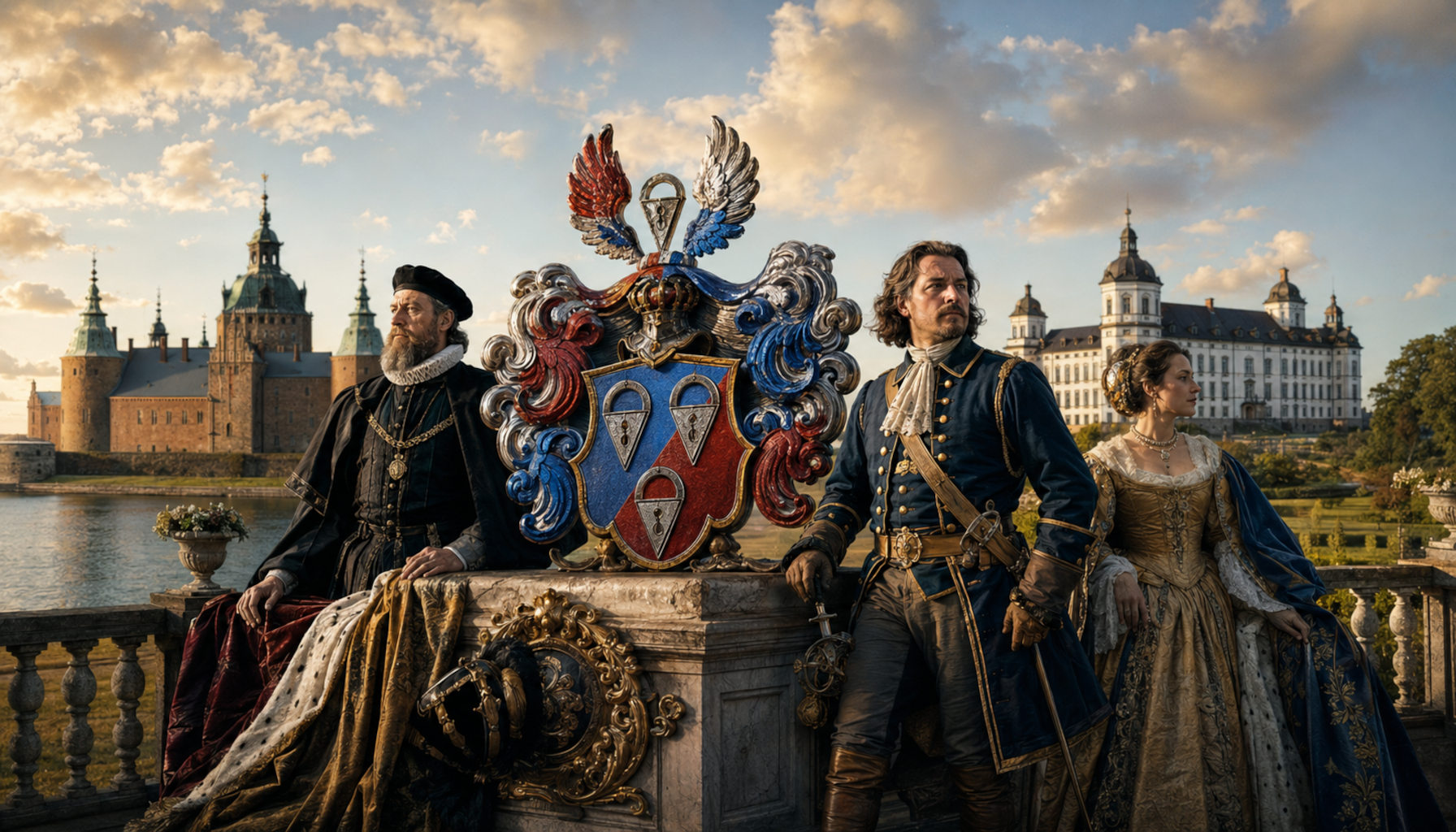
The Silfverlaas family was a Swedish noble house of the seventeenth century, registered at Riddarhuset as noble family no. 377, ennobled on 18 March 1647 and introduced the same year. Their story begins not in the old Swedish aristocracy, but with migration, trade, and town life. The earliest known ancestor, Peter Verklaes (?-1601), came from Holland and settled in Kalmar as a burgher, part of that busy North Sea and Baltic world in which merchants, craftsmen, shipowners, and officials moved between ports with surprising ease. The primary family haplogroup linked with this line is R1b1a1b1a1a2c1a1e, a branch that places the family within a much wider European paternal story. Tags: R1b1a1b1a1a2c1a1e, R1b.
What makes the Silfverlaas family so interesting is that it shows, very neatly, how noble status in Sweden could be made as well as inherited. Peter's descendants rose through money, office, landholding, marriage, and service to the Crown. Hans Verklaes, the real architect of the noble line, became known as Silfverlaas and was tied to Tornerum in Ryssby parish in Kalmar County. He was a wealthy and influential figure in Kalmar, serving as mayor from 1630, though his time in office was tangled in quarrels with the town council and the rather bruising politics of Swedish urban government under the expanding state. Removed, restored, and disputed, he remained important enough to be ennobled in the age when Sweden was turning itself into an empire. Later generations moved into the classic careers of the service nobility: captains, cavalry officers, majors, pages, and administrators, connected with estates such as Tornerum, Bagarbo, and Kaddala. Among the later named figures is Hans Silfverlaas (1665-1731), part of a family world increasingly shaped by regiment, manor, and Riddarhuset alliances.
Explore the Silfverskiold family
If there is one place that anchors the Silfverlaas story, it is Kalmar. This was no sleepy provincial corner. Kalmar was one of Sweden's key Baltic towns, with deep commercial connections and a strategic role facing the southern sea routes. Kalmar Cathedral, where Hans Verklaes died in 1654 and was buried in the city, remains one of the great monuments of Sweden's seventeenth-century urban ambition. Built largely between the 1660s and early 1700s in the Baroque style and designed by Nicodemus Tessin the Elder, it stands on Stortorget in the planned city moved from the old medieval site after the Kalmar War. The cathedral is notable for its balanced classical exterior, striking dome, and spacious interior shaped by the ideals of the Swedish great-power age, when architecture itself advertised order, monarchy, and Lutheran confidence. It can still be visited today, which gives the family story a very tangible setting: not just names in a genealogy, but a real civic landscape of church, square, port, and council chamber where families like the Silfverlaas made their mark.
Read more about Swedish royal history
The Silfverlaas family's reported primary haplogroup, R1b1a1b1a1a2c1a1e, also appears in a broad spread of ancient DNA samples linked to western and northern Europe. These are not claims of direct descent from the Silfverlaas family, nor of the family from any one ancient individual, but they do show the deeper landscape of related paternal lineages. Among the linked samples are several Celtic Durotriges burials from Duropolis at Winterborne Kingston in England, including WBK12, WBK20, WBK29, WBK41, WBK05, WBK30, WBK43, WBK06, WBK08, WBK18, and WBK191; Iron Age and Celtic Briton samples from Kent, Oxfordshire, Somerset, Hampshire, Yorkshire, and Scotland; a Viking Age sample from Varnhem in Sweden; medieval and Dark Age individuals from northern Spain at Las Gobas; post-Roman and Anglo-Saxon era individuals from Hinxton, Buckland Dover, Eastry, Lakenheath, and Hatherdene Close; and further related finds from Belgium, France, Croatia, Austria, Hungary, Ireland, Germany, and Iberia. In other words, the haplogroup sits inside a very long European story, stretching from Bronze Age and Iron Age communities through Roman, early medieval, and Viking worlds, before turning up again in later historical families such as the Silfverlaas.
Explore ancient DNA and Celtic origins
The Silfverlaas family is a fine example of how early modern nobility was built from movement, ambition, office, and service: from a Dutch settler in Kalmar to a Swedish noble house tied into the military world of the empire. If you have tested your DNA, you can upload it to MyTrueAncestry to see whether you match the Silfverlaas family or any of the related ancient DNA samples connected with haplogroup R1b1a1b1a1a2c1a1e.

Comments