The Royal House of Bernadotte
– 3 min read


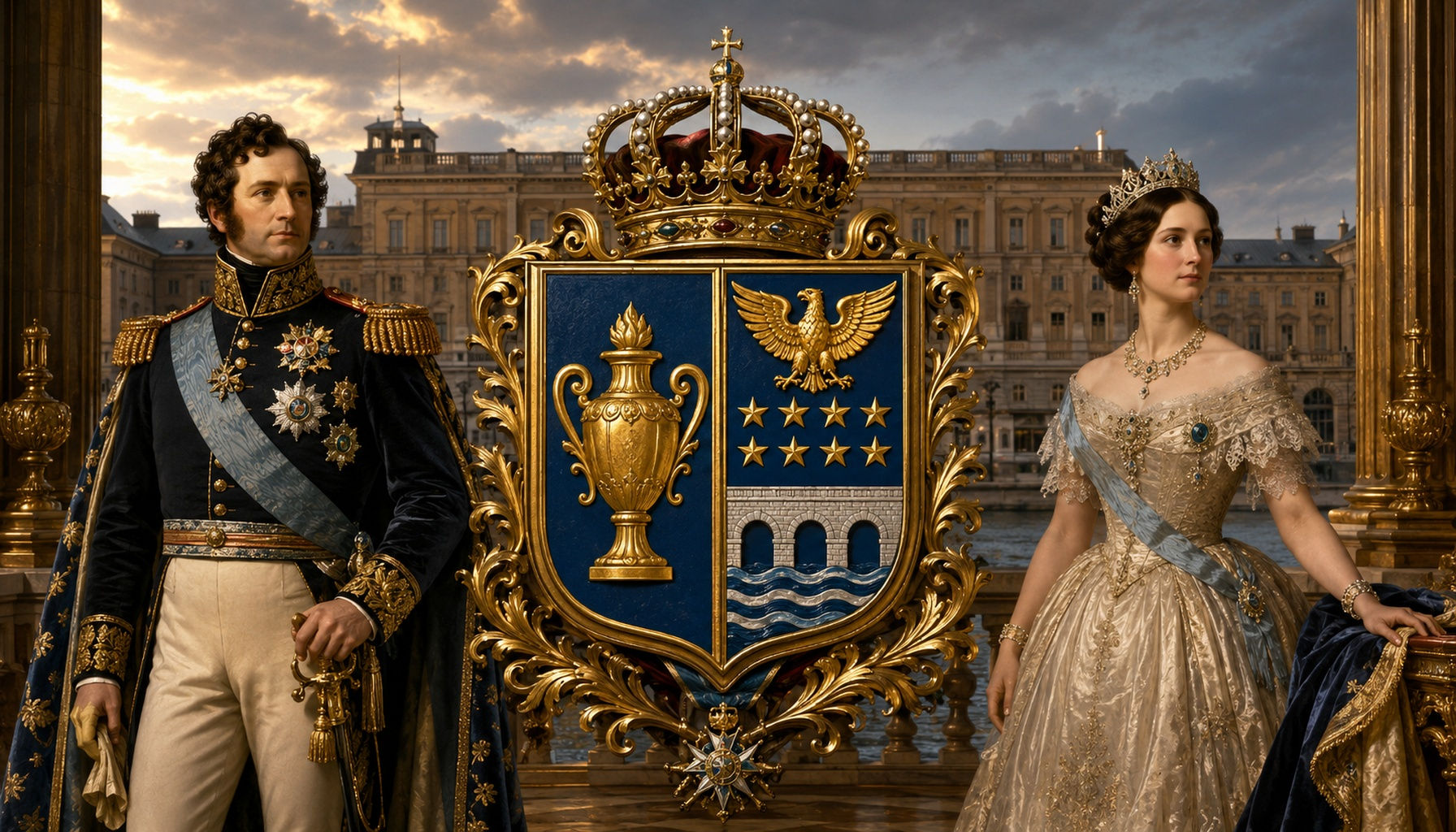
The Royal House of Bernadotte is the reigning royal house of Sweden, a dynasty with an origin story that sounds almost too dramatic to be true. It began not in Scandinavia but in Pau, in the old province of Bearn in southwestern France, where Jean-Baptiste Jules Bernadotte (1763-1844) was born into a bourgeois family during the last years of the ancien regime. His rise through the armies of Revolutionary and Napoleonic France was extraordinary enough on its own. But then came the astonishing second act: in 1810 he was elected Crown Prince of Sweden, adopted into the Swedish royal line, and later became King Charles XIV John. Linked here with the primary family haplogroup R1b1a1b1a1a2a1a1a2, the Bernadottes neatly embody one of modern Europe’s most curious political transformations, where military reputation became dynastic legitimacy and, in time, constitutional monarchy.
What makes the Bernadottes so interesting is that they are unmistakably a modern royal house. They were not simply an old medieval dynasty continuing unchanged across the centuries. They were, instead, founded in the age of revolution, nationalism, and diplomacy. Under Oscar I of Sweden and Norway (1799-1859), the house consolidated its role in the twin kingdoms, while later generations adapted to parliamentary politics and ceremonial kingship. In our own time, Carl XVI Gustaf (1946-) represents that long adjustment: a monarch whose public role is bound up with continuity, symbolism, and service rather than personal rule. The family’s story is therefore not just about crowns and uniforms, but about how monarchy survived by changing its meaning.
Explore the Spanish House of Bourbon
If there is one place that anchors the Bernadottes in the public imagination, it is Stockholm Palace. Standing on Stadsholmen in the heart of Stockholm’s old town, it is one of the largest royal palaces in Europe still used for official state purposes. The present building rose mainly in the 18th century after the earlier medieval Tre Kronor castle was destroyed by fire in 1697, and its exterior has that sober, weighty baroque grandeur which seems designed to remind you that monarchy is as much performance as power. It contains royal apartments, ceremonial halls, the Hall of State, museum spaces, and the Royal Chapel, and it remains a working setting for audiences, receptions, jubilees, and the rituals of Swedish kingship. In other words, this is not a dead shell of a palace: it is a living dynastic theatre, and yes, much of it can still be visited by the public, which is one of the great pleasures of the place. You can walk through rooms that help explain how the Bernadottes made themselves not foreign interlopers, but the visible face of the Swedish state.
Read more about the Royal House of Wettin
From a DNA perspective, the Bernadotte-linked haplogroup R1b1a1b1a1a2a1a1a2 belongs to a broad and well-travelled paternal line found across much of Europe over long stretches of time. Related or linked ancient samples associated with this branch include individuals from Medieval England at Cherry Hinton (ATP_PSN_950) and Cambridge St Johns Hospital (ATP_PSN_905), Medieval Belgium at Sint-Truiden Groenmarkt (ST2107), Bronze Age Austria at Unterhautzenthal (UZH028), Iron Age Prague Jinonice in Central Bohemia (I20522), Gallic France among the Sequani at Parancot (CGG023685), Anglo-Saxon Sedgeford in Norfolk (SED018, SED020, SED021), Visigothic Spain at Estevillas Virgen de la Torre (CGG022051), and even Punic-connected Sicily at Lilybaeum and Mozia (I21859, I21858). Other linked examples include Bronze Age Iberia at Lorca-Zapeteria Falls (ZAP002), a Hungarian Conqueror Period commoner from Szegvar-Szolokalja (SZA-7), Medieval Sardinia at Duomo San Nicola (SNN002), and the Ullastret Ligurian head from Girona (I3324). None of this proves direct descent from any one of these ancient people, of course. What it does show is that the wider paternal lineage connected with the Bernadotte tag has deep roots across the European and Mediterranean world, turning up in very different cultures, cemeteries, and historical moments.
Explore ancient DNA and archaeogenetics
If the Bernadottes catch your imagination, it may be because they sit at the meeting point of family history, state history, and the long genetic story of Europe. Uploading your DNA can help you see whether you match the Royal House of Bernadotte or any of these related ancient DNA samples, and it is precisely that mix of personal curiosity and deep history that makes the exercise so rewarding.






Comments